Showing posts with label human rights. Show all posts

Friday, 9 July 2021

“A Refugee is…” – The Refugee Dictionary


UK for UNHCR Trustee Mevan Babakar, who was a refugee from the Gulf war in the 1990s


What does the word “refugee” mean to you? 


For Maya Ghazal, a Syrian refugee and a pilot, “A refugee is a human being with hopes and dreams like everyone else. A refugee can be anyone, like a pilot flying your plane – a pilot like me!”


And for actor David Morrissey, UNHCR Goodwill Ambassador, ”A refugee is “a boy who had to give up his childhood to provide for his family.”


What is it for you? 

To mark the 70th anniversary of the 1951 UN Refugee Convention, on 28 July, UK for UNHCR, the UN Refugee Agency’s UK charity, is asking Britons to help compile a dictionary that will define only one word – “refugee” – but in thousands of different personal, emotive and thought-provoking ways. 

 The (physical) dictionary with its 1000s definitions of the term “refugee” will be unveiled on 28 July, the day, 70 years ago, when the convention first legally defined the term ‘refugee’ in universal terms and outlined the rights and obligations of women, men and children fleeing the horrors of war and persecutions to seek safety in another country.

Since then, the word refugee has taken on countless personal meanings, so “The Refugee Dictionary” aims to remind us of the rich tapestry of stories and futures made possible because of this significant human rights convention - and celebrate and encourage the UK’s proud tradition of giving refuge by inviting the public to join in.


It is hoped the project will bring thousands of new meanings to the word and highlight that refugees aren’t confined or defined by one word, but are individuals with myriad rich stories, hopes and lives.


UK for UNHCR is encouraging everyone to take part, from those who have sought refuge in the UK or people whose family members were refugees, to those who simply want to celebrate the positive role of refugees in their communities and to the country.


You can enter your definition until July 12th here. 


Monday, 23 November 2020

A bloody problem - Why and how is Poland’s richest woman trying to tackle period poverty


Dominika Kulczyk attends a lesson on menstruation in Nepal/ courtesy of Kulczyk Foundation


In India, 78%of women cannot afford menstrual products and between 6% and 43% say they missed school or work due to menstruation. Even in the UK, a recent report by Plan International UK revealed that 3 in 10 girls struggle to afford or access sanitary wear.


Globally, around 500 million people lack complete menstrual health and hygiene, something the world calls period poverty, according to UNICEF.


Harmful stigma, lack of access to toilets and water, lack of education or not being able to afford tampons and pads cause millions of girls and women worldwide to miss out on education, job opportunities and quality of life. And Covid-19 is making things worse.


Yet, despite growing attention over the past few years, period poverty remains massively neglected.

That a fundamentally basic need can be so challenging in 2020 is astounding. Why is more not being done?

This is a question Dominika Kulczyk wanted to address. She is a philanthropist, entrepreneur and a journalist – and also Poland’s richest woman.


“As a journalist and film director, I have seen the devastating impact of period poverty first-hand. If you are made to feel ashamed of your body, struggle because of the stigma, if you cannot attend school or go to work because your clothes are red, then you cannot participate fully in society,” Kulczyk says.

“Access to complete menstrual health and hygiene is a basic human right. Without it, women and girls cannot pursue full lives with dignity and confidence. It is deeply unfair that girls in all parts of the world miss out on better education, and women on work, because they were too poor to have a period.”

After filming in Nepal earlier this year and seeing women and girls asked to hide in caves and cowsheds while on their period, Kulczyk decided to act.

As a first step, she partnered the KulczykFoundation (her family foundation) with Founders Pledge to produce an extensive report reviewing the current state of funding and solutions to ending period poverty. 


One of the report’s shocking findings is that global spending on period poverty amounts to less than 20¢ per woman per year. “It means that the issue is not taken seriously by anyone,” Kulczyk says.


The report highlights eight organizations providing outstanding and cost-effective solutions in different parts of the world, and and what are the next steps for the international community in terms of funding.


 “The Kulczyk Foundation’s report highlights this fundamental gendered inequality that persists globally – and serves as a call to action to governments, donors and the world, to take long overdue action on period poverty,” says Marni Sommer, Associate Professor, Columbia University, who contributed to the report.


Friday, 24 July 2020

Hear Us – How refugee and asylum-seeking women experienced the pandemic


“Being destitute during a pandemic is the worst feeling ever. It makes you feel like you are just a box and if someone wanted to kick you, they could. It’s not easy relying on other people for food and shelter and it has caused me a lot of mental health issues,” says Edna (not her real name), who is living with no statutory support and relying on charities for her survival in Liverpool.


Edna is one of 115 refugee and asylum-seeking women in the UK who have shared their experiences during the pandemic for ‘Hear Us’, a new report by Sisters Not Strangers, a coalition of eight organisations. 

Most of these women have already fled violence and abuse. During the pandemic, they became more vulnerable: three quarters of them went hungry, a fifth of them were homeless, and most of them said that their mental health got worse, according to the report. 


The government’s research on the impact of Covid-19 on BAME communities found that Black, Asian and minority ethnic (BAME) women are almost three times more likely to die from COVID-19, compared to white women. The intersection of gender, race and immigration status, coupled with the trauma of their past experiences, means that asylum-seeking women are among those BAME women most affected by the consequences of the outbreak.


With charities closed, women have been unable to access meals and small hardship payments that have become so crucial both for women within the asylum system, who live in poverty, and women refused asylum, who are so often left destitute.


Three quarters of the women surveyed went hungry, including mothers who struggled to feed their children. A third of women were at high risk from coronavirus, reporting a serious health condition such as asthma, heart disease and diabetes. While the government emphasised social distancing, a fifth of women were homeless, relying on temporary arrangements with community members, and moving from one house to another. Self-isolation was impossible for the 21% of women who were forced to sleep in the same room as a non-family member. Frequent handwashing was a serious challenge for the 32% of women who struggled to afford soap and other hygiene products. A fifth of staff and volunteers had supported women who were trapped in unwanted or abusive relationships during the pandemic. 

Lo Lo (not her real name), an asylum-seeking woman who was homeless in London during lockdown says, “I have serious health conditions that mean it would be particularly dangerous for me to catch the virus. For a week during lockdown, I slept on buses. I went from one side of London to the other, because it was free to travel on the bus then.”

“Previous research has established that almost all women who seek asylum in the UK are survivors of gender-based violence. Even before this crisis, we have seen how they are forced into poverty and struggle to find safety,” says Natasha Walter, director of Women for Refugee Women.  “During the pandemic they have too often been left without basic support including food and shelter. It is now vital that we listen to these women and ensure that we build a fairer and more caring society.” 

In exposing deep structural inequalities along existing fault-lines of gender, race, citizenship and class, the pandemic is testing our society. We cannot simply return to normal, the report concludes. “We must seize this opportunity to build back better, and to create a society centred on solidarity and human dignity in which the lives of women seeking asylum, and women of colour, are fully valued.”

The Sisters Not Strangers coalition includes Coventry Asylum and Refugee Action Group, Development and Empowerment for Women’s Advancement (Sheffield), Oasis Cardiff, Refugee Women Connect (Liverpool), Swansea Women’s Asylum and Refugee Support Group, Women Asylum Seekers Together Manchester, Women for Refugee Women (London) and Women with Hope (Birmingham)


Thursday, 2 July 2020

Renowned Iranian scientists attacked because of child rights activism

Jahangir (left) and Shahin Gavanji

Two Iranian brothers, both respected research scientists and child rights activists, have been severely beaten by fundamentalists who see their campaigning work – particularly against child marriage - as promoting anti-Islamic values. Fearing for their lives, they had to flee the country. 

Last May, a group of motorcyclists descended on the brothers’ home in Isfahan. They assaulted them with truncheons and electric cables, and threatened to splash hydrochloric acid on their faces. “They wanted to blind us. They shouted: ‘Away with you, you are representatives of America, Israel and the United Kingdom’. It was horrible. I still remember the voice who said: ‘We will kill you both.’ My brother Jahangir lost 30 kilos in one month because of the stress, and his leg is now numb and he cannot walk properly," says Shahin Gavanji, 35.

"We don't want to do any political or religious activities," says Gavanji. "We only want to focus on children's rights.  Child marriage is a big problem in Iran, as well as child labour, and physical and sexual abuse of children are totally ignored.”

More than half a million marriages of children are registered in Iran every year, according to the Persian-language Entekhab news website. Up to 40,000 of them are between the age 11 and 14, and more than 300 are girls under the age of nine. Physical and sexual abuses are widespread, but these issues are completely taboo. In addition, according to UNICEF, there are three million child workers in Iran, but Iranian NGOs estimate their numbers at seven million. Under Iranian law, it is illegal to work under the age of 15, but because of circumstances like poverty and organized crime, the law is not often followed. An estimated 14% of Iranian children are forced to work in dangerous and unsanitary conditions - in the streets, in automobile or rug factories, or in the sex industry, according to international child NGO Humanium.

The Gavanji brothers have received various awards for their research work in their country and have been voted the best young inventors and scientists of Iran in 2009 and 2010. They  have also won several medals and awards at international science festivals in Germany, Poland and Croatia. 

 “My brother and I are very well-known in our country, so we thought that  we should use our voice to help children and make a better world for them,” says Gavanij, who has a degree in Biotechnology and chairs the Asian Council of the World Academy of Medical Sciences (WAMS) 

To break the silence around child rights issues, they have launched several campaigns in Iran and abroad, including the first national campaign to prevent child abuse in Iran and the Global Campaign for the Prevention of Child Marriage in 41 countries.  

 “We focus on raising awareness since we believe that education is the most powerful way to help change the world.”  They also held 5-minute classes in the streets across the country to help child labourers recognize and prevent different types of abuses. “We see a significant number of children who blame themselves and are even afraid to tell their family or anyone else about the abuse they have suffered,” Gavanji says.  

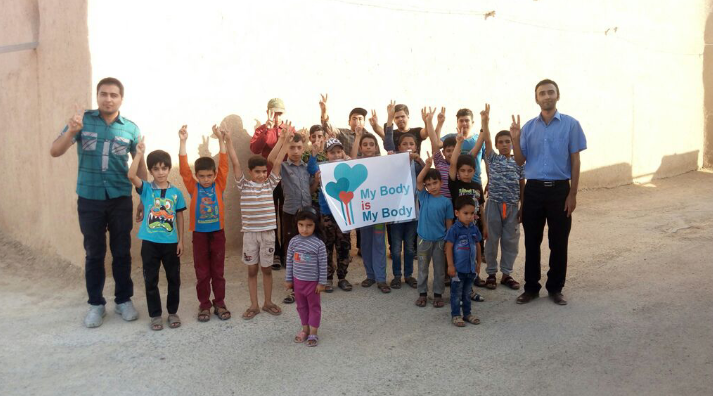
 The brothers are also Iran ambassadors for My Body is My Body, an international educational programme against child abuse, available in 21 languages. They have translated it into Farsi and organized information classes for children and their parents in Iran.

With the support of the World Academy of Medical Sciences, they have also created a national project to raise awareness about the negative physical and mental health consequences of child marriage.

Their work has been well received by children, parents and teachers across the country and abroad. "Many Iranians were very happy with our educational programmes. Every day we received support from children and their parents. We were also invited by many people to organize our classes in cities and in the countryside.”  Their human rights and peace work in Iran and internationally led them to be named World Peace Ambassadors of the International Forum for the Literature and Culture of Peace (IFLAC) in March of this year.

Yet, in Iran, their educational work attracted the wrath of fundamentalist groups who believe that they are promoting Western values, which will corrupt the younger generations. “They say that our activities, especially our campaign against girl brides, promote the UN's 2030 Sustainable Development Goals (SDGs), and because of that children and future generations will lose their Islamic spirit,” Gavanji says. “They believes that child marriage is a correct action and they think that we're promoting anti-Islamic culture in Iran."

After the attack, the brothers hid in the countryside, then in September decided to flee the country, leaving behind their families, research projects and campaigning work. 

They are now living in hiding in a small room in an undisclosed country, as they fear that fundamentalists will track them there. 

 They hope to be offered asylum in Canada or in another country and have launched a signature campaign to help them achieve this. 

“We want to make our voice heard by the United Nations. We ask all journalists, human rights organizations and governments to listen to us and help us.” 
Please, sign their petition.


Friday, 22 May 2020

Surge in global domestic violence during lockdown – the shadow pandemic


In Argentina, the number of women killed has reached a 10-year high under coronavirus lockdown, with more than 50 femicides in less than two months, according to La Casa del Encuentro, a Buenos Aires-based feminist group.  Not only the numbers, but the severity of the violence, is hugely concerning, they said.

In Spain, two women have been killed by their partners since the country’ strict lockdown came into force on 14 March. 

Last month, the UK charity Refuge reported a 50 per cent increase in calls to its National Domestic Abuse Helpline and a 400 per cent spike in visits to its website since the lockdown began.

Across Europe, the lockdown stress and anxiety has led to a sharp spike in the number of women reporting incidents of domestic abuse, according to the World Health Organization.


The data in Argentina and other countries follow a worldwide trend of rising gender-based violence under lockdown that has left women trapped at home with their abusers and unable to seek help while tensions due to COVID-19 escalate.


Social isolation under the current crisis not only increases the risk of domestic abuse, but also hinders access to assistance and protection services.
Dr Hans Kluge, director of WHO’s European region, told a recent press briefing that across the continent the number of women making emergency calls had risen 60 per cent in April, compared to the same month in 2019.


Last month the United Nations Population Fund warned of the "calamitous" impact of a prolonged lockdown, saying it that if it lasted for six months there would be an additional 31 million cases of gender-based violence globally.

Some countries have introduced innovative measures to address the issue – Greenland has limited sales of alcohol, for example, and Spain and France have introduced a system where pharmacists can be alerted to cases of domestic abuse with a code word. Other countries have announced measures including having 24-hour phone helplines, increasing funding,  providing refuge for victims in hotel rooms or having police check on households with previous cases of domestic violence.


CIVICUS (the global alliance of civil society organisations)’ Diversity & Inclusion Group for Networking & Action (DIGNA), recently held a domestic violence webinar with speakers from Botswana, Uganda, Fiji, India and Brazil in order to get some insights into the situation and solutions in their countries.  Here is a quick summary:

UGANDA - Lucky Kobugabe, GBV Prevention Network Uganda
•    Public spaces are becoming even more gendered during the pandemic. The streets are quieter due to lockdown, so women are more likely to be violated by strangers they don't know.

BRAZIL – Ana Addobbati, Social Good Brasil
•    In Rio De Janeiro, police reports can be filed online, and there has been around a 50% increase in cases. Technology is being utilised to adapt to the situation, including the use of apps to report cases.
•    There has been an increase in sexual abuse cases of children and adolescents.

INDIA – Uttanshi Agarwal, One Future Collective
•    In India, only 38% women of have access to technology - COVID-19 has exposed the need for digital literacy, which is now more urgent than ever.
•    Police can help reduce domestic violence during curfew hours by increasing patrols in different areas.
•    They are implementing a follow-up system for officers to call individuals who have reported a case in the last 6-8months, this makes the community feel supported.

FIJI – Roshika Deo, One Billion Rising
•    Curfews are making it harder to access police and restraining orders – abusers are using this to their advantage and targeting women during lockdown hours. Moreover, there has been a rise in verbal and physical abuse during curfew hours.
•    Why isn’t the government using empty hotels to house survivors of domestic violence? Tourism is a major industry in Fiji and there are now many rooms available.
•    Fiji has good legislation relating to domestic violence but it is not being enforced. For example, a police officer can apply for a restraining order via the telephone.

BOTSWANA – Dumiso Gatsha, Success Capital
•    In countries with a high cellphone penetration, such as Botswana, civil society organisations can provide airtime and data.
•    Increased risk for those who are marginalized:  there is a higher risk for LGBT+ persons being ‘outed’ by family members – families are using the lockdown period as a means to control.


Experts stressed that the end of lockdowns will bring additional challenges for women who are victims of an abusive relationship.  Financial uncertainty linked to income and job losses, psychological stress and the generalised feeling of loss of control are among the causes of increased domestic violence.

Additionally, the Covid-19 health crisis also has other effects in the long run, such as not talking to anyone about the violence suffered, unwanted pregnancies and facing difficulties accessing the voluntary termination of pregnancy services.


Services must continue to support vulnerable women and children and people should be on the alert for signs of abuse in the community. 


Tuesday, 5 May 2020

Media censorship a ‘global phenomenon’ obstructing efforts to tackle pandemic


On Sunday, we celebrated World Press Freedom Day, yet when it comes to reporting Covid-19, journalists across the world are far from free.  
They have been risking their lives to provide reliable and trustworthy information during the pandemic, but all over the world, governments’ crackdown and media censorship are hampering efforts to tackle the virus. Censorship of vital information related to the pandemic has become a ‘global phenomenon’, according to Amnesty International.
“There is no hope of containing this virus if people can’t access accurate information. It is truly alarming to see how many governments are more interested in protecting their own reputations than in saving lives,” says Amnesty International’s Director of Law and Policy, Ashfaq Khalfan.
A core feature of the right to health is the right to access timely and accurate information. In the case of COVID-19, this means everybody has a right to access all available information about the nature and spread of the virus, as well as the measures they can take to protect themselves. But governments around the world have arrested and detained journalists and other media workers for sharing exactly this kind of essential information.

Here are just a few examples of dangerous censorship and serious attacks on free speech across the globe collected by Amnesty International:

• Russia: On 12 April, the Russian newspaper Novaya Gazeta published an article by journalist Elena Milashina, in which she criticised the Chechen authorities' response to the pandemic. Chechen leader Ramzan Kadyrov posted and Instagram video in which he threatened Milashina, appealing to the Russian government and Federal Security Service (FSB) to "stop those non-humans who are writing and provoking our people."
Urge the Russian authorities to ensure her safety. 

• Niger: Journalist Mamane Kaka Touda was arrested on 5 March after posting on social media about a suspected case of COVID-19 infection in Niamey Reference Hospital. He was charged with "disseminating data tending to disturb public order". 

• Egypt: Editor-in-chief of AlkararPress newspaper, Atef Hasballah, was arrested by security forces on 18 March, and forcibly disappeared for nearly a month, following a post on his Facebook page in which he challenged the official statistics on COVID-19 cases. 

• India: Journalists reporting on the COVID-19 situation have been summoned to police stations and forced to explain their stories, including Peerzada Ashiq, a senior journalist with The Hindu in Kashmir, and Siddharth Varadarajan, editor of The Wire in Uttar Pradesh. Many others have been arrested. Internet restrictions in the Jammu & Kashmir region continue despite the rising number of COVID-19 cases. 

Journalists have been prosecuted for reporting on COVID-19 in many other countries including Azerbaijan, Kazakhstan, Serbia, Bangladesh, Cambodia, Uganda, Rwanda, Somalia, Venezuela, Tunisia and Palestine.

Meanwhile journalists who report on human rights abuses related to the pandemic, such as police abuses or poor prison conditions, have also been harassed, intimidated, attacked and prosecuted.

Many countries, including Azerbaijan, Hungary, Russia, Uzbekistan, Cambodia, Sri Lanka, Thailand, Tanzania and several Gulf states, have used the COVID-19 pandemic as a pretext to introduce new laws against disseminating “fake news”. In most cases, it is at the authorities’ discretion to define what constitutes false news or misinformation, and these laws act as a stark warning against free discussion of the situation. For example: 

• Hungary: Viktor Orban’s government has amended the country’s Criminal Code, introducing new provisions that threaten journalists with prison sentences for “spreading false information” or communicating facts in a way that impede ‘successful protection’ against the virus. Journalists have reported being harassed, threatened and smeared for scrutinising the government’s response to the outbreak. 

• Myanmar: Authorities have warned that anyone who spreads “fake news” about COVID-19 could be prosecuted, while a Ministry of Health official said they would file criminal charges against anyone who speaks out about the lack of Personal Protective Equipment at hospitals.

• Tanzania: On 20 April, Tanzanian authorities suspended the licence of the Mwananchi online newspaper after it posted a photo of President John Pombe Magufuli out shopping surrounded by a crowd of people, eliciting debate about the need for implementing physical distancing.


Wednesday, 11 December 2019

Generation Z fears climate change more than anything else; lives in failed system

Credit: Rosa Castaneda


At the UN Climate Change Conference in Madrid, Greta Thunberg today called upon world leaders to stop using "clever accounting and creative PR" to avoid real action on climate change.  Thunberg’s chiding of world leaders seems to chime with young people’s beliefs, according to a major new study by Amnesty International.

The Amnesty poll, released yesterday on Human Rights Day asked more than 10,000 people aged 18-25 - also known as Generation Z - in 22 countries across six continents, to pick up to five major issues from a list of 23.

Of those, four out of 10 young people (41%) selected climate change, making it the most commonly cited issue globally, ahead of pollution (36%) and terrorism (31%).

“For young people the climate crisis is one of the defining challenges of their age,” said Kumi Naidoo, Secretary General of Amnesty International.  “This is a wake-up call to world leaders that they must take far more decisive action to tackle the climate emergency or risk betraying younger generations further.”

Global warming was also most commonly cited as one of the most important environmental issues facing the world (57%), out of 10 environmental issues such as ocean pollution, air pollution and deforestation.


In their own countries, Generation Z’s concerns extend beyond the climate crisis, reflecting the everyday struggles and concerns young people are facing and the feeling that they are  “living inside a failed system”.

At a national level corruption was most commonly cited as one of the most important issues (36%), followed by economic instability (26%), pollution (26%), income inequality (25%), climate change (22%) and violence against women (21%).

“This generation lives in a world of widening inequality, economic instability and austerity where vast numbers of people have been left behind,” said Kumi Naidoo.

“The message from young people is clear. The climate crisis, pollution, corruption and poor living standards are all windows on an alarming truth about how the powerful have exploited their power for selfish and often short-term gain.”

The survey’s findings come at a time of widespread mass protests around the world, from Algeria to Chile, Hong Kong, Iran, Lebanon, and Sudan. Many of these movements have been largely led by young people and students, who have angrily called out corruption, inequality, and abuse of power and faced violent repression for doing so.


Friday, 28 June 2019

Kosovar women fight patriarchy - 20 years after the war


The art installation Thinking Of You, by the Kosovan-born, London-based artist Alketa Mrripa-Xhafa, in Pristina, Kosova – 2015. Photograph: Hazir Reka/Reuters
-->

This month, 20 years ago, the 1988-89 Kosovo war ended. It was a particularly brutal conflict that led to allegations of genocide and crimes against humanity, and the controversial involvement and bombings from NATO. During that war, 90 per cent of the population was displaced and some 20,000 women and girls were systematically raped - a crime that was used as a weapon of "ethnic cleansing."

In this predominantly traditional ethnic Albanian country, the rape’s stigma is so strong that many women have never talked about what happened to them during the war and never sought help. Some of their husbands have left them, unable to endure the shame.

Two decades later and despite years of international supervision that was supposed to bring gender equality, rates of sexual assault and domestic violence remain worryingly high. In a 2015 survey, 68% of women reported that they had suffered from domestic violence at one point in their lives.


In Europe’s newest country (which declared independence from Serbia in 2008), women struggle every day for social and economic equality in a rigid patriarchal society where men have the final say in all family matters and women are left with very limited access to education, health, property, protection and job opportunities. More than three quarters of women don’t have jobs - Kosovar women have the lowest employment rates and education levels in all Europe. Many have been widowed during the war and placed in the role of primary provider for their families, but without access to skills and resources, they are unable to make ends meet.

But many are fighting back.  Some have formed associations that give women the tools and resources they need to rebuild their lives and their communities, while others have run for office.  Others yet have launched small business, like Zarie Malsiu, from Kacanik municipality, a mother of five who married young and dropped out of school, like many young women at that time. After the war, she enrolled in a training for social and economic empowerment run by local NGO Kosova – Women for Women. She has formed her own agriculture association, collecting and selling medicinal and aromatic herbs and forest fruits. Her organization now counts 100 women. Kosova – Women for Women, a local independent organization affiliated to Women for Women International, has trained over 33,000 women in over 30 communities across the country, in life and vocational skills and rights awareness.

Women have also fought for justice and campaigned for women’s rights.
Among them is the amazing Dr Feride Rushiti, a physician who is the executive director of the Kosovo Rehabilitation Center for Torture Victims in Pristina. Through almost two decades of research and advocacy, she has secured access to healthcare and justice for civilian victims of war. In 2017, her campaigning work led to a landmark government decision to fund pensions for Kosovo’s victims of wartime sexual violence. And now, after many years of silence, hundreds of survivors have started to come forward.

Kosovar women’s braided stories show the enormous challenges women still face in the country, but also how they have managed to become self sufficient and obtain recognition and reparation - and the impact it has on themselves, their families, communities and the next generations.

I wanted to report this story with Arben Llapashtica, a brilliant photographer based in Pristina, as well as a cameraman and documentary filmmaker, but sadly we couldn’t get a commission. If you know a publication that might be interested, please let us know.


-->