Showing posts with label Activism. Show all posts

Thursday, 2 July 2020

Renowned Iranian scientists attacked because of child rights activism

Jahangir (left) and Shahin Gavanji

Two Iranian brothers, both respected research scientists and child rights activists, have been severely beaten by fundamentalists who see their campaigning work – particularly against child marriage - as promoting anti-Islamic values. Fearing for their lives, they had to flee the country. 

Last May, a group of motorcyclists descended on the brothers’ home in Isfahan. They assaulted them with truncheons and electric cables, and threatened to splash hydrochloric acid on their faces. “They wanted to blind us. They shouted: ‘Away with you, you are representatives of America, Israel and the United Kingdom’. It was horrible. I still remember the voice who said: ‘We will kill you both.’ My brother Jahangir lost 30 kilos in one month because of the stress, and his leg is now numb and he cannot walk properly," says Shahin Gavanji, 35.

"We don't want to do any political or religious activities," says Gavanji. "We only want to focus on children's rights.  Child marriage is a big problem in Iran, as well as child labour, and physical and sexual abuse of children are totally ignored.”

More than half a million marriages of children are registered in Iran every year, according to the Persian-language Entekhab news website. Up to 40,000 of them are between the age 11 and 14, and more than 300 are girls under the age of nine. Physical and sexual abuses are widespread, but these issues are completely taboo. In addition, according to UNICEF, there are three million child workers in Iran, but Iranian NGOs estimate their numbers at seven million. Under Iranian law, it is illegal to work under the age of 15, but because of circumstances like poverty and organized crime, the law is not often followed. An estimated 14% of Iranian children are forced to work in dangerous and unsanitary conditions - in the streets, in automobile or rug factories, or in the sex industry, according to international child NGO Humanium.

The Gavanji brothers have received various awards for their research work in their country and have been voted the best young inventors and scientists of Iran in 2009 and 2010. They  have also won several medals and awards at international science festivals in Germany, Poland and Croatia. 

 “My brother and I are very well-known in our country, so we thought that  we should use our voice to help children and make a better world for them,” says Gavanij, who has a degree in Biotechnology and chairs the Asian Council of the World Academy of Medical Sciences (WAMS) 

To break the silence around child rights issues, they have launched several campaigns in Iran and abroad, including the first national campaign to prevent child abuse in Iran and the Global Campaign for the Prevention of Child Marriage in 41 countries.  

 “We focus on raising awareness since we believe that education is the most powerful way to help change the world.”  They also held 5-minute classes in the streets across the country to help child labourers recognize and prevent different types of abuses. “We see a significant number of children who blame themselves and are even afraid to tell their family or anyone else about the abuse they have suffered,” Gavanji says.  

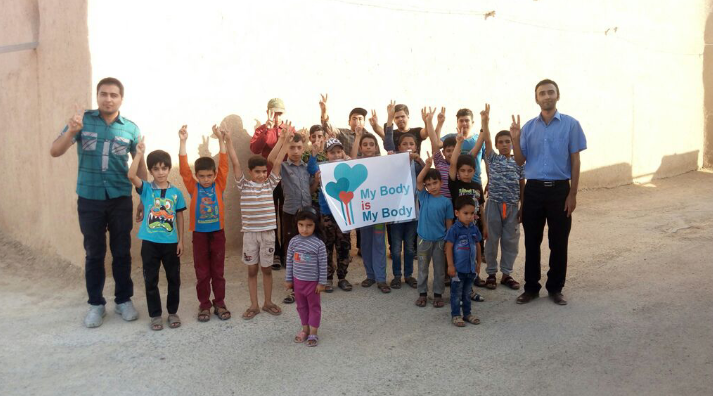
 The brothers are also Iran ambassadors for My Body is My Body, an international educational programme against child abuse, available in 21 languages. They have translated it into Farsi and organized information classes for children and their parents in Iran.

With the support of the World Academy of Medical Sciences, they have also created a national project to raise awareness about the negative physical and mental health consequences of child marriage.

Their work has been well received by children, parents and teachers across the country and abroad. "Many Iranians were very happy with our educational programmes. Every day we received support from children and their parents. We were also invited by many people to organize our classes in cities and in the countryside.”  Their human rights and peace work in Iran and internationally led them to be named World Peace Ambassadors of the International Forum for the Literature and Culture of Peace (IFLAC) in March of this year.

Yet, in Iran, their educational work attracted the wrath of fundamentalist groups who believe that they are promoting Western values, which will corrupt the younger generations. “They say that our activities, especially our campaign against girl brides, promote the UN's 2030 Sustainable Development Goals (SDGs), and because of that children and future generations will lose their Islamic spirit,” Gavanji says. “They believes that child marriage is a correct action and they think that we're promoting anti-Islamic culture in Iran."

After the attack, the brothers hid in the countryside, then in September decided to flee the country, leaving behind their families, research projects and campaigning work. 

They are now living in hiding in a small room in an undisclosed country, as they fear that fundamentalists will track them there. 

 They hope to be offered asylum in Canada or in another country and have launched a signature campaign to help them achieve this. 

“We want to make our voice heard by the United Nations. We ask all journalists, human rights organizations and governments to listen to us and help us.” 
Please, sign their petition.


Friday, 23 August 2019

Extinction Rebellion Art and Design at the V&A


Extinction Rebellion posters. Photo credit: Chris J Ratcliffe Getty Images


Protest movements have always used art to carry and amplify their messages. The Climate and Ecological emergency is THE issue of our time, and the Extinction Rebellion (XR) movement is skillfully using art and design to galvanise public concern for the planet with maximum impact. Their flags, banners and flyers in punchy colours with carefully worded slogans and woodblock prints are now immediately recognisable across the globe.

Extinction Rebellion, as many might already know, is a global activist group calling for urgent action on climate change through acts of non-violent civil disobedience and disruption. Since its first public action on 31 October 2018, urging the UK government to declare a climate and ecological emergency and commit to reduce emissions to net zero by 2025, XR has grown into an international movement with over 363 groups active in 59 countries around the world.

XR’s graphics balance joy and menace with a bold, tongue-in-cheek approach, and are characterised by four core design elements. These include the use of the Extinction Symbol, the XR logotype, a colour-palette of 12 playful tones including ‘Lemon’ yellow and ‘Angry’ pink influenced by pop artist Eduardo Paolozzi, and the fonts ‘FUCXED’ and ‘Crimson’. Often juxtaposing imagery of the natural world with more sinister images of skulls and bones, XR’s urgent visuals articulate hope, while outlining the grave consequences the group feels failure to act will bring. 

Recognizing the importance of the movement and the value of its unique designs, the London V&A has acquired a series of objects exploring the design identity of Extinction Rebellion.

The pieces produced by the Extinction Rebellion Arts Group, a coalition of graphic designers, artists and activists responsible for XR’s Design Programme, range from the open-source Extinction Symbol created by street artist ESP in 2011 and adopted by XR in 2018, to the Declaration that accompanied their first act of Rebellion, and flags carried during mass demonstrations. They are on display in the V&A’s Rapid Response Collecting Gallery (gallery 74a).

The objects have been acquired through the V&A’s Rapid Response Collecting, an innovative programme that enables the acquisition and immediate display of design objects that address questions of social, political, technological and economic change.

“Design has been key to Extinction Rebellion’s demands for urgent action on climate change. The strong graphic impact of the Extinction Symbol alongside a clear set of design principles have ensured that their acts of rebellion are immediately recognisable,” says Corinna Gardner, Senior Curator of Design and Digital at the V&A.

“Extinction Rebellion have galvanised public concern for the planet, and their design approach stands in relation to earlier protest movements such as the Suffragettes who encouraged the wearing of purple, green and white to visually communicate their cause.”

Tuesday, 24 April 2018

The Women who Stopped the Nuclear Deal

Liz McDaid and Makoma Lekalakaka in front of the country’s only nuclear power station - Koeberg/Courtesy of the Goldman Environmental Prize
 
 
Two South African women, Makoma Lekalakala and Liz McDaid, yesterday have won the Goldman Environmental Prize, the world’s largest award honouring grassroots environmental activists, for stopping their government’s massive secret nuclear deal with Russia – a deal that would have threatened the country’s health, environment and finances.

Their improbable victory against the powerful nuclear industry and South African government shows that, in McDaid’s words, ‘people can make a difference and that the country will not be sold to the highest bidder. It is a victory for democracy.'

I’ve met both women, who have been fighting injustice most of their lives, in London last week, while on their way to collect their award in San Francisco. Here is their story, which I have written for the New Internationalist.

Exposing corruption

In 2014, under the leadership of President Jacob Zuma, South Africa’s government made a secret deal with Russia to build eight to ten nuclear power stations throughout the country (currently the country has one station, operated by the state-owned electricity utility, Eskom). The $76 billion deal was unprecedented in scope and cost, and its terms assigned all liability for nuclear accidents to South Africa.

It looked like a done deal, but the two women stood in the way.

 ‘I work with women who don’t have access to electricity - they cannot afford to pay for it - so building a trillion rand nuclear power project with taxpayers’ money was never going to be the answer,’ said Lekalakala, 52, the director of the environmental organization Earthlife Africa.

Research has shown that nuclear is not needed for the country’s energy future, added McDaid, 55, climate change coordinator for Southern African Faith Communities’ Environment Institute (SAFCEI), which had long advocated for renewable energy to address climate change and had taken a stance against South Africa’s nuclear industry.

The women started asking how the government was making decisions about the country’s energy needs, and when they started scrutinizing the processes, they uncovered unlawful activities. Earthlife Africa obtained a copy of the secret South African-Russian agreement, which they shared with the Mail & Guardian, who published it in February 2015. The newspaper investigation uncovered more corruption and misconduct.

Both women decided they had to act. ‘You just don’t roll over when wrongdoing happens: you fight,’ McDaid said.

So Lekalakala, who is from Johannesburg, and McDaid from Cape Town, pooled their shoestring budgets, resources of skill and constituency within their small environmental NGOs to create a formidable collaboration. Along with their organizations, they highlighted the health and environmental risks, and financial implications from this massive nuclear upscaling.

For more than two years, they woke up early every Wednesday to greet ministers with anti-nuclear banners as their shiny black cars approached Parliament. Sometimes, it was just McDaid in the rain, sometimes they were dozens of protestors. They also organized pickets in front of the department of environmental affairs and the state-owned energy company Eskom, as well as countless protests, rallies, public meetings and petitions.

Seeking a just energy future

In the process, they built a broad coalition of various interest groups: women’s groups, youth groups, civic society groups, organizations against corruption, religious groups, trade unions and businesses. ‘So many different people and so many different organizations got involved. They could relate to what we were doing, they could see the impact of the deal on their own lives,’ Lekalakala said.

‘It started with the environment, but now, it's a whole movement for a more just future: us standing up and holding our government accountable in a democracy. And the movement keeps growing,’ McDaid added.

Along with their organizations, the two women also took the Zuma government to court on the grounds that the deal had been kept secret and bypassed legal process, without any public consultation or parliamentary debate. For many people, the deal was emblematic of the lack of transparency and corruption in the Zuma government in which a few people benefited while the rest paid the price. ‘The nuclear deal was never about energy. It was about the greed of a few individuals,’ as McDaid puts it.

The court battle was fought over a year and a half. But on April 26, 2017, the Western Cape High Court ruled that the nuclear power project was unconstitutional, invalidating the agreement and stopping the nuclear programme. The landmark legal victory also means that any new nuclear deals for South Africa have to be disclosed and approved by Parliament.

‘When the judge made the announcement that we got everything we had asked for, I broke down in tears,’ remembered Lekalakala. ‘And I shouted right there in court, although I knew that you have to keep silent in court,’ added McDaid.

‘So many times we thought that the forces against us were too great. Our first court appearance got postponed and we were running against time. They attempted to block us, to wear us out, to make us run out of money (we did run our of money, but our legal team were amazing: they kept carrying on), but all this only made us more determined to fight,’ said McDaid.

Despite their huge victory, the women fear that the nuclear build could be resurrected once more funding becomes available. So they are continuing their campaign and are calling on the new South African government to remove the entire nuclear build development from its integrated energy plan.

Yet Lekalakala and McDaid are optimistic, believing that their campaign for a transition to a low carbon economy with a decentralized and socially-owned energy supply has never had a better chance of success. ‘The science and the economy are on our side,’ said Lekalakala. ‘The international community agreed that we have reached an unprecedented level of greenhouse gas, so we need to act quickly – there are alternatives to fossil fuels that are more beneficial for the planet and individuals. The world is changing. Everyone is pushing for renewable energy.’


Friday, 26 January 2018

Gina Lopez, maverick environment activist fights Philippines’ mining


Courtesy of Gina Lopez

-->
I felt so energized and inspired after interviewing Gina Lopez, the Philippines’ former environment minister, for this issue of New Internationalist.


She is both a philanthropist and an environmentalist - a fiery, fearless, maverick activist who is not afraid of fighting the Philippines' powerful mining industry.  She believes that protecting the environment and promoting social justice go hand in hand.


She is irreverent, funny, full of energy and always in action – rolling her sleeves, campaigning, cleaning slums, jumping into a river to make a point, climbing a rock – and giving ministers and industrialists a piece of her mind.


"Yes, mining creates a few jobs and perhaps a few schools, and a few people enrich themselves, but thousands suffer and water sources are polluted for generations afterward.  Mining is just greed and selfishness."


As a minister, she banned open-pit mines and moved to shut down more than half of the operations of the country’s mining companies, after audits showed massive violations against the environment and the law. It cost her her job.


She is not your typical environmental activist. The daughter of one of the country’s wealthiest families, she fled the Philippines in 1972 to avoid political persecution during the Marcos regime, but returned in 1986 after being educated in the US, becoming a yoga master, and then working with disadvantaged communities in Africa. She still meditates every day.


She uses her connections as a shield in a country that is one of the world most dangerous places to be an environmental activist. “My family owns the biggest media company, I don’t think someone would want to harm me. I am not afraid of anything,” she told me matter-of-factly.


“What is needed is not a shift in economic priorities - but a greater realization and awareness of the damage some economic activities (mining, logging, rampant quarrying) inflict not only on our economic potential, but on our well being as a people. What is needed is a total economic valuation (monetizing the costs, the benefits) of these activities and then asking the very pertinent question - is it worth it?"


Last year, she received the Seacology Prize, awarded to those showing exceptional achievement in preserving island environments and culture.

You can read my story in New Internationalist here.