Showing posts with label asylum seekers. Show all posts

Thursday, 2 July 2020

Renowned Iranian scientists attacked because of child rights activism

Jahangir (left) and Shahin Gavanji

Two Iranian brothers, both respected research scientists and child rights activists, have been severely beaten by fundamentalists who see their campaigning work – particularly against child marriage - as promoting anti-Islamic values. Fearing for their lives, they had to flee the country. 

Last May, a group of motorcyclists descended on the brothers’ home in Isfahan. They assaulted them with truncheons and electric cables, and threatened to splash hydrochloric acid on their faces. “They wanted to blind us. They shouted: ‘Away with you, you are representatives of America, Israel and the United Kingdom’. It was horrible. I still remember the voice who said: ‘We will kill you both.’ My brother Jahangir lost 30 kilos in one month because of the stress, and his leg is now numb and he cannot walk properly," says Shahin Gavanji, 35.

"We don't want to do any political or religious activities," says Gavanji. "We only want to focus on children's rights.  Child marriage is a big problem in Iran, as well as child labour, and physical and sexual abuse of children are totally ignored.”

More than half a million marriages of children are registered in Iran every year, according to the Persian-language Entekhab news website. Up to 40,000 of them are between the age 11 and 14, and more than 300 are girls under the age of nine. Physical and sexual abuses are widespread, but these issues are completely taboo. In addition, according to UNICEF, there are three million child workers in Iran, but Iranian NGOs estimate their numbers at seven million. Under Iranian law, it is illegal to work under the age of 15, but because of circumstances like poverty and organized crime, the law is not often followed. An estimated 14% of Iranian children are forced to work in dangerous and unsanitary conditions - in the streets, in automobile or rug factories, or in the sex industry, according to international child NGO Humanium.

The Gavanji brothers have received various awards for their research work in their country and have been voted the best young inventors and scientists of Iran in 2009 and 2010. They  have also won several medals and awards at international science festivals in Germany, Poland and Croatia. 

 “My brother and I are very well-known in our country, so we thought that  we should use our voice to help children and make a better world for them,” says Gavanij, who has a degree in Biotechnology and chairs the Asian Council of the World Academy of Medical Sciences (WAMS) 

To break the silence around child rights issues, they have launched several campaigns in Iran and abroad, including the first national campaign to prevent child abuse in Iran and the Global Campaign for the Prevention of Child Marriage in 41 countries.  

 “We focus on raising awareness since we believe that education is the most powerful way to help change the world.”  They also held 5-minute classes in the streets across the country to help child labourers recognize and prevent different types of abuses. “We see a significant number of children who blame themselves and are even afraid to tell their family or anyone else about the abuse they have suffered,” Gavanji says.  

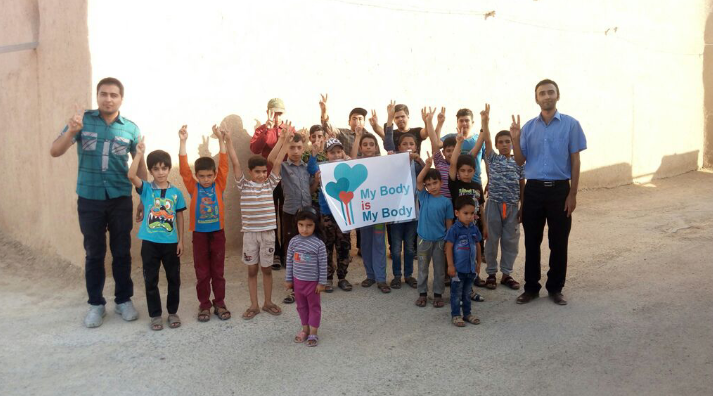
 The brothers are also Iran ambassadors for My Body is My Body, an international educational programme against child abuse, available in 21 languages. They have translated it into Farsi and organized information classes for children and their parents in Iran.

With the support of the World Academy of Medical Sciences, they have also created a national project to raise awareness about the negative physical and mental health consequences of child marriage.

Their work has been well received by children, parents and teachers across the country and abroad. "Many Iranians were very happy with our educational programmes. Every day we received support from children and their parents. We were also invited by many people to organize our classes in cities and in the countryside.”  Their human rights and peace work in Iran and internationally led them to be named World Peace Ambassadors of the International Forum for the Literature and Culture of Peace (IFLAC) in March of this year.

Yet, in Iran, their educational work attracted the wrath of fundamentalist groups who believe that they are promoting Western values, which will corrupt the younger generations. “They say that our activities, especially our campaign against girl brides, promote the UN's 2030 Sustainable Development Goals (SDGs), and because of that children and future generations will lose their Islamic spirit,” Gavanji says. “They believes that child marriage is a correct action and they think that we're promoting anti-Islamic culture in Iran."

After the attack, the brothers hid in the countryside, then in September decided to flee the country, leaving behind their families, research projects and campaigning work. 

They are now living in hiding in a small room in an undisclosed country, as they fear that fundamentalists will track them there. 

 They hope to be offered asylum in Canada or in another country and have launched a signature campaign to help them achieve this. 

“We want to make our voice heard by the United Nations. We ask all journalists, human rights organizations and governments to listen to us and help us.” 
Please, sign their petition.


Wednesday, 11 October 2017

Refugee Exhibition: "Claiming a New Place on Earth"


If you are in London this week, please come and see our exhibition “Claiming a New Place on Earth” at Protein Studios in Shoreditch, London.  Through photographs and interviews, photographer Caroline Irby and I have recorded the journey of 10 refugees or asylum seekers aged 18-24, who arrived in the UK as minors and are now coming of age in this country. 

How is it to grow up in an Afghan village with no water and no electricity, then to find yourself alone in London at 18, not speaking a word of English?

How does it feel when life is passing you by, when you cannot get your driving license, go to university or get a job because you are waiting for your papers?


Thousands of teenagers arrive in the UK every year seeking asylum. Many have missed out on education and have been scarred by war and by having to leave their home countries.  In the UK, they have to navigate complex systems to get the support they need. Yet, they are also young people with talent, pride, aspirations and dreams.


The young refugees are from Syria, Ivory Coast, Iran, Afghanistan, Nigeria, Pakistan, Ukraine and Uganda. They talk about the life they have left behind and their new experiences in this country - the hurdles and challenges they are facing, especially around the asylum and education systems - as well as their dreams and aspirations for the future.  They were photographed in the context of their dream job. 


The portraits and interviews are part of the exhibition “Claiming a New Place on Earth” at Protein Studios in London, Oct. 10-15 (the title is from Lesbos 2015  by poet Ruth Padel). The exhibition was commissioned and curated by Breaking Barriers (BB), a wonderful charity helping refugees to find meaningful employment.

Caroline and I have worked together on a number of humanitarian stories overseas – particularly in Africa and Asia - and in the UK.   We have a keen interest in refugee issues because we have seen some of the causes that trigger people to flee their homes. We wanted to meet some of the young refugees who have settled here to learn what propelled them to move so far, and to hear about their experiences of trying to make a new life here.  And, at a time when Brexit negotiations are pressing on and immigration is such a loaded topic, we wanted to let some young refugees tell their own stories in their own words.

This is our second collaboration with Breaking Barriers. Last year, Breaking Barriers’ exhibition portrayed refugees at the place where they first felt free or safe in the UK.

You can see some of the portraits and interviews in this Guardian article


Saturday, 17 June 2017

How to tell the refugee story?

Khalid's story/PositiveNegatives


Migration and the refugee story are one of the most important issues of our age and will be there for a long time. Migration, the movement of people, has always existed. “The current crisis isn’t about people being refugees and migrants, the crisis is that we think of such movement of people as a crisis,” said Mohsin Hamid, author of The Reluctant Fundamentalist in this issue (June 2017) of New Internationalist. He is right.
  
The way the media reports on migration and the refugee story has a huge impact on how people react to them and on public policies. So, as a journalist, I keep asking myself how to best report migration. How to produce fair and balanced pieces that counter the stereotypes and misinformation, but also how to keep telling these stories in ways that are engaging and innovative.

These are so many stories about refugees and migrants out there that people become numb and turn away from them.  Yet, it is our job as journalists to keep telling those stories again and again, and to keep telling them in ways that cut through the compassion fatigue and reach our readers.

Over the past months, I’ve been looking at examples of various creative ways  to do that - some are journalism, others not.

Here are just a few, illustrating or responding to three different issues in reporting migration:

• Most refugee stories have been told in Europe in two ways: one that instills fear with unfactual or biased reporting; the other that shakes the public awake through sorrow and shock. But there is a middle ground: stories that put a face on the numbers, that humanize the immigration statistics, that show that refugees are just people like us, thrown into exceptional circumstances. And the best stories are those told by refugees themselves.
- My favourite is “A Perilous Journey: Stories of Migration” an exhibition of literary comics based on testimonies from refugees. They were created by PositiveNegatives, a wonderful non-profit, which produces literary comics, animations and podcasts about contemporary social and human rights issues, including conflict, racism, migration, trafficking and asylum.  Concentrating on contemporary real-life stories from Syria and Iraq, we follow two men and two women on their long difficult journeys fleeing conflict and persecution.  Nadia’s Story, for example, tells of a pregnant Yazidi mother, fleeing ISIS controlled Iraq with her two young children. The last panel of each story is a real photograph of the refugee, reminding us that these are real people and real stories. It is very effective and moving.  The exhibition is at SOAS’ Brunei Gallery Room: 1st Floor Gallery until June 24. Really worth a visit!

Hasko'story/PositiveNegatives

- Then there is the series of short radio episodes produced by BBC Radio 4’s The World at One, following a Syrian family from the Jordan refugee camp where they had lived for two years to Greece, then across Europe to Germany. Reporter Manveen Rana documented the twists and turns of their journey in a series of short reports – showing the good and the bad, the hopes and the challenges.  Her reports are honest, fascinating, moving, though provoking and surprising.
- Last summer, short hand-written messages were left in public places - inside coffee shops, in between the pages of books in libraries, on benches in parks and tied to lampposts and railings - or written on white boards in tube stations. They were messages of hope for a better life, written by refugees from Nigeria, South Sudan, Syria, Afghanistan, Iraq and other countries - part of a campaign by humanitarian aid agency Mercy Corps, aimed at changing the attitudes and perspectives of people around Syrian refugees and the migrant crisis in general. The campaign was particularly effective with young people, who shared the messages on Instagram and Twitter. 
 
“Sometimes it is really hard to put yourselves in the shoes of these people because it seems so distant but when I read the note it really made it sink in that this girl was not any different from me,” said Rebecca Alexander, a 21-year-old student, who saw the note of a 15-year-old Syrian refugee, hanging from a tree in London's Regent’s Park.


• People are tired of refugee stories because stories of suffering are exhausting. Stories of empathy are empowering. As are those who show refugees not just as “victims”.

- For example, millions of people shared the image of Syrian refugee Alex Assali feeding homeless people on the streets of Berlin, but very few might have read his story in a newspaper.  

When Assali, 38, woke up in his small Berlin flat one autumn morning two years ago, and checked his email, 1,000 messages waiting for him. The day before, a friend had uploaded a photograph to Facebook of Assali feeding homeless people on the streets of Berlin. The caption below read: “Acts of kindness: A Syrian refugee mans a food stand for the homeless, to ‘give something back to the German people’.”   The image went viral - it was shared more than 3,000 times on Facebook and nearly three million times on Imgur. Al Jazeera produced this interactive story, giving Assali’s backstory, and that story got no trolls, according to Yasir Khan, senior editor of digital video at Al Jazeera English.

- Then there was the “Iam a refugee" campaign, launched last summer to celebrate the contribution refugees have made, and continue to make, to life in the UK. Plaques, inspired by the English Heritage blue plaques, were placed on buildings across the UK, where selected refugees have worked or studied. The idea was to show the diversity of the refugee population and the experiences they have had, as well as the creativity, skills and knowledge that they bring to the UK.
• Stories on refugees should try to portray a range of backgrounds and experiences, even contradictory, to help the audience get a fuller picture. And it's a good idea to let refugees tell their own stories.

For this year’s Refugee Week 2017, the Higgins Bedford Art Gallery and Museum is launching ‘Voices - Different Pasts, Shared Future’, an exhibition featuring oral histories from refugees, asylum seekers and other migrants from Syria, Iraq, Rwanda and Palestine. Some of the stories are from women who are detained at Yarl’s Wood Immigration Removal Centre. The exhibition also includes a wonderful tapestry of objects which people have brought from their countries of origin. The objects are printed, then partly stitched by volunteers from the community and women from Yarl’s Wood. “These Voices transform personal memories into collective memories impossible to ignore,” says Josepa Munoz, the artist behind the project. 


There are too many interesting and innovative projects and ways to report on the refugee story to feature here, but feel free to add those you like…


Thursday, 14 June 2012

Europe's deadly frontiers - EU must stand up for migrants


People move to Europe for different reasons. Some flee persecution or war. Others try to abandon a life of chronic poverty. They hope to find a better, safer future here. But many never make it, partly because Europe’s border control measures are often enforced with little regards to the harm they might cause.  

Last year, at least 1,500 men, women and children drowned in the Mediterranean struggling to reach Europe, according to Amnesty International. Some of these deaths could have been avoided if rescue attempts had been made in time.
In recent years, some survivors have been forced back to countries where they faced abuse and ill-treatment. On several occasions Italy pushed back people to Libya where they were detained and mistreated. In an environment where there is little transparency or oversight, human rights abuses often go unpunished along Europe’s coasts and borders. 

In response, Amnesty International is launching a new campaign to highlight the plight of ‘people on the move’. The When you don’t exist campaign will call on the EU’s governments and institutions to stop exposing people to danger on Europe’s borders.

Nicolas Beger, director of Amnesty’s European Institutions Office, said: “For the EU, reinforcing Europe’s borders clearly trumps saving lives. By attempting to curb ‘irregular migration’, European countries have bolstered border control measures beyond European frontiers without regard to the human cost. Far from public view, these measures put people at risk of serious abuse.”
The campaign includes an online public petition to MEPs, urging them to fulfill their ‘watchdog’ role and hold governments and institutions accountable for how they treat migrants, refugees and asylum-seekers in border areas.

Find out more here.