Showing posts with label Africa. Show all posts

Tuesday, 1 March 2022

Where the Sun is Used to Freeze


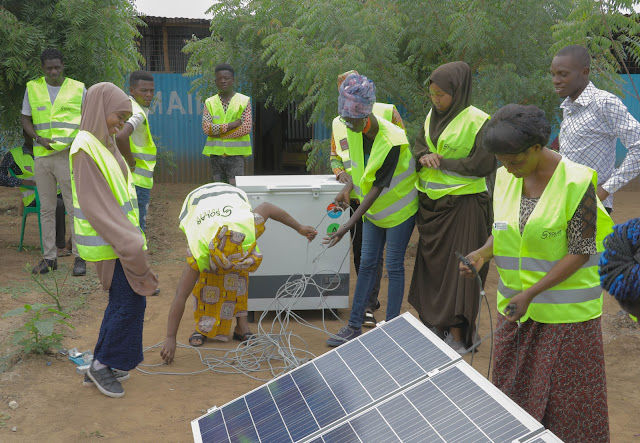
Skills training by Solar Freeze for Kakuma youths/credit: Ashden


With temperatures soaring across most of Africa due to climate change, preserving agricultural produces, medicines and other perishables is increasingly challenging. In eastern Kenya, a group of young people from smallholder families have created a pay-as-you-store solar cooling service, benefiting small-scale farmers, as well as health clinics and small businesses in Kakuma refugee camp, the oldest refugee camp in East Africa.

“Like many people our age, we watched our parents and grandparents work tirelessly, toiling in rural farms, only for a huge chunk of their fresh produce to rot away due to lack of proper cold storage units,” says Dysmus Kisilu, 27. “Often times, middle men would quickly swoop in and offer dirt cheap prices, and farmers would be forced to sell for a song out of fear of post-harvest loss,” says Kisilu.

Kisilu and many of his friends sought a better life in the city, but in 2016, some of them pulled their skills together to create Solar Freeze, a social enterprise harnessing solar power to offer off-grid small-scale farmers portable and affordable cold storage units in which to preserve their fresh fruits and vegetables.

“The growing seasons are now erratic and produce goes to waste because it cannot be stored. Whole communities are being destroyed as climate is changing. I knew I had to do something.”

Two years later, after meeting refugees in the huge Kakuma camp, Kisilu decided to expand into the humanitarian context. Kakuma, located in Turkana County, one of the poorest counties in Kenya, is home to 160,000 refugees from South Sudan, Sudan, Somalia, the Democratic Republic of the Congo, Burundi, Ethiopia, and Uganda. The camp has no access to energy from the national grid. Only 20% of its clinics have electricity and it is produced by polluting diesel generators, which operate only during specific times. Solar Freeze allows Kakuma’s clinics to store their medical products and vaccines, such as Covid, yellow fever, measles and rabies. The company has since diversified to include cold storage to food and drink shops, fishing and other businesses and households in the camp — a much needed service in the heat of the camp, and particularly as global warming increases.

Options for customers include buying cooling units on a lease-to-own basis or renting space in them on a pay-per-crate basis. This helps even worse-off individuals access cooling, as there is no upfront cost and the fees are low.

Solar Freeze team also launched an ‘Each One Teach One’ programme to train youth from agricultural families, especially women, to install, operate and maintain their units. The initiative was expanded to Kakuma and now also includes operation and maintenance of other solar products like solar-powered irrigation equipment, and sales.

“The education was super — it was not discriminatory to me by saying that I could not do it as a woman,” says Sakina Kariba, a refugee in the camp from the Democratic Republic of Congo. She was trained as a solar panel installer and now works freelance installing throughout the camp. “I am happy that even if I leave the camp today and I decide to go to back to Congo or another part of Kenya, I now have a skill that I can use.”

So far, Solar Freeze is working with 3000 smallholder farmers — reducing waste of fresh produce by 95% — and has 180 cold solar units in Kakuma.

Solar Freeze’s model is replicable to combat harvest loss and provide clean energy to off-grid small-scale farmers and vulnerable populations in sub-Saharan Africa. About 470 million smallholder farmers in developing countries lose an average of 35% of their income to food spoilage. The company plans to expand its work into other refugee camps, and to nearby nations including Rwanda and Uganda.

Last year, it has won the prestigious Ashden Awards in the Humanitarian Energy category. The Awards highlight some of the world’s most impressive climate pioneers and innovators and help them power up their impact.

The climate solutions charity is now calling for entries from similar climate innovators for their 2022 Awards. The application deadline is 15 March.


Wednesday, 23 September 2020

Run for Rangers – Rangers across Africa unite to protect wildlife from Covid-19 impact

Leruati Morijo, a ranger at a remote outpost on Lewa Wildlife Conservancy in Kenya, cares for a baby rhino. Credit: Martin Buzora, Wildlife Ranger Challenge  


Covid-19 has devastated African wildlife tourism with calamitous impacts on the animals and the people who have dedicated their lives protecting them. In response, rangers across Africa are taking part of a challenge to raise money to bring thousands of their colleagues back to the field. And you can help too.


Next week, on 3rd October, up to 50 ranger teams spanning the African continent will compete in the Wildlife Ranger Challenge, a half marathon race carrying their 25kg backpack containing a typical day’s equipment - along the way, building friendship and raising awareness of the hardship currently faced by those in their profession. 


Supporters around the world are encouraged to bolster their efforts and to ‘Run with Rangers’ by taking part in a virtual 5, 10 or 21km run and donating funds or raising sponsorship.


Support is coming from the world’s greatest long distance runner, Eliud Kipchoge from Kenya, adventurers and TV personalities Bear Grylls and Levison Wood, as well as the Duke of Cambridge, Tusk’s Patron, along with many other people internationally.


In 2018, the global wildlife tourism economy generated over $100bn and provided 9 million jobs, worldwide, but Covid-19 has resulted in an almost complete end to cross-border travel.  The African Union has suggested that the cost of the pandemic on the African travel sector may be $50 billion. 


The Game Ranger Association of Africa estimates that there are between 40,000 and 50,000 rangers across the continent and that the vast majority of them have either been furloughed or had their salary reduced by 50% to 80% - leaving families destitute and wildlife vulnerable and unprotected.


With remaining rangers stretched to capacity and international and national borders re-opening, it is feared that protected areas across Africa will experience a rapid increase in illegal poaching, as well as a decline in wellbeing and economic security for the communities to whom this wildlife belongs.  This threatens to undo years of rangers’ conservation gains, compromising decades of development and conservation work across Africa.


Funds raised through the Wildlife Ranger Challenge will cover salaries for at least 5,000 rangers, enabling them to provide for their families, protect communities and defend endangered wildlife -including elephant, pangolin, rhino and lion - in some of the continent’s most vulnerable areas.


“I have spent my entire career working for Malawi’s people and wildlife. I have worked with and alongside wildlife rangers, and even as one myself, and I know they are the lifeblood of the conservation sector in Africa,” says Brighton Kumchedwa, Director, Department of National Parks and Wildlife, Malawi.


“I have seen us move from a period of plenty in terms of wildlife to a period of huge losses. We must support rangers to work every day to ensure that our wildlife [is] not lost. The wildlife crisis we are facing is terrifying, but by supporting rangers we are in a position to make a difference, before it is too late. That’s what I remind myself every day.” 


Saturday, 24 March 2018

Yegna – a cautionary tale in humanitarian aid


Yegna in concert in Bahir Dar/Courtesy of Girl Effect


Should humanitarian aid be about food parcels and vaccination campaigns? Or could it be something more intangible and holistic?

Yegna,  a project trying to reframe the place of girls in Ethiopian society - a country where discrimination and violence against girls and women are common - crystallized that debate in the UK.

Over the past few years, the right-wing media waged a campaign against Yegna - which was co-funded by the UK Department for International Development (DIFD) - calling it “the most wasteful, ludicrous and patronizing” aid project in Africa and “blood boiling waste of taxpayers' money.” 

The articles caused widespread outcry from MPs and taxpayers. In January 2017, DIFD, which had previously given the program high marks and had planned to give it £11.8m between 2015 and 2018, cut all funding. 

Although the right-wing media dubbed it “Ethiopia’s Spice Girls”, Yegna is not just a girl group, but a brand that addresses issues such as early forced marriage, violence and barriers to education through a very popular radio drama, music and talkshows – all critical channels in a developing country with a strong musical and storytelling tradition. 

The radio drama, also called Yegna, features the five band members representing characters with different backgrounds, facing and overcoming many of the challenges experienced by Ethiopian girls. 

Take Mimi, for example. In the drama, she is a street kid who ran away from early marriage when she was 13 and had to sacrifice her education. She lives on the street and sells chewing gum and trinkets to passers-by. 

“Mimi is my favorite character because she is most like me. She’s very strong and does not give up,” says Alemtsehay Berihun, a 17-year-old Yegna fan who lives with her aunt in Wonka, a village in the Amhara region.

In Amhara, where Berihun lives, and in Addis, the two regions where Yegna is distributed, one in every two people listen to Yegna, according to Girl Effect. 

 “In our school, I don’t think there’s anyone who doesn’t know Yegna. You would walk into a random house in our town and find a Yegna poster inside,” Berihun says. 

The decision to cut funding disappointed Girl Effect, the charity behind Yegna, as well as other aid organizations, which are developing less traditional and more creative approaches to impact long-term changes.  “We were surprised and disappointed,” says Gaya Butler, the Ethiopia country director for Girl Effect. “Girl Effect addresses the demand for aid rather than the supply of it. For example, many organizations are building schools, but they are not filled because lots of cultural norms are preventing girls from attending school. We tackle those social norms.”

And they were having an impact. For example, 84 per cent of girls listening to Yegna, report that it has helped them become more confident, while 76 per cent report it has inspired them to continue their education, according to a 2014 audience survey, conducted by an independent local research agency.

Boys have also been inspired: 95 percent of boys who regularly listen to Yegna agreed that they would speak to someone if they saw a young girl being forced to get married. 

And Yegna has helped change parents’ attitudes, says Asnakech Kebede, 48, a mother of four girls and a primary school teacher. “It used to be culturally unacceptable for girls to stand up straight and speak up, but now parents see their value.” 

For aid workers and activists, the fate of Yegna is a lesson not only in tactics, but also in the limitations of foreign funding — and how much anti-aid sentiment exists in many countries.

Here is the story I wrote for Broadly on Yegna, explaining what Yegna is trying to achieve and how, and why I think it's a project well worth supporting, in spite of the smear campaign by the right-wing media.  Let me know what you think. 


Tuesday, 7 February 2017

Africa’s Bitter Sugar – Cash Crops Harm Smallholders


Faridah Nangobi and her family on their sugarcane farm in Kamuli, Uganda/Credit: Send a Cow


From coffee in Vietnam to sugar in Uganda, governments in developing countries have over the past decades pushed farmers to grow cash crops: they are important to the national economy and they provide jobs. This might be a good idea for farmers who have enough land to grow a variety of crops, but it actually harms smallholders.

Many farmers in developing countries own just a few acres of land, which means that most of their plot, often all of it, is dominated by the cash crop. This dependency on just one crop leaves them vulnerable to crop failures and any fall in the price of commodities. The lack of biodiversity also has a negative impact on the environment.

In addition, because smallholder farmers are no longer growing their own food, the region faces severe shortages and food has to be brought in from other parts of the country at high prices. The money the farmers do make from the cash crop is often not enough to feed their families.

"My children have nothing to eat. My baby just cries and cries. I’m forced to give her vodka so she can sleep,’’ says Faridah Nangobi, cradling her one-year-old baby inside her thatched hut.  Like most farmers in Uganda’s Kamuli district, she is growing sugarcane with her husband on their small plot.  Outside, her other children stand under a mango tree gnawing on sugarcane. The desperation with which they crush the canes shows that they are not chewing for pleasure: it is their only meal of the day.

 “Uganda must enact a policy to limit smallholder farmers from growing sugarcane as it has been shown not improve their lives,” says Patrick Sambaga, Uganda Country Director for Send a Cow, a small international development charity, working with farmers to strengthen the local economy and help them grow nutritious food and build greater gender equality.

 “Smallholder farmers must concern themselves with crops that bring in regular income for health care, school fees and food security,” Sambaga adds. “We encourage farmers to grow high value crops like citrus fruits, mangoes, kale, tomatoes, amaranth, garlic, potatoes, passion fruits, and at all times, keep small livestock such as ducks, chicken, rabbits and goats if they cannot keep cows.” 

Here is a story I’ve written for the Financial Times’ This is Africa examining how the sugar business system is operating in Kamuli, a major sugar hub in Uganda, and its human toll.


Thursday, 30 June 2016

Edward Loure, the Maasai leader who champions indigenous land rights in Tanzania


Edward Loure/courtesy of Goldman Environmental Prize


From the Andes to sub-Saharan Africa, indigenous groups are increasingly fighting for legal ownership of lands their ancestors have occupied for thousands of years – and in the rangelands of Tanzania, one activist believes he’s found a possible solution based on collective ownership.

Edward Loure, a Maasai leader and indigenous land rights activist from northern Tanzania, pioneered an innovative legal mechanism to preserve large expanses of ancestral lands in the Great Rift Valley, protecting both a traditional way of life and wildlife.  It is the first time tribal work has been linked to conservation in Tanzania - creating a model for other indigenous groups elsewhere in Africa and around the world to follow.

Up to two thirds of world's land held by indigenous people are under informal systems not legally recognised by states, according to a recent report by Oxfam International. Communities without formal title to lands where they may have lived for generations can be displaced by large-scale resource extraction projects, sold off to the highest bidder or seized by squatters clearing their land for illegal agriculture, according to the report, backed by 300 organisations worldwide who are pushing to expand land rights.

“Our land means everything to us. If we have no grass pastures, we will not have our cows, and without our cows, we cannot survive,” Loure told me, speaking via Skype from Dar es Salaam.

Loure, who is in his forties, grew up in the Simanjiro plains in the vast northern rangelands of Tanzania. Here communities of pastoralists and hunter-gatherers have lived off the land in harmony with migrating wildlife for centuries.  The savannahs and grasslands of northern Tanzania are home to an abundance of wildlife including gazelles, elephants, wildebeest, zebras, impalas and many other animals that keep the ecosystem in balance. Traditional communities are a vital part of that ecosystem, Loure says. “We depend on our lands and these lands have shaped our cultures and way of life.”

Edward Loure in his community/courtesy of Goldman Environmental Prize

But the pastoralists and hunter-gatherers’ traditional ways of life have been threatened since the 1950s when the Tanzanian government started creating National Parks. These efforts displaced thousands of indigenous people and jeopardized wildlife by destroying migratory corridors. The situation has been exacerbated in recent years by government sell-offs of ancestral lands to hunting and safari companies, and by the encroachment of unauthorised “land grabbers” seeking to use traditional grazing lands for large-scale farming.

Loure’s own community met a similar fate in 1970, when it was forcibly displaced to create the Tarangire National Park. This inspired Loure to join the Ujamaa Community Resource (UCRT), one of the first community-led NGOs in Tanzania, which has championed sustainable development and community land rights for the past 20 years.

Looking for better ways to secure land tenure, Loure saw an opportunity in the strong communal culture among tribes. He worked with UCRT to have a key legal mechanism called Certificates of Customary Rights of Occupancy (CCROs) – the primary mechanism through which land is protected under the Village Land Act – made available to groups, rather than only to individual land-owners. And that opened the door to a string a land victories. 

Over the years, at least 223,000 acres of Tanzania’s northern rangelands have been safeguarded through CCROs. Once their land rights are legally secured, communities can better access, manage and benefit from their natural resources, Loure says.

These communal land rights concepts, innovated in Tanzania, have the potential to have a global impact, says Matthew Brown, Africa Conservation Director at The Nature Conservancy.  “The notion that we need to secure local people’s collective land rights and have it officially signed off at the national level is replicable and is needed in other countries.”


For his innovative indigenous land rights work, Loure was awarded the 2016 Goldman Environmental Prize for Africa in April, a sort of Nobel for grassroots environmental activists.
 
You can read more about Loure’s communal land rights scheme and its impact in this story I wrote for Positive News.


Monday, 7 December 2015

Meet the Queen Mothers of Ghana: taking back their power and driving change in Africa

  Dogkudome Tegzuylle I, Pognaa (Queen Mother) of Lyssah /Credit:Nyani Quarmyne


This summer, we spent a couple of weeks with some truly amazing women in Ghana. They are the Queen Mothers – women who recently reclaimed their ancestral power and are now taking leadership roles in their communities. There are some 10,000 Queen Mothers in villages and towns across the country. They form a remarkable, but little known, network, bringing tangible social and economic development to the country and the continent.

Thanks to a grant from the European Journalism Centre, we (a filmmaker, photographer, TV producer and myself) were able to spend time with Queen Mothers in Lawra Traditional Area, a vast, rural territory in the upper western corner of the country, and in Ho, a town in the Volta region. We wanted to see how Queen Mothers worked at grassroots level. We found strong, warm, charismatic women who managed to accomplish so much with so little.  I often think of them…


And for a more immersive experience, watch our multimedia "The Formidable Queen Mothers of Ghana".

Monday, 27 October 2014

Reporting Diversity in Algeria - Terrorism stretches inclusive journalism training

Here I am with some of the brilliant journalists participating in the reporting diversity training in Algiers

You might not have heard much about Algeria and that’s not surprising. Unlike neighbouring Morocco, Algeria is not a popular tourist destination and the country is rarely in the (Anglo-Saxon) news - unless there is terrorism.  Well…a few weeks ago, not far from where I was staying on the outskirts of Algiers, a French tourist was kidnapped and beheaded by a militant group linked to Islamic State.  Police presence was beefed up in Algiers and foreigners like me were told to keep a low profile.


The murder hit at the core of the work we were doing there.  I had been asked by the Media Diversity Institute (MDI) to run a training for professional Algerian journalists on reporting diversity.  The London-based organization works internationally to prevent the media from intentionally or unintentionally spreading prejudice, intolerance and hatred; encouraging instead, fair, accurate, inclusive and sensitive media coverage in order to promote understanding between different groups and cultures.


During the five-day workshop, an Algerian colleague and I trained print and online journalists in how to write stories about the diverse groups who make up Algerian society, but whose voices are seldom heard in the media.  The journalists rose to the challenge and produced great stories on Syrian refugees, Sub-Saharan immigrants, people with disabilities, children in rural areas, single mothers and other marginalised groups.


And there was one other story – my favourite in fact. It was the story of a boy born in the mountains in Northeast Algeria during the “Black Decade” – the devastating conflict between Muslim extremists and government forces that tore the country apart in the 1990s and killed some 200,000 Algerians.  “Abd was the son of Islamist guerrillas, born in the ‘maquis’.  He is now 18. He doesn’t share his parents’ beliefs - in fact he has condemned them - but he is rejected everywhere he goes, he has no place in society and no future. He is suicidal,” explained the young journalist who had produced the story.  “I want to tell Abd’s story. It is the story of the children of the terrorists, of the “repented” – they are treated as pariahs in spite of the 2005 charter of national reconciliation,” the journalist told the class.


The other journalists greeted his story in stony silence. Then one said:  “I refuse to read anything about terrorists. We shouldn’t give them any voice, any recognition, any space.”  Many nodded in agreement. 


- “But he is a child. He didn’t ask to be born to terrorist parents, he doesn’t share their views,” I tried. 


- “What about the children of their victims? Do they have a voice?” angrily replied the journalist.


Everyone in Algeria is still traumatized by the “Black Decade” (Algiers still shuts down at night - a remnant of 10 years of curfew) and the story of the invisible children of Algerian terrorists hit a raw nerve. But it also generated a passionate and ultimately productive discussion around issues which were at the very heart of our training: how do we talk about other people’s views and experiences, especially when they disturb us?  Isn’t it better to hear what a segment of the population has to say, even if we don’t agree with them?  Some strongly believe that “terrorists” shouldn’t have a voice, but other people in Algeria believe that refugees, homosexuals, Christians and many other groups shouldn’t either.


The story also made me appreciate even more working with my Algerian colleague, as there are things which an outsider can only understand intellectually.


Friday, 9 May 2014

Rwanda's Gorilla Guardian


Eugene Rutagarama tracking gorillas early morning to locate them before tourists visit them in the Volcanoes National Park in Rwanda. This is what is done everyday to check on the health of each individual gorilla, but also to ensure that tourists visiting them are able to watch them. Photo: courtesy of Eugene Rutagarama.

Last month, the world remembered the Rwandan genocide. We all marvelled at how the country seemed to have healed and moved on, how the economy was blooming - and we talked about lessons to be learned (in the meantime, there are fears that the conflic in the Central African Republic could lead to another genocide...)


The Rwandan genocide was still in full swing this month 20 years ago - in just 100 days, nearly one million Tutsis and moderate Hutus were killed. I wanted to speak with a man who worked for peace in a different way: Eugene Rutagarama. He is the man who made sure the genocide didn't include a group of humanity's most endangered relatives – the mountain gorillas.  The gorilla population is now rising and contributing to the nation’s economic growth (an important factor of peace). It is also a rare unifying factor in a region still ravaged by conflicts. Here is my interview with him in The Ecologist.


Rwanda's 'gorilla guardian' - Eugene Rutagarama


Veronique Mistiaen

The 1994 genocide in Rwanda could easily have finished off the mountain gorillas of the Virunga mountains. The fact that they survived is in large part thanks to Eugene Rutagarama. He spoke with Veronique Mistiaen about the primates' future prospects ...

Rwandan biologist Eugene Rutagarama is widely credited for making sure that the victims of the genocide and subsequent wars didn't include the critically endangered mountain gorillas.

The gorillas have and are still contributing to the economic growth of the country - and this in turn is contributing to peace.

Today, nearly half of the world's 800-some remaining mountain gorillas live in the lush tropical forests covering the Virunga Mountains, the chain of volcanoes straddling Rwanda, Uganda and the Democratic Republic of Congo.
Rutagarama's conservation achievements won him the Goldman Environmental Prize - a kind of Nobel Prize for environmental activists - in 2001.

As people all over the world remember Rwanda's 1994 genocide - which was in full swing this month 20 years ago - I wanted to talk to Rutagarama about the remarkable recovery not only of the nation, but of the gorilla population, and his role in it.

The 1994 genocide - today and back then
"April is for me the month when I take time to think of the meaning of the genocide and its implication on the Rwandan society and on me in particular.
"How would I and my relatives be if the genocide didn't occur? What would have been the course of my life? Then I spend time thinking of each of the relatives and friends I lost during the genocide. 

"Almost each Rwandan from all ethnic groups has lost dear relatives and friends or suffered some pain as result of the genocide. The majority of youth is now enjoying the country economic growth and opportunities.
"The coexistence is of course far from being ideal, but tremendous progresses have been made. But the roots of hatred will take long to be completely removed. In this respect, the political leadership matters a lot."

Peaceful giants, and murderous people
Rutagarama is now advisor to the Greater Virunga Transboundary Collaboration - a wildlife conservation cooperation between the Democratic Republic of Congo, Rwanda and Uganda.

He first looked into the liquid brown eyes of a large silverback during a trip to the Virunga National Park with his brother in 1990. The encounter was so moving and thrilling that he decided to dedicate his life to preserving these peaceful giants.

As he was leaving the park with his brother, another encounter was also going to mark his life. A group of youth blocked their way, sneering: "Have you seen these snakes?" Then they addressed their guide: "Hey guide! Why don't you bash these snakes on the head?"

Four years later, nearly one million "snakes" - or "cockroaches" as the Tutsis were also called - and moderate Hutus were slaughtered by Hutus gone mad. Rutagarama's father, mother and three of his brothers were amongst the victims.

A life's mission: protecting the endangered gorillas
Protecting the gorillas in the aftermath of the genocide became the young biologist's single focus. Above all their habitats were at acute risk as the government tried to resettle more than two million people. And that effort also helped him go beyond hatred and despair.

"After the genocide in 1994, the need for protecting gorillas was urgent. It was for me a priority to make sure that they were protected. I put in my focus and my full soul. There was no more space for anything else."

Gorilla conservation, in fact, played a role in healing not just Rutagarama, but the surviving wildlife staff, many of whose former colleagues had been killed or forced to flee. Indeed the gorillas have helped to bring healing to the whole devastated country.

"After a humanitarian disaster as horrific as the genocide, the common struggle to preserve something of shared value allowed people to transcend the conflict and create links."

Monday, 17 March 2014

Virgin Wives of the Fetish Gods - Slavey in Ghana

Enyonam and Forgive, both former trokosi slaves, at home in their village. They bonded due to the stigma they face from the community and say "we have become family to each other". Photo by Fjona Hill (Aletheia Collective)
 
I love Ghana, so when Magnum ice cream asked me to conduct interviews for a film on sustainable cocoa in the Ashanti region, I jumped at the chance.  It would also allow me and photographer Fjona Hill to report on a story we have wanted to do for a long time, but didn’t have the means to, as editors rarely pay for travel expenses these days.

So after the film, we stayed behind and headed north to the Volta - a beautiful region rich in history and culture, dominated by the vast Lake Volta and the River Volta. We wanted to look at the terrible trokosi tradition and try to understand why it still endures today.  Ghana is widely seen as a model for political and economic reform in Africa and lauded for its rapid development.


But away from bustling Accra, in remote countryside villages, some deep-seated traditions prevail. The trokosi practice calls for virgin girls to be sent to the shrines of fetish gods to pay for crimes committed by one of their relatives. They become living sacrifices, protecting their families from the gods’ wrath. Some stay at the shrines for a few years; others for life.


The tradition, also practised in neighbooring Benin and Togo, is deeply rooted in the beliefs and identity of the Ewe (ay-vay) people. It serves rural communities’ need for justice and meets the material and sexual needs of the fetish priests. But it's also considered a spiritual act and as such it is, along with female genital mutilation, one of the most difficult human rights violations to eradicate.
With the help of International Needs Ghana (ING), the main NGO campaigning to stop the practive, we visited isolated rural villages, speaking with women who had spent many years in fetish shrines, fetish priests, ING director and government officials.  We were aware of being Western journalists looking at a tradition we couldn’t understand and didn’t want to present another story on “dark, exotic, dangerous Africa”.

But we felt this was not a story about Western against African values – rather it was one one about modern Ghana vs. traditional Ghana. The Government outlawed the custom in 1998 and many Ghanaians are deeply embarrassed it is still enduring today. But there are powerful religious and political lobbying groups who argue the tradition is part of their cultural and religious heritage, and is misunderstood.


Here is our story for the Thomson Reuters Foundation and here is the same story on the Chime for Change site, a global campaign to convene, unite and strengthen the voices speaking out for girls and women around the world. 

The priest, Torgbi Ahiaeu at the Avevi shrine. He complains that he now has to do the farmwork himself now the women have gone. His wife, behind him, is the one remaining trokosi in the village. All the other 23 trokosi have left the village after liberation. Photo by Fjona Hill (Aletheia Collective)


Tuesday, 14 January 2014

Uganda's Anti-Homosexuality Bill is Back - Stop It!

Credit: Amnesty International


‘Our neighbours said to me, “Why are you still alive?”’ – Frank, Kampala

Uganda’s notorious Anti-Homosexuality Bill is back. Passed by Parliament at the end of last year, it is now with the President for approval or dismissal by the end of January. The Bill proposes to sentence anyone identified as lesbian, gay, bisexual, transsexual or intersex - LGBTI - in Uganda to life in prison. It will have terrible wide-ranging repercussions and punish activists, health workers and lawyers for 'promoting' homosexuality. Amnesty International is asking people to urge the President to stop it.


It’s already illegal to be gay in Uganda, with a lengthy prison sentence for anyone found to have had same-sex relations. But this new Bill goes even further, and anyone identified as LGBTI will be imprisoned for life.
This month marks three years since prominent gay rights activist David Kato - who campaigned against the Anti-Homosexuality Bill when it first appeared before Parliament in 2009 - was murdered in his home. His murder followed a hate campaign in the national press which called for Kato and others on a ‘gay list’ to be hanged.
Sadly, in the years since Kato’s murder, attacks have increased and rights for LGBTI individuals rolled back even further – led by hateful tirades in the media, and vicious campaigns by law-makers keen to legitimise discrimination.
It is impossible to assist gay rights activists with court cases without receiving abuse and assaults – from neighbours and passers-by, to government officials and the police.
The Anti-Homosexuality Bill not only legitimises but actively encourages such activity.
What’s more, the Bill will extend punishments to anyone found to be 'promoting homosexuality'. If it becomes law, access to basic legal and health rights will be denied to a whole section of Uganda’s society.
Health workers will be barred from conducting HIV tests or advising LGBTI patients; lawyers prevented from advising LGBTI clients; activists prevented from defending LGBTI rights.
In fact, if you know of someone working with LGBTI individuals and you fail to report that activity within 24 hours, you too will be prosecuted.
Please tell the President that love is a human right and urge him to veto the bill: take part of  Amnesty International action here.