Showing posts with label London. Show all posts

Tuesday, 15 October 2019

Symbols of Humanity: Syrian artist bridges times, religions


In our divided and polarised world, who, but artists, can conjure up the possibility of coexistence between cultures, ethnic groups and religions?

Born in 1966 in Aleppo, George Baylouni fled to France during the war.  And now his work builds bridges between the East and the West, and the past and the present.

Fascinated by the ancient civilisations of Mesopotamia, he studied their mysterious artefacts and texts, written in ancient cuneiform. He paints religious symbols and makes collages, adding gold leaf, his trademark, telling a tale of ancient worlds and of contemporary times. Uniquely, his paintings combine religions, with several pieces focusing on both Christianity and Islam in the same painting.

His work has been showcased prominently in the Middle East and Europe and he was named one of the 100 most important personalities in the Arab world in 2014 by Arabian Business Magazine.

”Symbols of Humanity”, Baylouni’s first exhibition in London, opens at the Stories Art Gallery in Mayfair on October 17 and runs until November 17. 

Baylouni's exhibition marks the first anniversary of Stories Art Gallery, which features renowned and upcoming artists from around the world, many from war-torn countries, and focuses on the stories behind their artwork.

If you have a chance, do see the exhibition and meet gallery director, the wonderful Manas Ghanem, who was born in Damascus, then educated in the West. Before opening her gallery, she worked as a lawyer in the Middle East and North Africa with UNHCR and Unicef.  


Thursday, 14 February 2019

Stories From Within – Syrian artists tell stories of survival, resilience


Human Bull I by Bassem Dahdouh/courtesy of Stories Art Gallery

When four internationally renowned Syrian artists were asked to contribute pieces showing what they wanted the West to see about their country, they selected artworks representing the untold stories of ordinary people who have endured and persevered through extraordinary circumstances.

Their work form  “Stories from Within”, a fascinating exhibition on display at Stories Art Gallery in London’s Mayfair until February 25. The gallery opened last October with the aim of promoting current Syrian artists whose work challenges their country’s one-dimensional image presented in the media. All the “Stories From Within” pieces were created in Syria over the past seven (almost eight) years and it is the first time since the war that they are exhibited in Europe.

 “We look for works that widen our vision and shift the image of Syria from refugees and needy victims to be pitied to one of humanity and respect – one with whom the viewers can have a connection,” says Manas Ghanem, the gallery’s director.  


 “Yes, there is war, destruction and darkness, but you cannot reduce Syria’s 7000 years of existence to seven years of war.  Syria is still alive,” adds Ghanem, who was born in Damascus, but educated in the West. Before opening her gallery, she worked as a lawyer in the Middle East and North Africa with UNHCR and Unicef.   


Bassem Dahdouh’s mixed media on canvas “humanoid bull” series depicts hybrid beings who are neither fully human nor beast.  The humanoid bull “portrays us, oppressed when reaching out for a breath of fresh air in an attempt to lead normal lives," he explains.  "It is my hope that we as humanity would succeed and plant some kindness and compassion in this land before it is too late."


Nizar Sabour’s work reflects the emotional impact of the war on the sacred Aramaic town of Maloula, where people still speak the dialect of the Christ and which was ravaged by jihadists linked to Al-Qaeda in 2013.  Never before had this ancient mountain town been harmed.  His five mixed media canvases represent various views of Maloula and the surrounding Qalamoun mountains, some surrounded by protecting lace, guardian angels and saints or official-looking stamps.


The works of the other artists in the exhibition - Edward Shahda and Asmaa Fayoumi - depict the anxiety of those left behind while waiting for the unknown, and finally also hope, love and compassion, which is what allows people to survive.

People don’t easily associate art and Syria, says Ghanem, but the Syrian art scene has been vivid since the 50s and the 60s, and many of the artists exhibited in the gallery are renowned in the world of contemporary art, including Sabour, Shahda, Dahdouh and Fayoumi, who have works in private collections and galleries from USA to Russia, as well as in Arabic countries like UAE, Kuwait and Lebanon.

“Yet for the past eight years, it’s as if that has just gone, and all that you hear about Syria is different. So we are trying to bring it back,” Ghanem says.

The gallery’s next projects include an Arabic calligraphy exhibition by the famous Syrian artist Mounier Al-Sharaani. They also hope to be able to bring artworks from Iraq, Yemen and other countries. 


Stories From Within at the Stories Art Gallery  until February 25. 
51/53    South    Audley    Street Mayfair London W1J 7DD

Friday, 30 November 2018

Outdoor Education - Bringing back nature into our children's lives


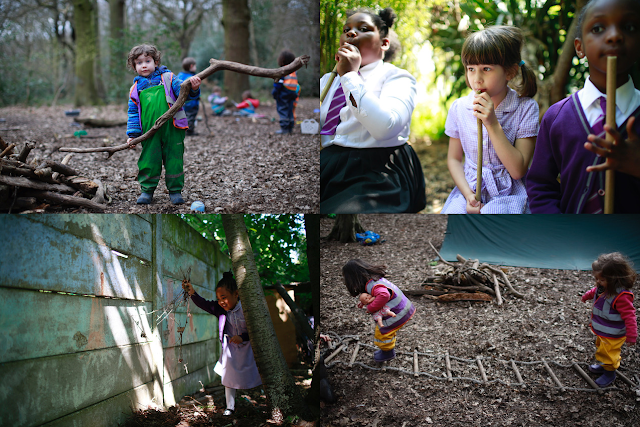
Children at Into the Woods nursery and Ark Franklin Primary Academy/Credit: Caroline Irby


“Nature breeds curiosity; it helps grow explorers rather than robots.” Ben Palmer-Fry, outdoor learning teacher, Ark Franklin Primary Academy.

Children in the UK spend less time outside than high-security prisoners, according to a recent report While their grandparents roamed unsupervised outdoors, our children spend their days cooped up inside, glued to a screen.  We have displaced nature from their lives: selling off their outdoors spaces, feeding them technology, keeping them inside with our fears and lack of time.  

A few years ago, the National Trust published a report on the phenomenon of "nature deficit disorder", a term coined in 2005 by the American author Richard Louv, who argued that the human cost of "alienation from nature" was measured in "diminished use of the senses, attention difficulties and higher rates of physical and emotional illnesses".  

Nature deficit disorder is not generally regarded as a medical condition. Yet, in the UK as in many other countries, rates of obesity, self-harm and mental health disorders diagnosed in children have climbed significantly since the 1970s.  

What if we could ‘rewild’ their childhood - bring back nature into their lives?  Could it produce healthier and happier young people?

Many people believe so, and a growing number of schools across the country (and elsewhere) are trying to do just that: they are re-introducing nature into children’s lives.  It is seen as a new trend, but the UK has a rich heritage of outdoor learning going back at least to the 19th century with Wordsworth, Ruskin, Baden and many others.

Some schools are following the Forest School philosophy, drawing on the Scandinavian model of Nature Kindergartens, while others are developing their own outdoor learning organically, adapting it into their curriculum.  Many community programmes, projects and social enterprises are also trying to reconnect young people with nature.

And the results are amazing. A solid body of research show the significant health, social and emotional benefits of outdoor learning. Forest School teachers say their children are healthier, more independent, confident, creative, socially minded and caring for the environment than other children. Yet, outdoor learning is likely to remain on the margins of education until the benefits are  recognised by policymakers and reflected in policies.

Photographer Caroline Irby and I have visited two London schools, which represent two different approaches to outdoor learning.  Into the Woods, a nursery where children spend their entire days in the woods, rain or shine, and Ark Franklin Primary Academy, which has transformed a piece of urban derelict land into a green oasis with a storytelling grove, a bug hotel, a vegetable garden and more.  The outdoors lessons include sciences, literacy and maths, but also “weaving and knot-tying and everything we think will be useful,” says headteacher Janine Ryan.

“Education is increasingly dominated by academic targets and a narrow curriculum,” says Emma Shaw, founder and manager of Into the Woods, London’s first Forest School nursery.  “The concept of play is lost along the way. ‘Let’s do the Maths earlier’: everything is measured. We all live our lives on screen all the time…  Here, the children can be themselves. They have space and time to explore, learn and do their own things.”  

You can read our story “Learning Outdoors: Growing Explorers, not Robots”  published in Positive News.


Wednesday, 11 October 2017

Refugee Exhibition: "Claiming a New Place on Earth"


If you are in London this week, please come and see our exhibition “Claiming a New Place on Earth” at Protein Studios in Shoreditch, London.  Through photographs and interviews, photographer Caroline Irby and I have recorded the journey of 10 refugees or asylum seekers aged 18-24, who arrived in the UK as minors and are now coming of age in this country. 

How is it to grow up in an Afghan village with no water and no electricity, then to find yourself alone in London at 18, not speaking a word of English?

How does it feel when life is passing you by, when you cannot get your driving license, go to university or get a job because you are waiting for your papers?


Thousands of teenagers arrive in the UK every year seeking asylum. Many have missed out on education and have been scarred by war and by having to leave their home countries.  In the UK, they have to navigate complex systems to get the support they need. Yet, they are also young people with talent, pride, aspirations and dreams.


The young refugees are from Syria, Ivory Coast, Iran, Afghanistan, Nigeria, Pakistan, Ukraine and Uganda. They talk about the life they have left behind and their new experiences in this country - the hurdles and challenges they are facing, especially around the asylum and education systems - as well as their dreams and aspirations for the future.  They were photographed in the context of their dream job. 


The portraits and interviews are part of the exhibition “Claiming a New Place on Earth” at Protein Studios in London, Oct. 10-15 (the title is from Lesbos 2015  by poet Ruth Padel). The exhibition was commissioned and curated by Breaking Barriers (BB), a wonderful charity helping refugees to find meaningful employment.

Caroline and I have worked together on a number of humanitarian stories overseas – particularly in Africa and Asia - and in the UK.   We have a keen interest in refugee issues because we have seen some of the causes that trigger people to flee their homes. We wanted to meet some of the young refugees who have settled here to learn what propelled them to move so far, and to hear about their experiences of trying to make a new life here.  And, at a time when Brexit negotiations are pressing on and immigration is such a loaded topic, we wanted to let some young refugees tell their own stories in their own words.

This is our second collaboration with Breaking Barriers. Last year, Breaking Barriers’ exhibition portrayed refugees at the place where they first felt free or safe in the UK.

You can see some of the portraits and interviews in this Guardian article


Sunday, 10 July 2016

Freedom is not easy - exhibition of refugees who found safety in London


Hodan Omar from Somalia/Credit: Caroline Irby @carolineirby


If you are in London July 12-18, come and see “Freedom is not easy” - an exhibition of portraits and interviews of refugees living in London. My friend photographer Caroline Irby represented 12 refugees in the various places where they first felt free or safe after arriving in this city. The portraits are accompanied by interviews I’ve made, capturing their stories of flight, readjustment to a new life, as well as the moment each refugee first felt safe or at home here.
There are an estimated 120,000 refugees in the UK, and last year some 32,414 applied for asylum. For most, life is not easy. Unemployment in refugee communities is above 50% (5.1% is the national average), and in 2015, the British Red Cross supported more than 9,000 who were destitute. Yet some keep striving and pulling through, and successfully make new lives here.
 

Caroline and I have worked together on a number of humanitarian stories overseas and in the UK. We have travelled widely with our work, particularly in Africa and Asia where we have seen some of the causes that trigger people to flee their homes, and visited the camps where refugees and displaced people find shelter - usually in their own countries or in neighbouring states. But some refugees move further: some cross the Sahara, the Mediterranean and the Channel, and now live here in London.

We wanted to meet some of the refugees who have settled here, to learn what propels them to move so far, and to hear about their experiences of seeking - and sometimes finding - freedom, safety and a home in this city.
At a time when politicians and the media too often dehumanise refugees by referring to them as an anonymous mass, we wanted in our small way to restore some of their identities by giving these 12 refugees a face and a voice. We also wanted to show how strong and resilient refugees have to be in order to make it here. The men and women featured in the exhibition also demonstrate that if they require some help to settle in the country, they also bring fresh energy, knowledge, talent and tremendous potential.
 

We also wanted to support Breaking Barriers, the charity which is putting together this exhibition. They are helping refugees to find meaningful employment, matching their skills. So many refugees told us that finding a "real" job was one of the main factors that helped them integrate and feel at home.
 

Here is what Hodan Omar, a young woman from Somalia, told us about the internship she found through Breaking Barriers:

"As a refugee, all you hear is negative: everything seems to conspire to put you down, so you think that maybe they are telling the truth, that you are never going to make it. But at Source8, I felt positive. They made me feel at ease. They trusted me with important things. I felt capable. It freed me of that negative cloud. Yesterday was my last day there, but I’ve gained skills, experience and confidence. Now, I am hopeful I can find a good job."


Some of the portraits/stories in this exhibition are featured in the summer issue of Positive News magazine and on their website. You can read them here.
 

“Freedom is not easy” at the Archivist's Gallery, 2-10 Hertford Road, London N1 5ET, 11-18th July 2016 from 10 am to 6pm.


Saturday, 20 June 2015

Another Day Lost - Mapping Syrian Refugee Camps


Another Day Lost: 1,579 days and counting.../Installation by Issam Kourbaj
        
 
If you live in London, make sure to see the haunting installations by my friend, Syrian-born, Cambridge-based artist Issam Kourbaj, evoking the plight of his fellow Syrians in refugee camps scattered all over Syria and neighbouring countries. The installations are part of London-wide festival, Shubbak: A Window on Contemporary Arab Culture, between 11th July and 26th July. 

Taking the title of a Fairouz song, these five installations by Kourbaj are inspired by and based upon refugee camps. Each installation is constructed from imagined camp waste products, such as educational material, books and medical packaging, and is encircled with a fence of 1,579 burnt matches. The matches, which increase in number over the course of the exhibition, count the irretrievable days since the Syrian uprising (15th March 2011).

Another Day Lost: 1,579 days and counting.../Installation by Issam Kourbaj

By repurposing discarded materials and extinguished matches, Kourbaj laments not only the loss of time, normality and everyday life for Syrians everywhere, but also the poor quality of life experienced by his compatriots in their displacement. The installations are scattered around central London, in a pattern that loosely relates to the diaspora of refugee camps that have arisen in the countries bordering Syria over the last four years.

" I am counting the days since the uprising; it is more than 1500 days and I am still counting. My homeland, 'the country formerly known as Syria'* is torn apart; its cities are turned to dust, millions of my fellow Syrian families, women and children are daily forced to flee this largest humanitarian crisis in the world.

Though life continues in refugee camps throughout the region, with the help of many generous organisations such as UNHCR and MSF and others, the displaced millions now bear a lasting trail of visible and invisible scars caused by the conflict, the separation from their homeland and the scars of permanent loss.
Over the last four years, I have witnessed from this painful distance the way these vulnerable human beings are waiting in makeshift shelters they call home, and I fear for their lives are on hold and many are becoming citizens of a tent. "

Kourbaj was born in Syria and studied art in Damascus and St Petersburg, before settling in the UK. He currently teaches at the University of Cambridge, where he is Lector at Christ's College. Since the 2011 revolution, Kourbaj has been making work based on the horrors of the war in Syria, raising awareness and money for projects and aid in Syria.

The catalogue of Another Day Lost is on sale at each location, with contributions by Nabil Almulhem, Paul Connerton, Tarek Fustok, Kevin Hart, Martin Johnson, Tim Knox, Issam Kourbaj, Louisa Macmillan, Polly Markandya, Bill Norris, Eva Schmitt, Eckhard Thiemann, Laurence Topham, Gonzalo Vargas Llosa and Lucy Winkett. Proceeds will go to MSF and UNHCR. You can also donate to these charities directly, as well as to preorder artworks to be made out of these installations after the exhibition finishes.


 *As described in The Economist, "Syria's civil war: The country formerly known as Syria" (23rd February, 2013).  


Another Day Lost: 1,579 days and counting.../Installation by Issam Kourbaj

Conversation with the artist St James's Church, Piccadilly Wednesday 22nd July 6:30–7:30pm Issam Kourbaj in conversation with curator Louisa Macmillan at St James's Church, Piccadilly (free, no booking required, donations most welcome)
St James's Day celebrations St James's Church, Piccadilly Sunday 26th Julyfrom 1pm Members of the public are invited to join in the deinstallation of one of the camps, with opportunity to buy some of the artworks, as part of the St James's Day celebrations at St James's Church

LOCATIONS
St James's Church
197 Piccadilly, London W1J 9LL Mon–Sat 9am–6pm. Sun 1–6pm
10 Golborne Road
10 Golborne Road, London W10 5PE Mon–Sun 10am–6pm
Goethe-Institut London
50 Princes Gate, Exhibition Road, SW7 2PH Mon–Fri 8:30am–7pm. Sat8:30am–5pm
Heath Street Baptist Church
84 Heath Street, London NW3 1DN Mon–Sun 10am–6pm
Central Books
99 Wallis Road, London E9 5LN Mon–Fri 9am–5pm. Sat 11th July 9am–5pm


-->Supported by: Goethe Institute, St James's Church Piccadilly, Heath Street Baptist Church, Central Books, Cambridge School of Visual & Performing Arts