Showing posts with label commodities. Show all posts

Friday, 20 December 2013

Ghana's climate-smart cocoa

Cocoa drying in the Juabeso district, Ghana/Credit: Veronique Mistiaen


I recently went to Ghana to look at how cocoa farmers were adapting to and fighting the impacts of climate change.

I loved that assignment because Ghana is one of my favourite countries. I am also crazy about chocolate and worry about not being able to get my daily fix. I had read a report by the International Centre for Tropical Agriculture (CIAT), which predicted that increasing temperatures will lead to massive declines in cocoa production by 2030 in Ghana and Cote d’Ivoire, which produce more than half of the world’s cocoa. With China and India developing an appetite for chocolate, the demand for cocoa might then outweigh the supply.
I have looked at commoditie across Africa and Asia in the past and reported on efforts to improve production while giving good wages and living conditions to  farmers and protect the environment. But the project I visited in Western Ghana was different because it focused not only on the farms, but on the whole landscape, the fallow lands and the forests.

Once, lush forests covered most of the country - the green of the Ghanaian flag represents them - but over the past decades, they have been cut to make space for more cocoa. Ghana is now the country with the fastest deforestation rate in the world.
The loss of forests compromises the region’s biodiversity, but also exacerbates the impact of climate change.  The country’s temperatures are slowly rising - and cocoa trees are now under threat.  
In the Juabeso/Bia district, international environmental organization Rainforest Alliance (RA) and Olam International Ltd have teamed up to help farmers produce what they believe is the first “climate-smart" cocoa in the world.  The $1 million three-year pilot project provides farmers in 36 communities with a combination of proven tools and innovative practices for land management and conservation, so that they can help reduce deforestation and climate change and at the same time earn a sustainable livelihood.
Cocoa farmers at a RA training session in Eteso, Ghana/Credit: Veronique Mistiaen

“In order to insure there is a future for cocoa production, you need an environment that supports cocoa, otherwise cocoa is dead,” says Atsu Titiati, RA project director in Ghana.
 
Read my piece for New Agriculturist here and Economist’s Baobab blog here.

Tuesday, 27 March 2012

Vietnam coffee - A better future is percolating for Vietnam's coffee

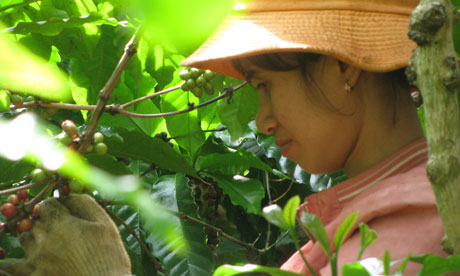
Ripe coffee cherries ready for picking on a Rainforest Alliance certified farm in Vietnam/Veronique Mistiaen

I recently went to the central highlands region of Vietnam to look at the terrible environmental cost the country is paying for its spectacular coffee growth over the past two decades. Now the country is trying to undo the damages and put itself on a more sustainable path.

Here is my story, published in the Guardian yesterday.
  

 A better future is percolating for Vietnam's coffee


 The spectacular growth of coffee in Vietnam came at a terrible environmental cost. Now conservation groups are working with food multinationals to ensure quality and sustainable production
MDG : Sustainable coffee in Vietnam
A coffee picker from the ethnic minority Edê. Photograph: Veronique Mistiaen
The velvety coffee slowly dripping from the filter into my glass is bitter and dark. But once mixed with the sweet, silky condensed milk at the bottom, it turns into a rich chocolaty brew. It is a fitting metaphor for the story of coffee in Vietnam.

French colonists introduced coffee here in 1857. The central highlands region – known as Buon Ma Thuot – proved a perfect area for growing robusta beans. But a century later, the Vietnam war devastated the country and coffee production was severely disrupted.

After the long war, the government, supported by development agencies, launched a vast coffee-growing programme in the region to help put the country on the road to recovery. Its success has been astonishing.

In just two decades, Vietnam went from the scorched earth of Agent Orange to become the second coffee exporter in the world after Brazil, and the number one for robusta – one of the two main coffee species, often used in instant coffee. (Arabica, the other main variety, is grown at a higher altitude and comprises about 75% of world production).

This spectacular comeback has been a huge boon to the economy – coffee is Vietnam's key export, generating an income of more than $1.5bn. In total, the coffee sector represents 3% of national GDP, providing a livelihood for around 2.6 million people – 600,000 of them farmers and many from minority ethnic groups. Only 5% to 7% of the total production is used for domestic consumption; the rest is exported, mostly to the US and Europe.

But the coffee miracle has come at a terrible cost. In the 1990s, when coffee price was high, entire forests were razed to make space for more coffee, grown as a monoculture with heavy use of agrochemicals and over-irrigation. While the acreage under coffee expanded rapidly, the development of training and processing infrastructure could not keep up.

The proliferation of poorly managed coffee farms (coffee in Vietnam is mostly grown on small family-run farms of two to five acres), where beans were cultivated with little regard for the environment, resulted in a glut of low quality beans that drove export prices down, contributing to the global collapse of coffee prices in the 2000s. It has also caused widespread pollution, soil and water degradation, habitat destruction and loss of biodiversity in one of the most biologically diverse countries in south-east Asia.

Coffee pickers with their harvest after a long day of work/Veronique Mistiaen

 Aside from the catastrophic impact on the environment and the quality of its beans, coffee in Vietnam is now facing new challenges, such as adaptation to climate change, a younger generation not wanting to be farmers and a global market changing from oversupply with record low prices to supply shortage with high prices (and as China and India are developing a taste for coffee, the demand is likely to skyrocket).

These issues are so critical that, for the first time, the government, farmers, traders and global food giants see the need to develop sustainable practices. They are working with social and conservation groups such as the Rainforest Alliance, the 4C Association and the Fairtrade Foundation to find ways to make coffee farming more productive, while reducing the cost on the environment.