Showing posts with label Syria. Show all posts

Tuesday, 15 October 2019

Symbols of Humanity: Syrian artist bridges times, religions


In our divided and polarised world, who, but artists, can conjure up the possibility of coexistence between cultures, ethnic groups and religions?

Born in 1966 in Aleppo, George Baylouni fled to France during the war.  And now his work builds bridges between the East and the West, and the past and the present.

Fascinated by the ancient civilisations of Mesopotamia, he studied their mysterious artefacts and texts, written in ancient cuneiform. He paints religious symbols and makes collages, adding gold leaf, his trademark, telling a tale of ancient worlds and of contemporary times. Uniquely, his paintings combine religions, with several pieces focusing on both Christianity and Islam in the same painting.

His work has been showcased prominently in the Middle East and Europe and he was named one of the 100 most important personalities in the Arab world in 2014 by Arabian Business Magazine.

”Symbols of Humanity”, Baylouni’s first exhibition in London, opens at the Stories Art Gallery in Mayfair on October 17 and runs until November 17. 

Baylouni's exhibition marks the first anniversary of Stories Art Gallery, which features renowned and upcoming artists from around the world, many from war-torn countries, and focuses on the stories behind their artwork.

If you have a chance, do see the exhibition and meet gallery director, the wonderful Manas Ghanem, who was born in Damascus, then educated in the West. Before opening her gallery, she worked as a lawyer in the Middle East and North Africa with UNHCR and Unicef.  


Thursday, 14 February 2019

Stories From Within – Syrian artists tell stories of survival, resilience


Human Bull I by Bassem Dahdouh/courtesy of Stories Art Gallery

When four internationally renowned Syrian artists were asked to contribute pieces showing what they wanted the West to see about their country, they selected artworks representing the untold stories of ordinary people who have endured and persevered through extraordinary circumstances.

Their work form  “Stories from Within”, a fascinating exhibition on display at Stories Art Gallery in London’s Mayfair until February 25. The gallery opened last October with the aim of promoting current Syrian artists whose work challenges their country’s one-dimensional image presented in the media. All the “Stories From Within” pieces were created in Syria over the past seven (almost eight) years and it is the first time since the war that they are exhibited in Europe.

 “We look for works that widen our vision and shift the image of Syria from refugees and needy victims to be pitied to one of humanity and respect – one with whom the viewers can have a connection,” says Manas Ghanem, the gallery’s director.  


 “Yes, there is war, destruction and darkness, but you cannot reduce Syria’s 7000 years of existence to seven years of war.  Syria is still alive,” adds Ghanem, who was born in Damascus, but educated in the West. Before opening her gallery, she worked as a lawyer in the Middle East and North Africa with UNHCR and Unicef.   


Bassem Dahdouh’s mixed media on canvas “humanoid bull” series depicts hybrid beings who are neither fully human nor beast.  The humanoid bull “portrays us, oppressed when reaching out for a breath of fresh air in an attempt to lead normal lives," he explains.  "It is my hope that we as humanity would succeed and plant some kindness and compassion in this land before it is too late."


Nizar Sabour’s work reflects the emotional impact of the war on the sacred Aramaic town of Maloula, where people still speak the dialect of the Christ and which was ravaged by jihadists linked to Al-Qaeda in 2013.  Never before had this ancient mountain town been harmed.  His five mixed media canvases represent various views of Maloula and the surrounding Qalamoun mountains, some surrounded by protecting lace, guardian angels and saints or official-looking stamps.


The works of the other artists in the exhibition - Edward Shahda and Asmaa Fayoumi - depict the anxiety of those left behind while waiting for the unknown, and finally also hope, love and compassion, which is what allows people to survive.

People don’t easily associate art and Syria, says Ghanem, but the Syrian art scene has been vivid since the 50s and the 60s, and many of the artists exhibited in the gallery are renowned in the world of contemporary art, including Sabour, Shahda, Dahdouh and Fayoumi, who have works in private collections and galleries from USA to Russia, as well as in Arabic countries like UAE, Kuwait and Lebanon.

“Yet for the past eight years, it’s as if that has just gone, and all that you hear about Syria is different. So we are trying to bring it back,” Ghanem says.

The gallery’s next projects include an Arabic calligraphy exhibition by the famous Syrian artist Mounier Al-Sharaani. They also hope to be able to bring artworks from Iraq, Yemen and other countries. 


Stories From Within at the Stories Art Gallery  until February 25. 
51/53    South    Audley    Street Mayfair London W1J 7DD

Wednesday, 4 May 2016

What drives young Syrians into ISIS?


Young Syrian refugees in Lebanon/Russell Watkins DFID


More than ideologies, it is poverty, desperation and desire for revenge that drive young Syrians into extremist groups.


A new study by the peacebuilding NGO International Alert shows that the key factors that push young Syrians into joining extremist groups are the need to earn a basic living, regain a sense of purpose and dignity, and the belief in a moral duty to protect, avenge and defend their people.


The study, titled Why young Syrians choose to fight: Vulnerability to recruitment by violent extremist groups, draws on interviews with 311 young Syrians, their families and community members in Syria, Lebanon and Turkey, to understand what drives both vulnerability and resilience to recruitment by the groups ISIS and Jabhat al-Nusra (Al Qaeda’s affiliate in Syria).


Adolescent boys and young men between the ages of 12 and 24 were found to be most at risk, along with children and young adults not in education, internally displaced persons (IDPs) and refugees without supportive family structures and networks.


The findings suggest that radicalisation is not an explanation for joining a violent extremist group per se. For many young Syrians, belief in extreme ideologies appears to be, at most, a secondary factor in the initial decision to join an extremist group. 


Instead, vulnerability is driven by a combination of extreme trauma, loss and displacement, lack of alternative ways to make a decent living, the collapse of social structures and institutions including education, and the desire to get revenge against the regime of President Bashar Al-Assad. According to respondents, armed groups also provide a strong sense of purpose, honour and self-worth.


As one young Syrian man in Lebanon said: “People can find a new meaning to their life in extremism. Extremism opens a door to a new life where they are wanted.”


In Syria more than 6,000 schools are out of use, having been attacked, occupied by the military or turned into an emergency shelter. The collapse of the education system, with some two million children out of school, has also greatly contributed to young people’s vulnerability to joining violent extremist groups, who are filling this gap by providing their own forms of education, the report says. These ‘schools’ are highly segregated, exploit sectarian divisions and support divisive narratives.


UNICEF, which today unveiled details of a major new fund (Education Cannot Wait) to help get children back in class during emergencies, also stresses the crucial role of education in countries affected by wars and disasters.  


"Education changes lives in emergencies," said Josephine Bourne, UNICEF's education chief, in a statement. "Going to school keeps children safe from abuses like trafficking and recruitment into armed groups."


Yet, only 2 percent of global humanitarian appeals are on average dedicated to education.  "It is time education is prioritised by the international community as an essential part of basic humanitarian response, alongside water, food and shelter," Bourne added.


Offering comprehensive, inclusive and quality education, which also incorporates trauma healing and psychosocial support, was one of the four key factors identified by the report that can prevent recruitment.  The others were: providing alternative sources of livelihood, better access to positive social groups and institutions, and avenues for exercising non-violent activism.


The report stresses the need to integrate these social cohesion efforts into humanitarian aid projects, regional policy objectives and diplomacy aiming to reduce discrimination against refugees, which can also drive recruitment.


Note: The study was conducted five years into the conflict in Syria, which has claimed an estimated 300,000 lives, displaced 6.5 million people internally and prompted 4.8 million people to flee to neighbouring countries. 

You can find out more about International Alert's work in Syria here.


Saturday, 20 June 2015

Another Day Lost - Mapping Syrian Refugee Camps


Another Day Lost: 1,579 days and counting.../Installation by Issam Kourbaj
        
 
If you live in London, make sure to see the haunting installations by my friend, Syrian-born, Cambridge-based artist Issam Kourbaj, evoking the plight of his fellow Syrians in refugee camps scattered all over Syria and neighbouring countries. The installations are part of London-wide festival, Shubbak: A Window on Contemporary Arab Culture, between 11th July and 26th July. 

Taking the title of a Fairouz song, these five installations by Kourbaj are inspired by and based upon refugee camps. Each installation is constructed from imagined camp waste products, such as educational material, books and medical packaging, and is encircled with a fence of 1,579 burnt matches. The matches, which increase in number over the course of the exhibition, count the irretrievable days since the Syrian uprising (15th March 2011).

Another Day Lost: 1,579 days and counting.../Installation by Issam Kourbaj

By repurposing discarded materials and extinguished matches, Kourbaj laments not only the loss of time, normality and everyday life for Syrians everywhere, but also the poor quality of life experienced by his compatriots in their displacement. The installations are scattered around central London, in a pattern that loosely relates to the diaspora of refugee camps that have arisen in the countries bordering Syria over the last four years.

" I am counting the days since the uprising; it is more than 1500 days and I am still counting. My homeland, 'the country formerly known as Syria'* is torn apart; its cities are turned to dust, millions of my fellow Syrian families, women and children are daily forced to flee this largest humanitarian crisis in the world.

Though life continues in refugee camps throughout the region, with the help of many generous organisations such as UNHCR and MSF and others, the displaced millions now bear a lasting trail of visible and invisible scars caused by the conflict, the separation from their homeland and the scars of permanent loss.
Over the last four years, I have witnessed from this painful distance the way these vulnerable human beings are waiting in makeshift shelters they call home, and I fear for their lives are on hold and many are becoming citizens of a tent. "

Kourbaj was born in Syria and studied art in Damascus and St Petersburg, before settling in the UK. He currently teaches at the University of Cambridge, where he is Lector at Christ's College. Since the 2011 revolution, Kourbaj has been making work based on the horrors of the war in Syria, raising awareness and money for projects and aid in Syria.

The catalogue of Another Day Lost is on sale at each location, with contributions by Nabil Almulhem, Paul Connerton, Tarek Fustok, Kevin Hart, Martin Johnson, Tim Knox, Issam Kourbaj, Louisa Macmillan, Polly Markandya, Bill Norris, Eva Schmitt, Eckhard Thiemann, Laurence Topham, Gonzalo Vargas Llosa and Lucy Winkett. Proceeds will go to MSF and UNHCR. You can also donate to these charities directly, as well as to preorder artworks to be made out of these installations after the exhibition finishes.


 *As described in The Economist, "Syria's civil war: The country formerly known as Syria" (23rd February, 2013).  


Another Day Lost: 1,579 days and counting.../Installation by Issam Kourbaj

Conversation with the artist St James's Church, Piccadilly Wednesday 22nd July 6:30–7:30pm Issam Kourbaj in conversation with curator Louisa Macmillan at St James's Church, Piccadilly (free, no booking required, donations most welcome)
St James's Day celebrations St James's Church, Piccadilly Sunday 26th Julyfrom 1pm Members of the public are invited to join in the deinstallation of one of the camps, with opportunity to buy some of the artworks, as part of the St James's Day celebrations at St James's Church

LOCATIONS
St James's Church
197 Piccadilly, London W1J 9LL Mon–Sat 9am–6pm. Sun 1–6pm
10 Golborne Road
10 Golborne Road, London W10 5PE Mon–Sun 10am–6pm
Goethe-Institut London
50 Princes Gate, Exhibition Road, SW7 2PH Mon–Fri 8:30am–7pm. Sat8:30am–5pm
Heath Street Baptist Church
84 Heath Street, London NW3 1DN Mon–Sun 10am–6pm
Central Books
99 Wallis Road, London E9 5LN Mon–Fri 9am–5pm. Sat 11th July 9am–5pm


-->Supported by: Goethe Institute, St James's Church Piccadilly, Heath Street Baptist Church, Central Books, Cambridge School of Visual & Performing Arts
 

Friday, 13 March 2015

Turn the Lights Back on in Syria: fourth year of conflict


This Sunday, March 15, marks the fourth anniversary of the start of the bloody conflict in Syria.  I wanted to share “Afraid of the Dark”, a short video reminding people that the conflict is still going on and showing one of its repercussions.


Since the start of the war,  83% of all the lights in Syria have literally gone out. Analysing satellite images, scientists based at Wuhan University in China, in co-operation with the #withSyria coalition of 130 non-governmental organisations, have shown that the number of lights visible over Syria at night has fallen by 83% since March 2011. In cities like Aleppo, the situation is even more extreme – satellite images show that 97 percent of lights have gone out since 2011.


The video makers - BAFTA-winning agency Don’t Panic and production partners UNIT9 – wanted to use this little-thought off repercussion of the conflict as a symbol of the darkness and chaos in which the country has been plunged already four years ago.  Over 200,000 people have died and millions more have been forced to flee their homes.

Four years since the start of the crisis, tell world leaders that they must stand by Syrians


"It is a literal truth that 83% of Syria's lights have gone out since the start of the war," said Richard Beer, Creative Director of Don't Panic, "but the darkness that afflicts them has a metaphorical truth that goes deeper. We wanted to use this shocking statistic to tell the story of just how far Syria has fallen into darkness, in every conceivable way, despite UN resolutions and international outcry. The hero of our film, Khalid, could afford to be afraid of the dark four years ago; now he faces far worse every day, despite his own bravery. He, and all Syrians like him, need our help."


Directed by UNIT9’s Greg&Jacob, this video is part of an international campaign launched by the #withSyria coalition. The coalition is a movement of humanitarian and human rights organisations from around the world, including Oxfam, Amnesty, International Rescue Committee, and the International Federation for Human Rights (FIDH), standing in solidarity with those caught in the conflict.


The #withSyria coalition launched this video alongside a global petition, calling on world leaders to ‘turn the lights back on in Syria’ by:

•           Prioritising a political solution with human rights at its heart;

•           Boosting the humanitarian response both for those inside Syria and refugees, including through increased resettlement;

•           Insisting that all parties put an end to attacks on civilians and stop blocking aid


A new report 'Failing Syria' released today by 21 humanitarian and human rights organisations accuses warring parties and powerful states of failing to achieve what three 2014 UN Security Council resolutions set out to do. 


Tuesday, 7 October 2014

Yezidi Refugees Living in Limbo in Turkey

Children at the Yezidi refugee camp in Batman, Turkey/Credit: Kimbal Bumstead
Refugees from Iraq's Yezidi (or Yazidi) religious minority, who have fled to Turkey from the advance of jihadists, are still living in harsh conditions in refugee camps.  And many fear they will never be able to return home. 

The Yezidi refugees have fled to the southeastern Turkish province of Sirnak bordering Iraq to escape the murderous advance of Islamic State (IS) jihadists who specifically target their community.

Turkey, which is already giving sanctuary to some 1.2 million fleeing the Syria conflict, is not coping with this additional refugee influx.


Kimbal Bumstead, a young British-Dutch artist, has spent some time in the Yezidi refugee camp of Batman. Here is his report: 

Five minutes walk from “Batman Park”, a monster of a shopping mall, complete with lights that change colour, glass elevators and chocolate fondue fountains, is a disused football ground building that houses over 500 Yezidi refugees who have fled from Sinjar, Northern Iraq. They have been living there for over a month now, with three families to a room, after ISIS militia came to their village massacring those who refused to convert to Islam.

The Yezidi people are a Kurdish tribe who follow an ancient Mesopotamian pagan religion in which they worship the sun, and have a spiritual connection with the land.

Credit: Kimbal Bumpstead


I was lucky to meet two men there who spoke English, having been interpreters to the US Army during military campaigns in Iraq during 2007/2008. They told me some horrific stories about their families and friends who had been killed, women raped and sold into sexual slavery. On the 3rd August, ISIS militia came to their village and took 80 men out into the street, and told them they must convert to Islam or they will be killed. Those who refused were shot; those who accepted were also shot. 

According to local news sources there are now over 30,000 Yezidi refugees in Turkey, having fled their villages on foot, it is estimated that there are over 1 million refugees in Turkey now since the start of ISIS attacks in Syria and Iraq.

A place in-between, a life in limbo

The disused sports hall housing the refugees is a place in-between, a place of not knowing, and hopes that may be shattered. There is not enough room inside the building or enough blankets for everyone to sleep. Many of the men are sleeping outside. The winter is coming and the people I spoke to have received no information about where they can go or when.

They have not been granted asylum in Turkey and neither do they want that. All of them have the same dream: to move to a place that is safe, in either Europe or America. They want permanent solutions and asylum, but for now they are in limbo, not having the tools or the means to be able to apply for it. Without having money to travel to an embassy, nor documents, they are reliant on officials to come to them. They are becoming increasing frustrated, and none of them know how long they will have to wait.

The majority of them are undocumented, having left their homes with just the clothes they were wearing, many of them had never had the need for a passport before. Turkey has granted them temporary shelter in its territory, but not political asylum.  

“We want to go to Europe or America”, says Saado, one of the former US interpreters, “we can’t go back to Iraq, it’s not safe, they will kill us, but we can’t stay in Turkey either. Maybe they will make us stay here for one or two years but then what?”

Another man, a Kurdish Yezidi who lives in Batman and has taken it on himself to organise the camp, tells me:  “The Turkish government say they are helping, but they are not doing anything to help us. The only help we are getting is from the local Kurdish community, they give us food and water and have helped with giving us blankets to sleep on, but we need help from governments. People see us but they are blind to us, we need help… Even the animals have rights, if they can’t give us human rights, at least give us animal rights.”

Credit: Kimbal Bumpstead

 "74th recorded genocide of Yezidian peope"

Turkey is a comfortable buffer zone for ‘Fortress Europe’, literally a space in-between, to help delay responses in helping to take in refugees. For how long these people will have to wait, for politicians to make decisions about their futures, they do not know.

The message from the refugees is clear, that they do not want to stay in Turkey, they are afraid of the possible future reprisals of Islamic fundamentalism and possible attacks here. I asked a boy what he thought about the future.  He said that he couldn’t event think about the future, everything was gone. He just wants to be able to go back to school and feel safe. I asked if he felt safe here. “No”, he said, “I am afraid that those people will come here too”.

Saado expands, saying that if Turkey really wanted to help then they would help by attacking ISIS, not by supplying them with weapons and supporting their actions.

Meanwhile, out on the streets of Batman, police in armoured tanks are firing tear gas at a group of protestors angry about the Turkish Government’s lack of support to Kurdish Guerillas who are fighting ISIS in the Syrian/Turkish border village of Kobane.

This is the 74th recorded genocide of Yezidian people in history, as Saado tells me.  “This happens to our people every 100 years or so. The past 100 years alone has many cases of Yezidians being persecuted both in Iraq and Syria ,but also within Turkey. Turkey used to be home to a large proportion of the Yezidian population, but following the Ottoman led genocide during the years 1915-18, in which around 300,000 Yezidians were killed, plus further attacks after the creation of the Turkish state, most Yezidians fled to neighbouring countries. Stories are passed down through generations and their fears and lack of trust in the Turkish state is heavily apparent. Those I spoke to, made it clear that this is a religious problem, not a political one. ISIS wants to kill them because they believe they are devil worshipers, and the Turkish state does not officially recognise Yezidism as a religion. Interestingly, Turkey is classified by the United Nations as a ‘secular state’, however it only recognises three minority religions; Greek Orthodox Christians, Armenian Orthodox Christians, and Jews. Those Yezidians, and those of other minority religions such as Syrian Christian, Chaldean and Bulgarian Orthodox who live in Turkey are classified as either atheists or as Muslim.

“It’s chosen by god, (this genocide),” the other interpreter tells me. I ask why he thinks god would want that.  “I don’t know”, he says, “maybe this is not our place, maybe this is our destiny.” There is a sense of bad ‘kader’ (destiny)  amongst Yezidians, which I imagine many Kurdish people also can relate to. Having a shared history of being persecuted by the states that encompass them. These are placeless people, and now they do not even have a home.

Are you hopeful that something will change I ask? “Yes we hope,” he says, and looked down at the ground. “but until now we did not hear anything…. Maybe we are hopeless….” He smiles, and looks out into the yard.

In the yard, under a blanket propped by a stack of chairs, a group of children watch a TV. On the screen are images of American jets. They are excited, people welcome the latest bombings, but it’s not enough, “they are just putting on a show”, another man told me. “They are just securing their oil once again, rather than actually doing something to help the people”.

Credit: Kimbal Bumstead

Thursday, 26 June 2014

Unearthed exhibition - Syrian Artist Responds to Conflict in his Homeland

2014-06-25-IMG_9877.jpg
Unearthed (in Memoriam), 2014, repurposed book covers/credit: Emma K Freeman

I love artist studios with their works in progress scattered all over, tools and material everywhere, the smell of paint and that special light, so I was delighted when Issam Kourbaj invited me to visit his studio in Cambrige.  Koubaj is a Syrian artist living in the UK, currently working on Unearthed, a exhibition inspited by the conflict in Syria.  I spent an afternoon in his attic studio and another at the P21 Gallery in London where Unearthed opens on July 4 and runs until August 16. I watched as he put the final touch to his pieces and listened to the processes and stories behind them. Each piece is his reflection on the conflict in Syria, but also carries fragments from his childhood in Swaida, a small village built from black volcanic stone in the mountains south of Damascus. 
Kourbaj is a wonderful storyteller, so I wish I could tell his stories here. Instead, I wrote this article about the exhibition. You can also read it on the Huffington Post's website.
Unearthed - Syrian artist responds to the was in his homeland

Over the last three years, Issam Kourbaj, a Syrian artist living in the UK, has been watching from a painful distance the war eviscerating his homeland: its people, its cities and villages, its past and present, and its memory. 

He brings the images of death, destruction and displacement reported by the media to his studio in Cambridge. There, in his attic rooms crammed with all matter of reclaimed objects, he tries to digest, respond and translate the war images into subtle forms "with meaning rather than anger. 

"My work is a quiet gesture, an archive to remember those who have been forgotten, and an invitation to ponder what the future might bring to what's left of my people and of my country," he says.

The result is Unearthed - a mesmerizing and haunting body of work in multimedia: his response to the Syrian conflict, as well as fragments from his childhood in a small village in the Druze mountains south of Damascus. The exhibition opens at the P21 Gallery in London on 4th July and runs until 16th August. 

Kourbaj was born in Syria and studied art, theatre design and architecture in Damascus, St. Petersburg and London. Since 1990, he has lived in Cambridge where he is artist-in-residence at Christ's College and teaches at the university. His work has been widely exhibited and is held in numerous private and public collections, including that of the British Museum.

For this exhibition, he has worked with a wide variety of media, from drawings on paper and photographic and optical work, to large-scale installations made for and assembled in the gallery itself. The exhibition is arranged as a journey, where pieces echo one another and create a multi-layered experience.
2014-06-25-IMG_9521.jpg
Damascus I, 2013, ink, collage and cut-out paper/credit: Emma K Freeman


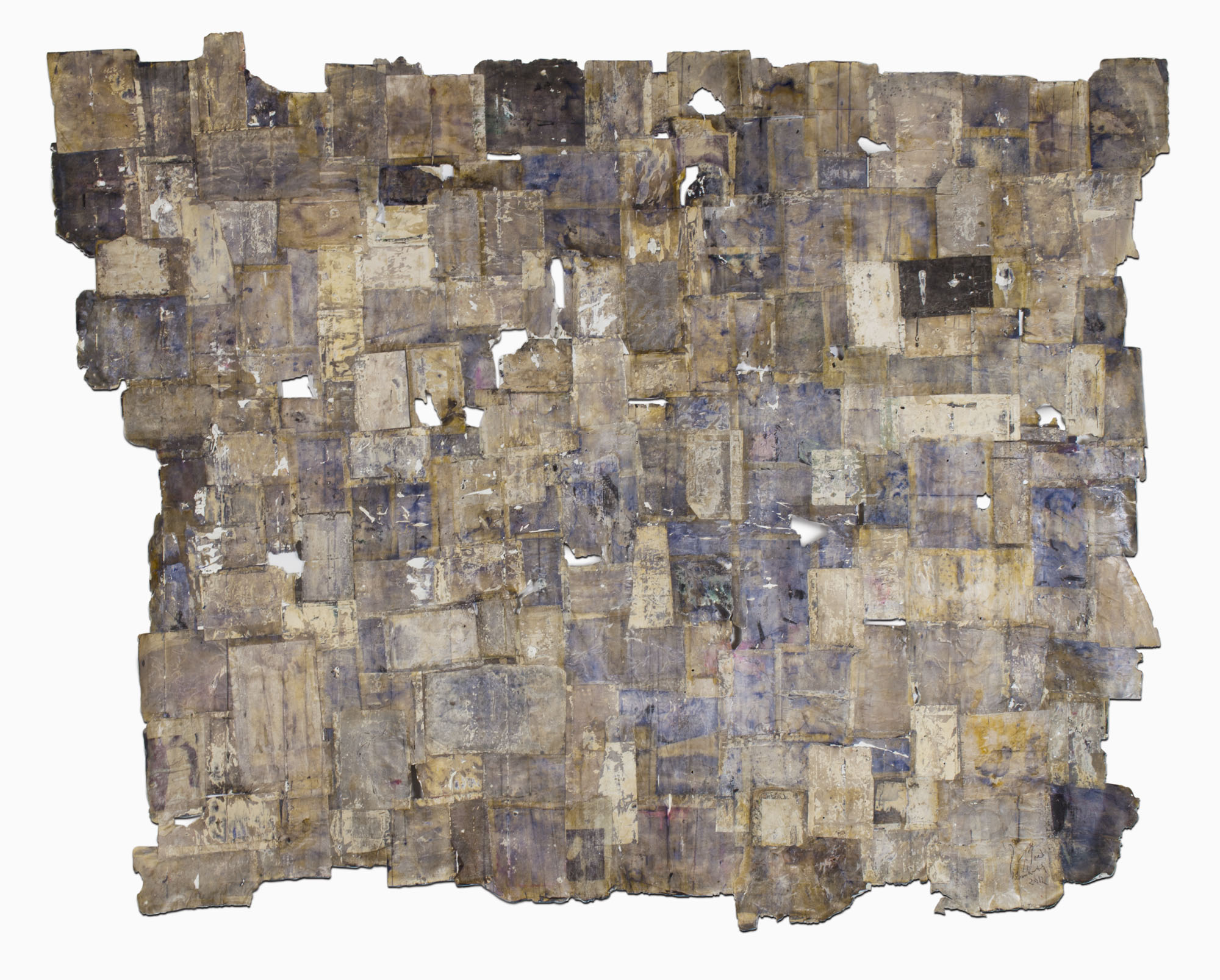
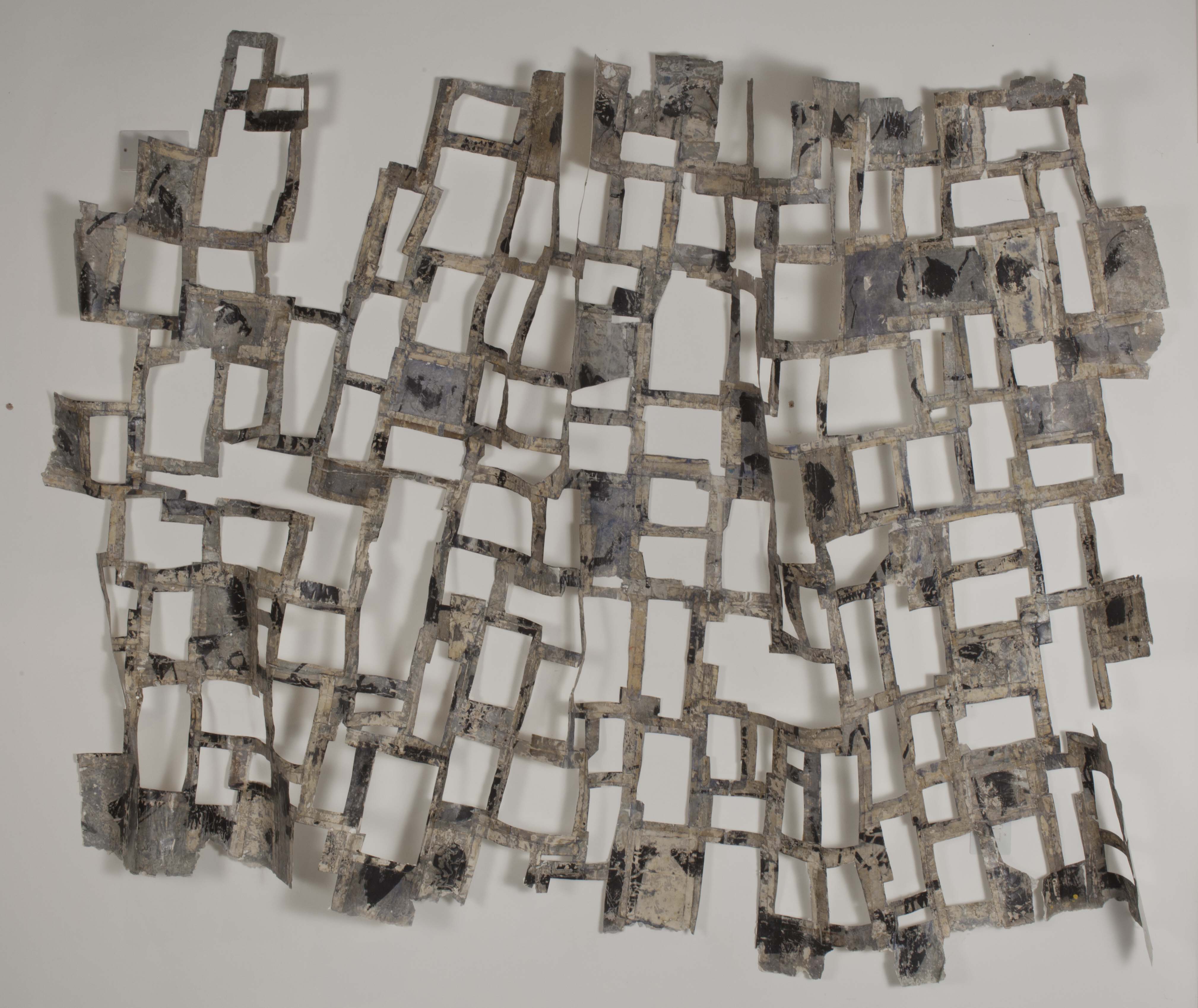
For example, the exhibition opens with Damascus I, a piece based on an aerial map of the old city. Assembled from loose pages from reclaimed books, inked and sanded, it looks like an ancient wall or perhaps mummified skin. "It is the entire city - its many layers, its history." At end of the exhibition, we see Damascus II. It has a sculptural feel to it. It is the buckled, distorted version of Damascus I - a fragile, skeletal city - a city being destroyed by war.

2014-06-25-IMG_9531.JPG
Damascus II, 2013, ink, collage and cut-out paper/credit: Emma K Freeman


Most of Kourbaj's work is created from "excavated" objects - discarded poster fragments, X-rays plates obtained from a local hospital, sales records from a furniture shop, broken chairs and book covers found in a bookbinder' skip behind his studio. 

The 7-meter long Border, the other side of sky is the reverse side of a huge torn piece of billboard collected from a nearby skip. It looks like the rusty wing of an airplane. Scattered underneath, as if falling from the other side, are tiny pieces of colourful paper like little flecks of hope. "They represent all the people who are trying to cross the border, going to the other side of the sky. They don't know where they are going or whether they are going to make it."

2014-06-25-IMG_0627.jpg
Counting, Alphabetising, 2014, paper, fabric and leather fragments; insect pins/credit: Emma K Freeman

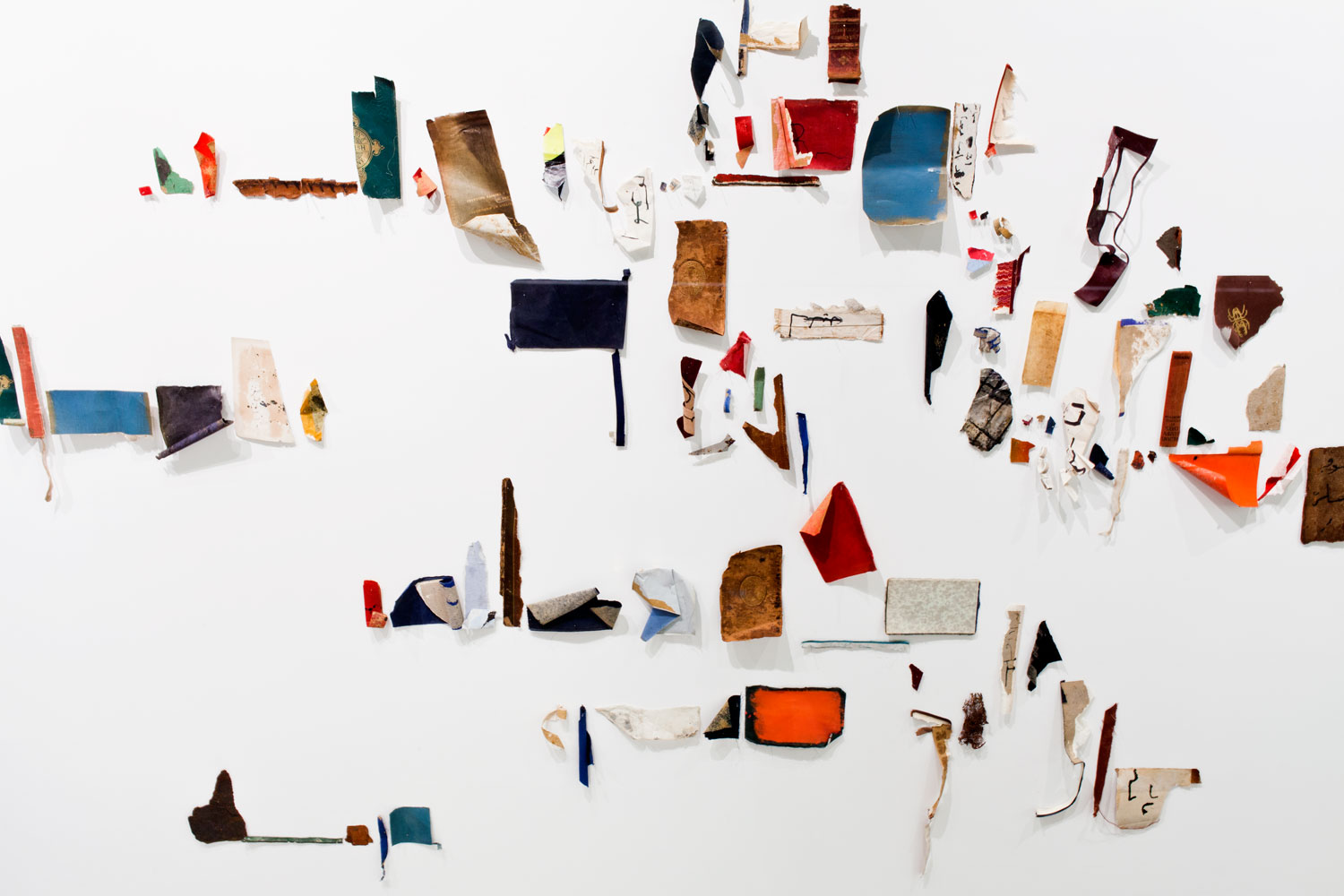
Counting and Alphabetising is a moving, 17-meter-long piece about loss. Small, colourful pieces torn from cardboard, fabric and leather book covers ("but they could be pieces of flesh or clothes") are pinned on the wall like butterflies in an immense entomological display. There are tiny ones arranged in neat rows and larger ones more randomly displayed. "They are a sort of archiving of what remains, of the fragility of life." 
 
Part of the same display, After Image was inspired by his mother. "I taught her to read and write. She was almost making drawings instead of writing. I wanted to connect with her and the struggle to make oneself heard or seen." In order to do this, Kourbaj formed his large letters upside down and with his left hand. 


2014-06-26-P21Unearthed.jpg
Unhearted (in Memoriam), 2014, repurposed book covers/courtesy of P21


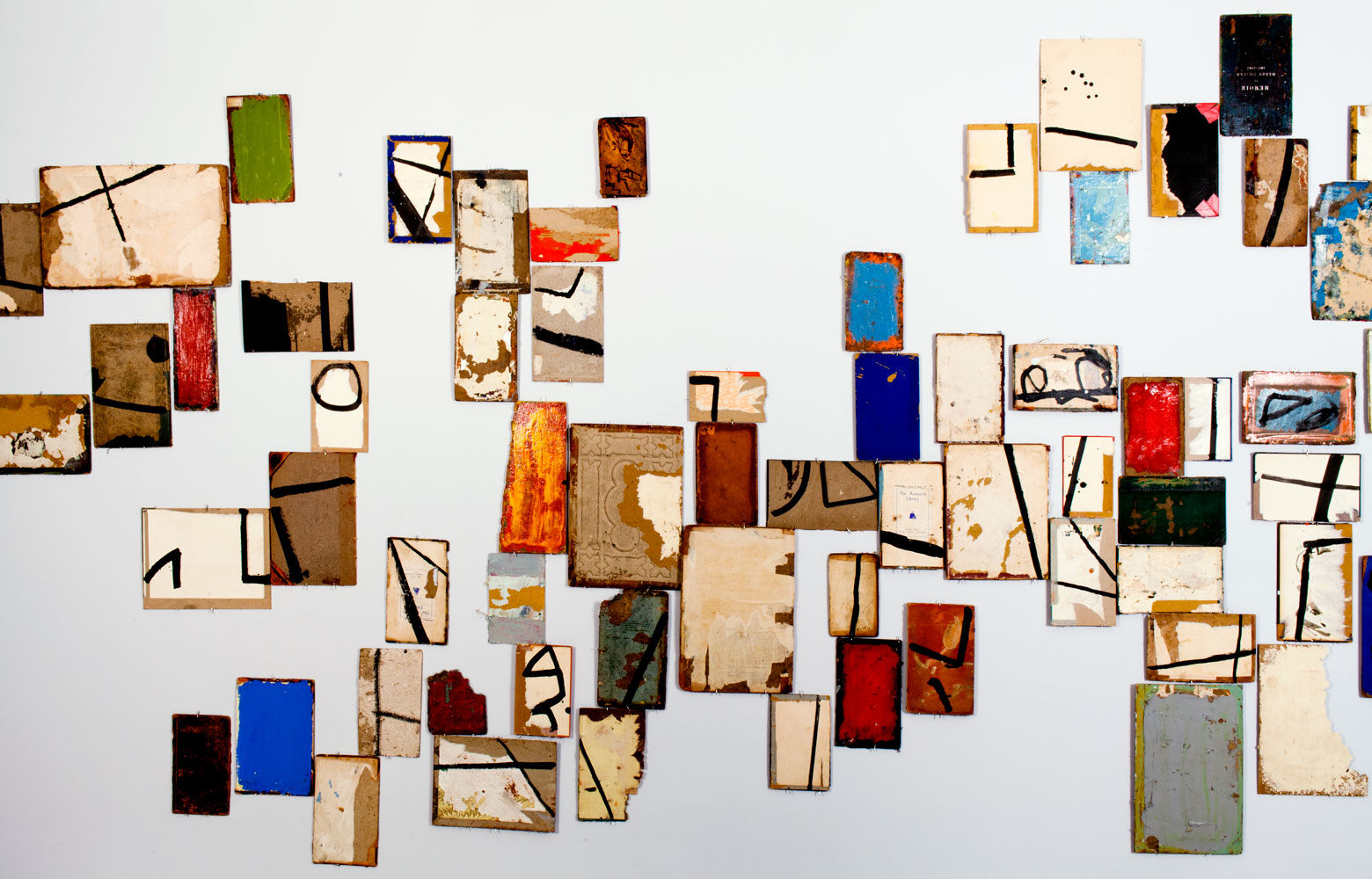
For Unearthed (in Memoriam), the artist covered 18 meters of wall with mounted discarded hardback book covers. Some are painted with bright colours and some are plain, but most have a black line painted across them, reminiscent of the traditional black ribbons used to indicate mourning in many countries. The sheer number of them - "all these lost, redundant books of which only the cover remains" - is a poignant reminder of the growing number of lost lives in Syria. 
 
2014-06-25-Scan21.jpeg
171 weeks and ongoing..., 2011 onwards, ink on paper//credit: Emma K Freeman


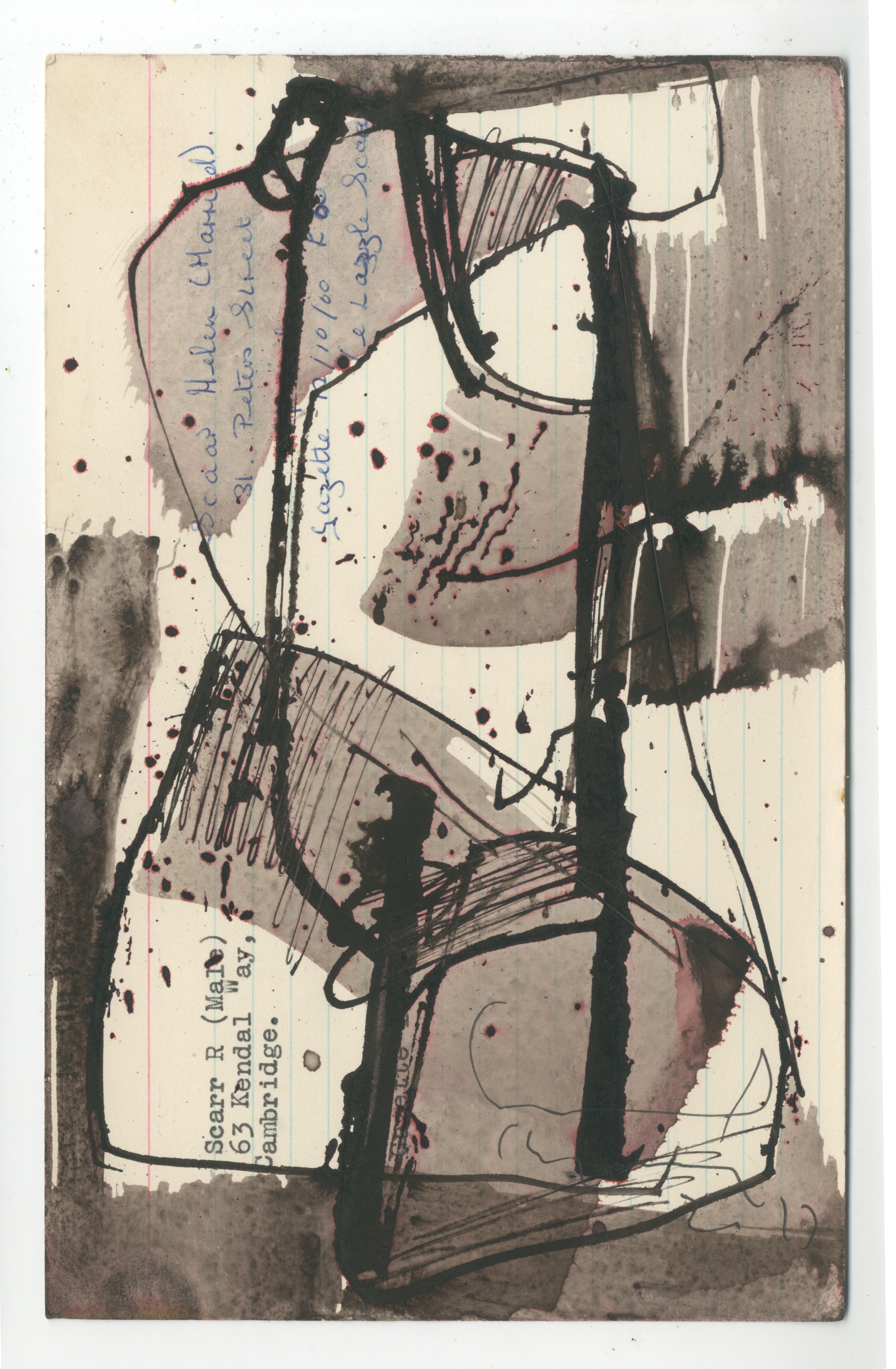
One of the exhibition's last works, 171 weeks and ongoing..., is a diary of the war. Kourbaj started making abstract ink marks on cards (old record sales from a furniture store) during the first week of the conflict and keeps adding a new one every week. "They are inspired by the news, but I re-digest them. The images of the war from the media are too much to take. I needed to filter them."

The P21 Gallery is a London-based non-profit organisation promoting contemporary Middle Eastern and Arab art and culture. Proceeds from the exhibition will be donated to Médecins sans Frontières who are working in Syria.

Exhibition dates: 4th July - 16th August, 2014
Readings by Ruth Padel and Hisham Matar: 16th JulyArtist's talk with Venetia Porter: 23rd JulyCurators' talk with Bibiana Macedo and Louisa Macmillan: 30th July