Showing posts with label environment. Show all posts

Tuesday, 1 March 2022

Where the Sun is Used to Freeze


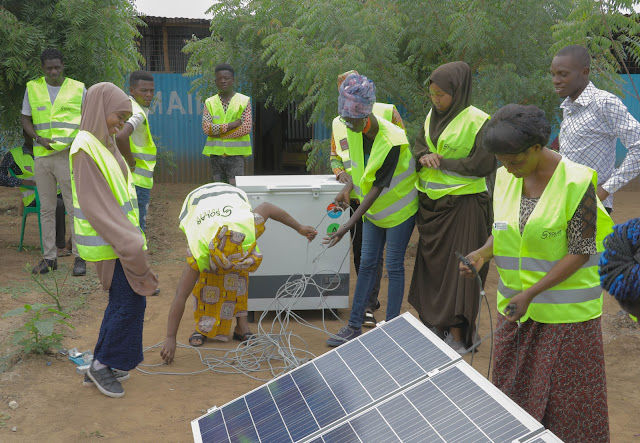
Skills training by Solar Freeze for Kakuma youths/credit: Ashden


With temperatures soaring across most of Africa due to climate change, preserving agricultural produces, medicines and other perishables is increasingly challenging. In eastern Kenya, a group of young people from smallholder families have created a pay-as-you-store solar cooling service, benefiting small-scale farmers, as well as health clinics and small businesses in Kakuma refugee camp, the oldest refugee camp in East Africa.

“Like many people our age, we watched our parents and grandparents work tirelessly, toiling in rural farms, only for a huge chunk of their fresh produce to rot away due to lack of proper cold storage units,” says Dysmus Kisilu, 27. “Often times, middle men would quickly swoop in and offer dirt cheap prices, and farmers would be forced to sell for a song out of fear of post-harvest loss,” says Kisilu.

Kisilu and many of his friends sought a better life in the city, but in 2016, some of them pulled their skills together to create Solar Freeze, a social enterprise harnessing solar power to offer off-grid small-scale farmers portable and affordable cold storage units in which to preserve their fresh fruits and vegetables.

“The growing seasons are now erratic and produce goes to waste because it cannot be stored. Whole communities are being destroyed as climate is changing. I knew I had to do something.”

Two years later, after meeting refugees in the huge Kakuma camp, Kisilu decided to expand into the humanitarian context. Kakuma, located in Turkana County, one of the poorest counties in Kenya, is home to 160,000 refugees from South Sudan, Sudan, Somalia, the Democratic Republic of the Congo, Burundi, Ethiopia, and Uganda. The camp has no access to energy from the national grid. Only 20% of its clinics have electricity and it is produced by polluting diesel generators, which operate only during specific times. Solar Freeze allows Kakuma’s clinics to store their medical products and vaccines, such as Covid, yellow fever, measles and rabies. The company has since diversified to include cold storage to food and drink shops, fishing and other businesses and households in the camp — a much needed service in the heat of the camp, and particularly as global warming increases.

Options for customers include buying cooling units on a lease-to-own basis or renting space in them on a pay-per-crate basis. This helps even worse-off individuals access cooling, as there is no upfront cost and the fees are low.

Solar Freeze team also launched an ‘Each One Teach One’ programme to train youth from agricultural families, especially women, to install, operate and maintain their units. The initiative was expanded to Kakuma and now also includes operation and maintenance of other solar products like solar-powered irrigation equipment, and sales.

“The education was super — it was not discriminatory to me by saying that I could not do it as a woman,” says Sakina Kariba, a refugee in the camp from the Democratic Republic of Congo. She was trained as a solar panel installer and now works freelance installing throughout the camp. “I am happy that even if I leave the camp today and I decide to go to back to Congo or another part of Kenya, I now have a skill that I can use.”

So far, Solar Freeze is working with 3000 smallholder farmers — reducing waste of fresh produce by 95% — and has 180 cold solar units in Kakuma.

Solar Freeze’s model is replicable to combat harvest loss and provide clean energy to off-grid small-scale farmers and vulnerable populations in sub-Saharan Africa. About 470 million smallholder farmers in developing countries lose an average of 35% of their income to food spoilage. The company plans to expand its work into other refugee camps, and to nearby nations including Rwanda and Uganda.

Last year, it has won the prestigious Ashden Awards in the Humanitarian Energy category. The Awards highlight some of the world’s most impressive climate pioneers and innovators and help them power up their impact.

The climate solutions charity is now calling for entries from similar climate innovators for their 2022 Awards. The application deadline is 15 March.


Wednesday, 23 September 2020

Run for Rangers – Rangers across Africa unite to protect wildlife from Covid-19 impact

Leruati Morijo, a ranger at a remote outpost on Lewa Wildlife Conservancy in Kenya, cares for a baby rhino. Credit: Martin Buzora, Wildlife Ranger Challenge  


Covid-19 has devastated African wildlife tourism with calamitous impacts on the animals and the people who have dedicated their lives protecting them. In response, rangers across Africa are taking part of a challenge to raise money to bring thousands of their colleagues back to the field. And you can help too.


Next week, on 3rd October, up to 50 ranger teams spanning the African continent will compete in the Wildlife Ranger Challenge, a half marathon race carrying their 25kg backpack containing a typical day’s equipment - along the way, building friendship and raising awareness of the hardship currently faced by those in their profession. 


Supporters around the world are encouraged to bolster their efforts and to ‘Run with Rangers’ by taking part in a virtual 5, 10 or 21km run and donating funds or raising sponsorship.


Support is coming from the world’s greatest long distance runner, Eliud Kipchoge from Kenya, adventurers and TV personalities Bear Grylls and Levison Wood, as well as the Duke of Cambridge, Tusk’s Patron, along with many other people internationally.


In 2018, the global wildlife tourism economy generated over $100bn and provided 9 million jobs, worldwide, but Covid-19 has resulted in an almost complete end to cross-border travel.  The African Union has suggested that the cost of the pandemic on the African travel sector may be $50 billion. 


The Game Ranger Association of Africa estimates that there are between 40,000 and 50,000 rangers across the continent and that the vast majority of them have either been furloughed or had their salary reduced by 50% to 80% - leaving families destitute and wildlife vulnerable and unprotected.


With remaining rangers stretched to capacity and international and national borders re-opening, it is feared that protected areas across Africa will experience a rapid increase in illegal poaching, as well as a decline in wellbeing and economic security for the communities to whom this wildlife belongs.  This threatens to undo years of rangers’ conservation gains, compromising decades of development and conservation work across Africa.


Funds raised through the Wildlife Ranger Challenge will cover salaries for at least 5,000 rangers, enabling them to provide for their families, protect communities and defend endangered wildlife -including elephant, pangolin, rhino and lion - in some of the continent’s most vulnerable areas.


“I have spent my entire career working for Malawi’s people and wildlife. I have worked with and alongside wildlife rangers, and even as one myself, and I know they are the lifeblood of the conservation sector in Africa,” says Brighton Kumchedwa, Director, Department of National Parks and Wildlife, Malawi.


“I have seen us move from a period of plenty in terms of wildlife to a period of huge losses. We must support rangers to work every day to ensure that our wildlife [is] not lost. The wildlife crisis we are facing is terrifying, but by supporting rangers we are in a position to make a difference, before it is too late. That’s what I remind myself every day.” 


Friday, 23 August 2019

Extinction Rebellion Art and Design at the V&A


Extinction Rebellion posters. Photo credit: Chris J Ratcliffe Getty Images


Protest movements have always used art to carry and amplify their messages. The Climate and Ecological emergency is THE issue of our time, and the Extinction Rebellion (XR) movement is skillfully using art and design to galvanise public concern for the planet with maximum impact. Their flags, banners and flyers in punchy colours with carefully worded slogans and woodblock prints are now immediately recognisable across the globe.

Extinction Rebellion, as many might already know, is a global activist group calling for urgent action on climate change through acts of non-violent civil disobedience and disruption. Since its first public action on 31 October 2018, urging the UK government to declare a climate and ecological emergency and commit to reduce emissions to net zero by 2025, XR has grown into an international movement with over 363 groups active in 59 countries around the world.

XR’s graphics balance joy and menace with a bold, tongue-in-cheek approach, and are characterised by four core design elements. These include the use of the Extinction Symbol, the XR logotype, a colour-palette of 12 playful tones including ‘Lemon’ yellow and ‘Angry’ pink influenced by pop artist Eduardo Paolozzi, and the fonts ‘FUCXED’ and ‘Crimson’. Often juxtaposing imagery of the natural world with more sinister images of skulls and bones, XR’s urgent visuals articulate hope, while outlining the grave consequences the group feels failure to act will bring. 

Recognizing the importance of the movement and the value of its unique designs, the London V&A has acquired a series of objects exploring the design identity of Extinction Rebellion.

The pieces produced by the Extinction Rebellion Arts Group, a coalition of graphic designers, artists and activists responsible for XR’s Design Programme, range from the open-source Extinction Symbol created by street artist ESP in 2011 and adopted by XR in 2018, to the Declaration that accompanied their first act of Rebellion, and flags carried during mass demonstrations. They are on display in the V&A’s Rapid Response Collecting Gallery (gallery 74a).

The objects have been acquired through the V&A’s Rapid Response Collecting, an innovative programme that enables the acquisition and immediate display of design objects that address questions of social, political, technological and economic change.

“Design has been key to Extinction Rebellion’s demands for urgent action on climate change. The strong graphic impact of the Extinction Symbol alongside a clear set of design principles have ensured that their acts of rebellion are immediately recognisable,” says Corinna Gardner, Senior Curator of Design and Digital at the V&A.

“Extinction Rebellion have galvanised public concern for the planet, and their design approach stands in relation to earlier protest movements such as the Suffragettes who encouraged the wearing of purple, green and white to visually communicate their cause.”

Friday, 30 November 2018

Outdoor Education - Bringing back nature into our children's lives


Children at Into the Woods nursery and Ark Franklin Primary Academy/Credit: Caroline Irby


“Nature breeds curiosity; it helps grow explorers rather than robots.” Ben Palmer-Fry, outdoor learning teacher, Ark Franklin Primary Academy.

Children in the UK spend less time outside than high-security prisoners, according to a recent report While their grandparents roamed unsupervised outdoors, our children spend their days cooped up inside, glued to a screen.  We have displaced nature from their lives: selling off their outdoors spaces, feeding them technology, keeping them inside with our fears and lack of time.  

A few years ago, the National Trust published a report on the phenomenon of "nature deficit disorder", a term coined in 2005 by the American author Richard Louv, who argued that the human cost of "alienation from nature" was measured in "diminished use of the senses, attention difficulties and higher rates of physical and emotional illnesses".  

Nature deficit disorder is not generally regarded as a medical condition. Yet, in the UK as in many other countries, rates of obesity, self-harm and mental health disorders diagnosed in children have climbed significantly since the 1970s.  

What if we could ‘rewild’ their childhood - bring back nature into their lives?  Could it produce healthier and happier young people?

Many people believe so, and a growing number of schools across the country (and elsewhere) are trying to do just that: they are re-introducing nature into children’s lives.  It is seen as a new trend, but the UK has a rich heritage of outdoor learning going back at least to the 19th century with Wordsworth, Ruskin, Baden and many others.

Some schools are following the Forest School philosophy, drawing on the Scandinavian model of Nature Kindergartens, while others are developing their own outdoor learning organically, adapting it into their curriculum.  Many community programmes, projects and social enterprises are also trying to reconnect young people with nature.

And the results are amazing. A solid body of research show the significant health, social and emotional benefits of outdoor learning. Forest School teachers say their children are healthier, more independent, confident, creative, socially minded and caring for the environment than other children. Yet, outdoor learning is likely to remain on the margins of education until the benefits are  recognised by policymakers and reflected in policies.

Photographer Caroline Irby and I have visited two London schools, which represent two different approaches to outdoor learning.  Into the Woods, a nursery where children spend their entire days in the woods, rain or shine, and Ark Franklin Primary Academy, which has transformed a piece of urban derelict land into a green oasis with a storytelling grove, a bug hotel, a vegetable garden and more.  The outdoors lessons include sciences, literacy and maths, but also “weaving and knot-tying and everything we think will be useful,” says headteacher Janine Ryan.

“Education is increasingly dominated by academic targets and a narrow curriculum,” says Emma Shaw, founder and manager of Into the Woods, London’s first Forest School nursery.  “The concept of play is lost along the way. ‘Let’s do the Maths earlier’: everything is measured. We all live our lives on screen all the time…  Here, the children can be themselves. They have space and time to explore, learn and do their own things.”  

You can read our story “Learning Outdoors: Growing Explorers, not Robots”  published in Positive News.


Friday, 17 August 2018

Claire Nouvian: Guardian of the Deep


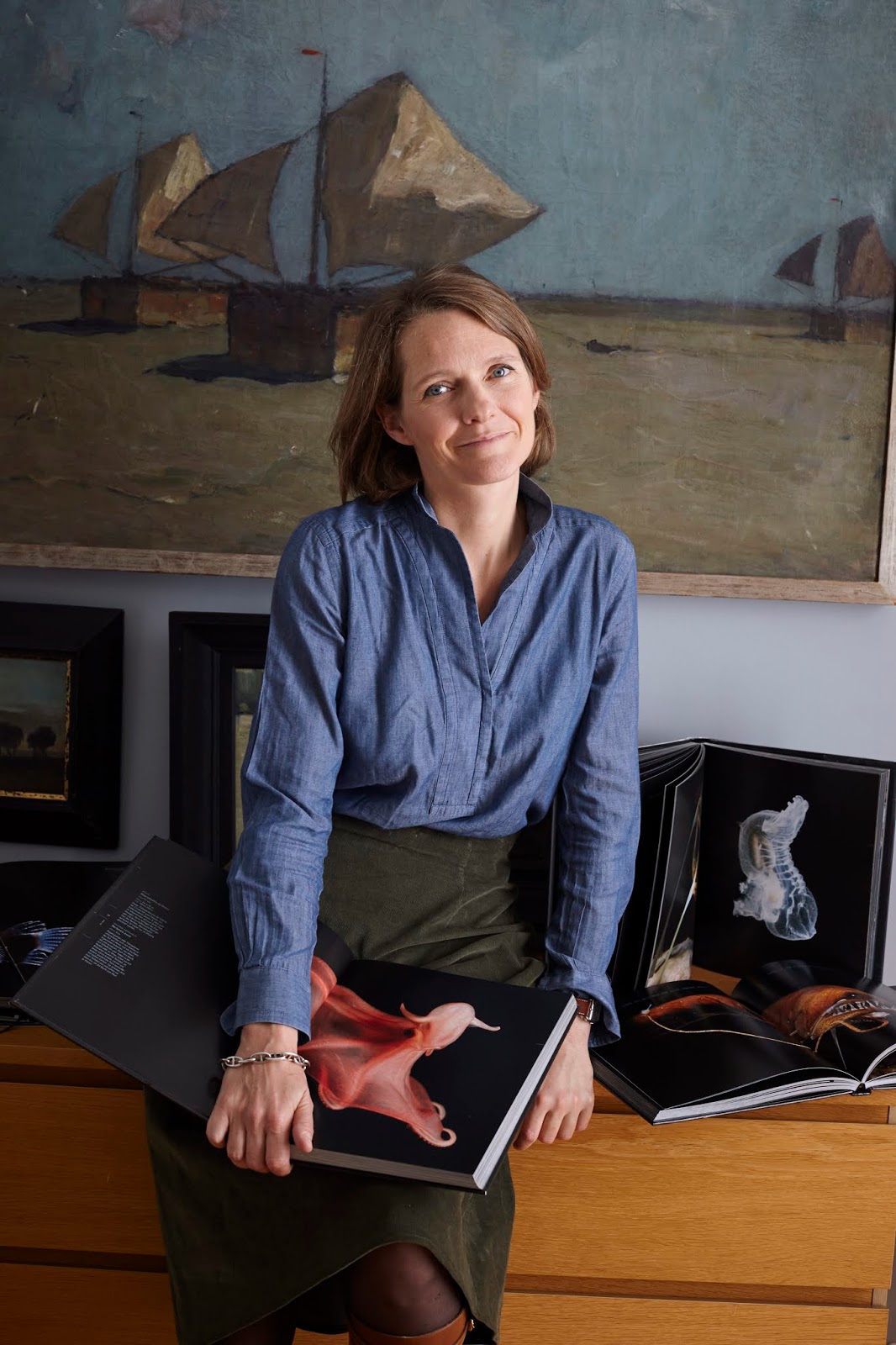
Claire Nouvian with her book: The Deep: The Extraordinary Creatures of the Abyss/Courtesy of Goldman Environmental Prize


This is a story I wrote for New Internationalist on how an encounter with strange creatures of the abyss tuned a French filmmaker into a passionate guardian of the deep and an untiring campaigner. Against all odds, Claire Nouvian managed to convince France to ban deep-sea bottom trawling, a devastating fishing method, which annihilates everything in its path.  In 2016, the entire EU banned the practice. This was an amazing victory for Nouvian and her small environmental NGO Bloom. 

She had hoped to catch her breath after the long campaign, but then another destructive fishing practice caught her attention: electric ‘pulse’ fishing. “It’s the same story, but with a different destructive practice...”

Here is the story of her fight:

A glimpse into an unknown world alive with mysterious and strange creatures turned Claire Nouvian into a formidable defender of the deep sea – one who survives on little sleep - armed with passion, hard facts and a steely determination.

In 2001, Nouvian, 44, a French wildlife filmmaker and journalist, who grew up in Algiers, Paris and Hong Kong and speaks six languages, was filming a documentary at the Monterey Bay Aquarium in California. “I discovered deep sea creatures – extraordinary creatures I couldn’t have imagined, like giant jellies, dragonfish and vampire squid,” says Nouvian, who has recently won the 2018 Goldman Environmental Prize for ending deep-sea bottom trawling in Europe. 

 The deep ocean is the largest habitat on earth and home to some of the oldest living creatures on the planet, such as 4000-year old corals. But this huge diversity is being destroyed by deep-sea bottom trawlers – boats, which tow a heavily-weighted net that is dragged multiple times over the seafloor. “It is one of the most destructive forms of fishing, which annihilates everything in its path. The fishing industry practices a boom and bust model: they go somewhere new and take everything there, then move on to the next fish stock. It’s serial depletion. They are roving bandits,” says Nouvian, still visibly upset.

Determined to challenge this, Nouvian founded the NGO Bloom in 2005. “I was naïve. I thought that if we could tell the world that the deep sea is full of life and is being destroyed, it would stop.” So she put together a book and an exhibition describing the wonders and fragility of the deep sea. Both received a lot of media attention, but it was not enough.  “I understood the need to take it to a political level.”

In 2008, as the EU was preparing reforms of its deep-sea fishing laws, the young activist saw her chance to influence policy at both the French and EU levels. In Europe, the main deep-sea fleet was French and belonged to supermarket chain Intermarché.  “A EU campaign could only succeed if we could change the French position. But in France, fishermen were heroes and the public didn’t care about protecting the ocean. So Nouvian and her Bloom colleagues launched a sustained campaign, addressing the issue from all fronts. They worked with scientists to publish fact-based reports and launched a public consumer campaign that ranked French supermarkets according to their fishing practices - Intermarché came last. This was followed by a media blitz, with giant anti-trawling posters in front of Paris’ gare du Nord (from where politicians boarded trains to Brussels), newspapers ads, press statements and social media drives. They also visited schools, organised demonstrations, and collected 900,000 signatures for an anti-trawling petition, with the help of a brilliant cartoon based on Nouvian’s TEDx talk, which went viral.

The relentless campaigning paid off: in January 2014, Intermarché announced that it would no longer fish below 2,600 feet (800 meters) and would phase out the sale of deep-sea fish by 2025.

A year later, France - in response to overwhelming public pressure - finally agreed to a ban on deep-sea bottom trawling below 2,600 feet (800 meters). In 2016, all EU member states followed suit.

It was a huge victory, but it took a toll on the small team. “We were dead tired, completely toasted. It was a very violent fight. I was not a big NGO, so the fishing industry assumed I would let go if they put enough pressure. They tried to discredit and smear me. I got death treats and intimidation. It was constant.”

She adds with a grin:  “It was not pleasant, but the more I get threats, the more I think that I am doing the right thing!”  And after a short pause, she continues:  “I am blessed to be in Europe because in other countries, I’d be blown up by now.”

Nouvian had hoped to catch her breath after the long campaign, but then another destructive fishing practice caught her attention: electric ‘pulse’ fishing. “It’s the same story, but with a different destructive practice,” and this time, the Netherlands is the main culprit.

So, with Bloom, Nouvian is now campaigning for a full EU-wide ban on electric fishing, which she describes as “putting a Taser in water, electrocuting marine life and destroying ecosystems”. She also wants to end harmful fisheries subsidies at the international level as they encourage overfishing and destructive fishing practices around the world.

“It’s an on-going fight. But it’s a privilege of living in a democracy to be able to open our mouths, so we need to do it. We will not let go.”


Tuesday, 24 April 2018

The Women who Stopped the Nuclear Deal

Liz McDaid and Makoma Lekalakaka in front of the country’s only nuclear power station - Koeberg/Courtesy of the Goldman Environmental Prize
 
 
Two South African women, Makoma Lekalakala and Liz McDaid, yesterday have won the Goldman Environmental Prize, the world’s largest award honouring grassroots environmental activists, for stopping their government’s massive secret nuclear deal with Russia – a deal that would have threatened the country’s health, environment and finances.

Their improbable victory against the powerful nuclear industry and South African government shows that, in McDaid’s words, ‘people can make a difference and that the country will not be sold to the highest bidder. It is a victory for democracy.'

I’ve met both women, who have been fighting injustice most of their lives, in London last week, while on their way to collect their award in San Francisco. Here is their story, which I have written for the New Internationalist.

Exposing corruption

In 2014, under the leadership of President Jacob Zuma, South Africa’s government made a secret deal with Russia to build eight to ten nuclear power stations throughout the country (currently the country has one station, operated by the state-owned electricity utility, Eskom). The $76 billion deal was unprecedented in scope and cost, and its terms assigned all liability for nuclear accidents to South Africa.

It looked like a done deal, but the two women stood in the way.

 ‘I work with women who don’t have access to electricity - they cannot afford to pay for it - so building a trillion rand nuclear power project with taxpayers’ money was never going to be the answer,’ said Lekalakala, 52, the director of the environmental organization Earthlife Africa.

Research has shown that nuclear is not needed for the country’s energy future, added McDaid, 55, climate change coordinator for Southern African Faith Communities’ Environment Institute (SAFCEI), which had long advocated for renewable energy to address climate change and had taken a stance against South Africa’s nuclear industry.

The women started asking how the government was making decisions about the country’s energy needs, and when they started scrutinizing the processes, they uncovered unlawful activities. Earthlife Africa obtained a copy of the secret South African-Russian agreement, which they shared with the Mail & Guardian, who published it in February 2015. The newspaper investigation uncovered more corruption and misconduct.

Both women decided they had to act. ‘You just don’t roll over when wrongdoing happens: you fight,’ McDaid said.

So Lekalakala, who is from Johannesburg, and McDaid from Cape Town, pooled their shoestring budgets, resources of skill and constituency within their small environmental NGOs to create a formidable collaboration. Along with their organizations, they highlighted the health and environmental risks, and financial implications from this massive nuclear upscaling.

For more than two years, they woke up early every Wednesday to greet ministers with anti-nuclear banners as their shiny black cars approached Parliament. Sometimes, it was just McDaid in the rain, sometimes they were dozens of protestors. They also organized pickets in front of the department of environmental affairs and the state-owned energy company Eskom, as well as countless protests, rallies, public meetings and petitions.

Seeking a just energy future

In the process, they built a broad coalition of various interest groups: women’s groups, youth groups, civic society groups, organizations against corruption, religious groups, trade unions and businesses. ‘So many different people and so many different organizations got involved. They could relate to what we were doing, they could see the impact of the deal on their own lives,’ Lekalakala said.

‘It started with the environment, but now, it's a whole movement for a more just future: us standing up and holding our government accountable in a democracy. And the movement keeps growing,’ McDaid added.

Along with their organizations, the two women also took the Zuma government to court on the grounds that the deal had been kept secret and bypassed legal process, without any public consultation or parliamentary debate. For many people, the deal was emblematic of the lack of transparency and corruption in the Zuma government in which a few people benefited while the rest paid the price. ‘The nuclear deal was never about energy. It was about the greed of a few individuals,’ as McDaid puts it.

The court battle was fought over a year and a half. But on April 26, 2017, the Western Cape High Court ruled that the nuclear power project was unconstitutional, invalidating the agreement and stopping the nuclear programme. The landmark legal victory also means that any new nuclear deals for South Africa have to be disclosed and approved by Parliament.

‘When the judge made the announcement that we got everything we had asked for, I broke down in tears,’ remembered Lekalakala. ‘And I shouted right there in court, although I knew that you have to keep silent in court,’ added McDaid.

‘So many times we thought that the forces against us were too great. Our first court appearance got postponed and we were running against time. They attempted to block us, to wear us out, to make us run out of money (we did run our of money, but our legal team were amazing: they kept carrying on), but all this only made us more determined to fight,’ said McDaid.

Despite their huge victory, the women fear that the nuclear build could be resurrected once more funding becomes available. So they are continuing their campaign and are calling on the new South African government to remove the entire nuclear build development from its integrated energy plan.

Yet Lekalakala and McDaid are optimistic, believing that their campaign for a transition to a low carbon economy with a decentralized and socially-owned energy supply has never had a better chance of success. ‘The science and the economy are on our side,’ said Lekalakala. ‘The international community agreed that we have reached an unprecedented level of greenhouse gas, so we need to act quickly – there are alternatives to fossil fuels that are more beneficial for the planet and individuals. The world is changing. Everyone is pushing for renewable energy.’


Friday, 26 January 2018

Gina Lopez, maverick environment activist fights Philippines’ mining


Courtesy of Gina Lopez

-->
I felt so energized and inspired after interviewing Gina Lopez, the Philippines’ former environment minister, for this issue of New Internationalist.


She is both a philanthropist and an environmentalist - a fiery, fearless, maverick activist who is not afraid of fighting the Philippines' powerful mining industry.  She believes that protecting the environment and promoting social justice go hand in hand.


She is irreverent, funny, full of energy and always in action – rolling her sleeves, campaigning, cleaning slums, jumping into a river to make a point, climbing a rock – and giving ministers and industrialists a piece of her mind.


"Yes, mining creates a few jobs and perhaps a few schools, and a few people enrich themselves, but thousands suffer and water sources are polluted for generations afterward.  Mining is just greed and selfishness."


As a minister, she banned open-pit mines and moved to shut down more than half of the operations of the country’s mining companies, after audits showed massive violations against the environment and the law. It cost her her job.


She is not your typical environmental activist. The daughter of one of the country’s wealthiest families, she fled the Philippines in 1972 to avoid political persecution during the Marcos regime, but returned in 1986 after being educated in the US, becoming a yoga master, and then working with disadvantaged communities in Africa. She still meditates every day.


She uses her connections as a shield in a country that is one of the world most dangerous places to be an environmental activist. “My family owns the biggest media company, I don’t think someone would want to harm me. I am not afraid of anything,” she told me matter-of-factly.


“What is needed is not a shift in economic priorities - but a greater realization and awareness of the damage some economic activities (mining, logging, rampant quarrying) inflict not only on our economic potential, but on our well being as a people. What is needed is a total economic valuation (monetizing the costs, the benefits) of these activities and then asking the very pertinent question - is it worth it?"


Last year, she received the Seacology Prize, awarded to those showing exceptional achievement in preserving island environments and culture.

You can read my story in New Internationalist here.    


Friday, 25 August 2017

Prafulla Samantara: indigenous land rights' champion

Samantara with the Dongria Kondh/ Credit: Goldman Environmental Prize  


Prafulla Samantara has been threatened, kidnapped and jailed trying to stop a huge mining project on sacred tribal land in Odisha, India.  But he is not afraid and, at 65, not ready to retire. ‘I will keep on fighting until my last breath. I cannot betray the people, the cause,’ he told me when I met him in London in late Spring.

The Indian social justice activist won the 2017 Goldman Environmental Prize  for Asia for his 12-year campaign to block the mine and for securing indigenous communities’ voting rights on such projects.

From a young age, he witnessed the impact of mining and industrial development on small farming communities and the growing inequalities between rich and poor. ‘I’ve seen working people and those at the bottom of society being exploited and suffering. Equality and justice became my guiding principles.’

Yet he recognizes that development is necessary, but not at all costs. ‘In India, 60 million people have been displaced over the last 60 years because of big projects such as mining and dams. Indigenous people are not consulted. They are marginalized, even though they are the owners and guardians of natural resources.’

Odisha, the eastern Indian state on the Bay of Bengal where he grew up, is known for its pristine forests, high mountain peaks and numerous rivers; but also for its vast reserve of minerals – almost a third of the state is under mining concessions.

The Odisha Mining Company had agreed a deal with London-based Vedanta Resources to gouge a $2 billion open-pit bauxite mine on the Dongria Kondh’s land without consulting them. 

‘The Dongria Kondh don’t believe in religion, but in nature. The Niyamgiri Hills are their gods. They get everything from them: their entire livelihood and their social and cultural identity. They believe it’s their duty to protect them at all cost.’ The mine would not only have destroyed their homeland, but also polluted water for millions downstream as far as the Bay of Bengal, and destroyed large areas of protected forests which are home to rare wildlife including elephants and the Bengal tiger. In anticipation of receiving the mining licences, Vedanta illegally annexed 148 acres of forest and bulldozed 12 villages.

You can read my article on Samantara for New Internationalist here.


Friday, 5 May 2017

Rodrigue Katembo - the Congo's park ranger who risks his life to protect wildlife


Rodrigue Katembo/Credit: Goldman Environmental Prize


The best part of my job as a journalist is to spend time with amazing people whom I would never have a chance to meet otherwise.

One of them is Rodrigue Mugaruka Katembo, a former child soldier who has become one of the most passionate defenders of Congo’s natural heritage, first as head ranger at Virunga National Park and now as the director of Upemba National Park, one of Congo’s most spectacular, but also most pillaged, neglected and dangerous parks. 


I’ve met Katembo on one of his rare forays away from Upemba. He spoke in French, in a measured way, sounding more like the civil servant he always wanted to be than the brave ranger who has risked his life many times to protect Congo’s iconic parks. He wants to fight corruption and illegality – a dangerous mission in a country like the Congo.

Katembo was in London last month on his was to San Francisco to receive the 2017 Goldman Environmental Prize for Africa (a sort of Nobel for environmental activists), for exposing illegal oil exploration in Virunga - a UNESCO World Heritage Site and home to one quarter of the world’s critically endangered mountain gorillas. 

He paid a heavy price: during his investigation, he has been kidnapped, tortured and faced mock executions. You might have seen “Virunga,” the 2014 Netflix documentary which recalls that story. 

A year later, he was transferred to Upemba for his own safety. There he is trying to slowly stabilise wildlife. The elephants, which were emblematic of the park, had been poached on a massive scale by the rangers themselves, the military, the police, the locals and the brutal Mai Mai militia- and those who escaped the slaughter had left the protected area.

He has already reintroduced one population of 68 elephants and another larger one is approaching the park’s borders.  Under his watch, no elephants have been poached in Upemba since 2016.  But it’s no easy job.

Since starting work at Upemba, Katembo has fought off armed militia, faced death threats and refused to accept multiple bribes to gain access to the park for illegal mining. He now lives apart from his wife and children for their safety.

“I am not special, ” Katembo simply said. “Yes, I was imprisoned and tortured, but many guards have died doing their jobs.”   Protecting Congo’s national parks is widely recognized as one of the most dangerous jobs in conservation. Over the past 20 years, more than 160 of Katembo’s park ranger colleagues have been killed - and they still continue to get killed today.

“We need to respect their work. We need to be willing to defend what they have died to protect. By protecting the park, we are protecting unique wildlife, local populations’ livelihood and Congo’s natural heritage – which is also the heritage of the whole world.”

Here is my full story on Katembo for Positive News. There are some great photos too!