Showing posts with label humanitarian issues. Show all posts

Tuesday, 1 March 2022

Where the Sun is Used to Freeze


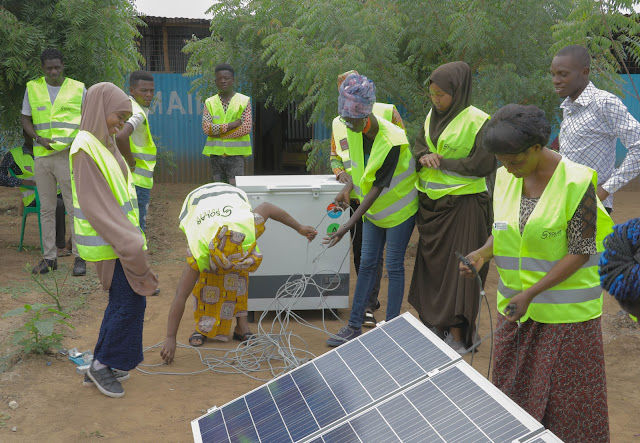
Skills training by Solar Freeze for Kakuma youths/credit: Ashden


With temperatures soaring across most of Africa due to climate change, preserving agricultural produces, medicines and other perishables is increasingly challenging. In eastern Kenya, a group of young people from smallholder families have created a pay-as-you-store solar cooling service, benefiting small-scale farmers, as well as health clinics and small businesses in Kakuma refugee camp, the oldest refugee camp in East Africa.

“Like many people our age, we watched our parents and grandparents work tirelessly, toiling in rural farms, only for a huge chunk of their fresh produce to rot away due to lack of proper cold storage units,” says Dysmus Kisilu, 27. “Often times, middle men would quickly swoop in and offer dirt cheap prices, and farmers would be forced to sell for a song out of fear of post-harvest loss,” says Kisilu.

Kisilu and many of his friends sought a better life in the city, but in 2016, some of them pulled their skills together to create Solar Freeze, a social enterprise harnessing solar power to offer off-grid small-scale farmers portable and affordable cold storage units in which to preserve their fresh fruits and vegetables.

“The growing seasons are now erratic and produce goes to waste because it cannot be stored. Whole communities are being destroyed as climate is changing. I knew I had to do something.”

Two years later, after meeting refugees in the huge Kakuma camp, Kisilu decided to expand into the humanitarian context. Kakuma, located in Turkana County, one of the poorest counties in Kenya, is home to 160,000 refugees from South Sudan, Sudan, Somalia, the Democratic Republic of the Congo, Burundi, Ethiopia, and Uganda. The camp has no access to energy from the national grid. Only 20% of its clinics have electricity and it is produced by polluting diesel generators, which operate only during specific times. Solar Freeze allows Kakuma’s clinics to store their medical products and vaccines, such as Covid, yellow fever, measles and rabies. The company has since diversified to include cold storage to food and drink shops, fishing and other businesses and households in the camp — a much needed service in the heat of the camp, and particularly as global warming increases.

Options for customers include buying cooling units on a lease-to-own basis or renting space in them on a pay-per-crate basis. This helps even worse-off individuals access cooling, as there is no upfront cost and the fees are low.

Solar Freeze team also launched an ‘Each One Teach One’ programme to train youth from agricultural families, especially women, to install, operate and maintain their units. The initiative was expanded to Kakuma and now also includes operation and maintenance of other solar products like solar-powered irrigation equipment, and sales.

“The education was super — it was not discriminatory to me by saying that I could not do it as a woman,” says Sakina Kariba, a refugee in the camp from the Democratic Republic of Congo. She was trained as a solar panel installer and now works freelance installing throughout the camp. “I am happy that even if I leave the camp today and I decide to go to back to Congo or another part of Kenya, I now have a skill that I can use.”

So far, Solar Freeze is working with 3000 smallholder farmers — reducing waste of fresh produce by 95% — and has 180 cold solar units in Kakuma.

Solar Freeze’s model is replicable to combat harvest loss and provide clean energy to off-grid small-scale farmers and vulnerable populations in sub-Saharan Africa. About 470 million smallholder farmers in developing countries lose an average of 35% of their income to food spoilage. The company plans to expand its work into other refugee camps, and to nearby nations including Rwanda and Uganda.

Last year, it has won the prestigious Ashden Awards in the Humanitarian Energy category. The Awards highlight some of the world’s most impressive climate pioneers and innovators and help them power up their impact.

The climate solutions charity is now calling for entries from similar climate innovators for their 2022 Awards. The application deadline is 15 March.


Wednesday, 4 May 2016

What drives young Syrians into ISIS?


Young Syrian refugees in Lebanon/Russell Watkins DFID


More than ideologies, it is poverty, desperation and desire for revenge that drive young Syrians into extremist groups.


A new study by the peacebuilding NGO International Alert shows that the key factors that push young Syrians into joining extremist groups are the need to earn a basic living, regain a sense of purpose and dignity, and the belief in a moral duty to protect, avenge and defend their people.


The study, titled Why young Syrians choose to fight: Vulnerability to recruitment by violent extremist groups, draws on interviews with 311 young Syrians, their families and community members in Syria, Lebanon and Turkey, to understand what drives both vulnerability and resilience to recruitment by the groups ISIS and Jabhat al-Nusra (Al Qaeda’s affiliate in Syria).


Adolescent boys and young men between the ages of 12 and 24 were found to be most at risk, along with children and young adults not in education, internally displaced persons (IDPs) and refugees without supportive family structures and networks.


The findings suggest that radicalisation is not an explanation for joining a violent extremist group per se. For many young Syrians, belief in extreme ideologies appears to be, at most, a secondary factor in the initial decision to join an extremist group. 


Instead, vulnerability is driven by a combination of extreme trauma, loss and displacement, lack of alternative ways to make a decent living, the collapse of social structures and institutions including education, and the desire to get revenge against the regime of President Bashar Al-Assad. According to respondents, armed groups also provide a strong sense of purpose, honour and self-worth.


As one young Syrian man in Lebanon said: “People can find a new meaning to their life in extremism. Extremism opens a door to a new life where they are wanted.”


In Syria more than 6,000 schools are out of use, having been attacked, occupied by the military or turned into an emergency shelter. The collapse of the education system, with some two million children out of school, has also greatly contributed to young people’s vulnerability to joining violent extremist groups, who are filling this gap by providing their own forms of education, the report says. These ‘schools’ are highly segregated, exploit sectarian divisions and support divisive narratives.


UNICEF, which today unveiled details of a major new fund (Education Cannot Wait) to help get children back in class during emergencies, also stresses the crucial role of education in countries affected by wars and disasters.  


"Education changes lives in emergencies," said Josephine Bourne, UNICEF's education chief, in a statement. "Going to school keeps children safe from abuses like trafficking and recruitment into armed groups."


Yet, only 2 percent of global humanitarian appeals are on average dedicated to education.  "It is time education is prioritised by the international community as an essential part of basic humanitarian response, alongside water, food and shelter," Bourne added.


Offering comprehensive, inclusive and quality education, which also incorporates trauma healing and psychosocial support, was one of the four key factors identified by the report that can prevent recruitment.  The others were: providing alternative sources of livelihood, better access to positive social groups and institutions, and avenues for exercising non-violent activism.


The report stresses the need to integrate these social cohesion efforts into humanitarian aid projects, regional policy objectives and diplomacy aiming to reduce discrimination against refugees, which can also drive recruitment.


Note: The study was conducted five years into the conflict in Syria, which has claimed an estimated 300,000 lives, displaced 6.5 million people internally and prompted 4.8 million people to flee to neighbouring countries. 

You can find out more about International Alert's work in Syria here.


Friday, 13 March 2015

Turn the Lights Back on in Syria: fourth year of conflict


This Sunday, March 15, marks the fourth anniversary of the start of the bloody conflict in Syria.  I wanted to share “Afraid of the Dark”, a short video reminding people that the conflict is still going on and showing one of its repercussions.


Since the start of the war,  83% of all the lights in Syria have literally gone out. Analysing satellite images, scientists based at Wuhan University in China, in co-operation with the #withSyria coalition of 130 non-governmental organisations, have shown that the number of lights visible over Syria at night has fallen by 83% since March 2011. In cities like Aleppo, the situation is even more extreme – satellite images show that 97 percent of lights have gone out since 2011.


The video makers - BAFTA-winning agency Don’t Panic and production partners UNIT9 – wanted to use this little-thought off repercussion of the conflict as a symbol of the darkness and chaos in which the country has been plunged already four years ago.  Over 200,000 people have died and millions more have been forced to flee their homes.

Four years since the start of the crisis, tell world leaders that they must stand by Syrians


"It is a literal truth that 83% of Syria's lights have gone out since the start of the war," said Richard Beer, Creative Director of Don't Panic, "but the darkness that afflicts them has a metaphorical truth that goes deeper. We wanted to use this shocking statistic to tell the story of just how far Syria has fallen into darkness, in every conceivable way, despite UN resolutions and international outcry. The hero of our film, Khalid, could afford to be afraid of the dark four years ago; now he faces far worse every day, despite his own bravery. He, and all Syrians like him, need our help."


Directed by UNIT9’s Greg&Jacob, this video is part of an international campaign launched by the #withSyria coalition. The coalition is a movement of humanitarian and human rights organisations from around the world, including Oxfam, Amnesty, International Rescue Committee, and the International Federation for Human Rights (FIDH), standing in solidarity with those caught in the conflict.


The #withSyria coalition launched this video alongside a global petition, calling on world leaders to ‘turn the lights back on in Syria’ by:

•           Prioritising a political solution with human rights at its heart;

•           Boosting the humanitarian response both for those inside Syria and refugees, including through increased resettlement;

•           Insisting that all parties put an end to attacks on civilians and stop blocking aid


A new report 'Failing Syria' released today by 21 humanitarian and human rights organisations accuses warring parties and powerful states of failing to achieve what three 2014 UN Security Council resolutions set out to do. 


Wednesday, 20 March 2013

The quiet humanitarian - interview with Andreas Kamm of the Danish Refugee Council


I’ve interviewed Andreas Kamm, Secretary General of the Danish Refugee Council (DRC) for Development Post, a new development quarterly magazine.  I relished this assignment as I think DRC does a fantastic job and I deeply respect and admire what they do. 

 Fittingly, they have just been names as the world's best humanitarian NGO in 2013 by Global Journal, an American magazine which has analyzed  and compared 450 international NGOs and ranked the top 100. To see the whole list, click here.

DRC was formed to address the European refugee crisis caused by the Soviet invasion of Hungary. Today it works with refugees and internally displaced people (IDPs) in more than 30 countries, including some of the world’s worst conflict zones and most fragile states, such as Syria, Somalia, Iraq, Chechnya and South Sudan. 

It is an unusual organization as it is formed of 30 member organizations and voluntary groups. They are known for using strategic partnerships to achieve better results and for involving and supporting beneficiaries, local communities and local and national authorities in their humanitarian efforts across the world.

Andreas Kamm/courtesy of RDC
 
When I asked one of Kamm’s colleagues, Mary B. Anderson, to describe him, she said that what she admired the most in him, aside from his obvious managerial qualities, was his kindness: that he managed to deliver and do his job while remaining deeply caring.  I really liked that and can see this kindness reflected in the values of the organization.


I was fascinated by Kamm’s description of how they find new ideas.  Most of DRC’s innovations, he said, originate in the field where staff working there notice various needs and opportunities. Kamm explained: “the SMS-based complaints system our team in Somalia has developed is a good example. It used to be a slow and problematic process to insure that the aid promised was in fact delivered on the ground. The SMS feedback system is an innovation that has paved the way for accountability and dialogue with aid beneficiaries, as communities and beneficiaries can use SMS, Tweeter and Facebook to lodge complaints, point out problems with distribution of aid or mistakes made by DRC.”  Ideas like that are collected from DRC staff all over the world by the headquarter in Copenhagen, then redistributed to all of their projects.
I also liked his suggesting that the world should do more than just removing dictators.  There are currently about 40 fragile states, such as Somalia, Iraq, and Afghanistan, and the refugee and IDP problem will keep growing because this number is increasing. “We see a need to do more to support the development of peace and democracy in countries of conflict.  We shouldn’t expect problems to simply disappear when a dictator falls, for example, because they actually tend to grow and create many years of instability," he told me.
And on the impact of climate change:  "There might be as many as 200 million people displaced in 2050 because of climate change. This is a huge challenge and it will lead to conflicts, and thus create even more refugees.  The rich part of the world should be willing to do much more to get down to the root cause of the problem and put more efforts into building fragile states – but it is not an easy task.”
Read my full interview with Andreas Kamm in the spring issues of Development Post.

Saturday, 23 February 2013

Silent Disasters: Let’s turn up the volume

Image by IFRC/Finnish Red Cross


Last October, the United States, the Bahamas, Jamaica, Haiti, the Dominican Republic, Cuba, India, Vietnam, Argentina, Somalia and Indonesia all were all hit by a flurry of natural disasters.  Yet of all of these, most people have only heard about Hurricane Sandy, which claimed 131 lives and caused major damages to the East Coast of the US. 

Media figures released by the International Federation of Red Cross and Red Crescent Societies (IFRC) showed that the impact of Hurricane Sandy in the US grabbed almost 90 percent of all print and online media coverage of a set of 13 disasters from January 2012 to January 2013, across 160 countries.

The other "silent disasters" were food insecurity in both the Sahel and southern Africa, a tropical storm that struck Bangladesh in October, floods in Cambodia and Ecuador, a recent snap of extreme cold in Mongolia, disease epidemics in Uganda including Ebola, a series of earthquakes in Tajikistan, hand, foot and mouth disease in Vietnam, a dengue outbreak in El Salvador and the difficulties faced by Burundian refugees returning home from Tanzania.

The Red Cross and the European Commission have launched a media campaign this week to raise public awareness about the many “silent disasters” around the world that are under-reported, under-funded and often forgotten.

Over 90 percent of disasters around the world go unnoticed. They’re too small, inconvenient or overshadowed by other events. Without the attention of the public and the media, they often pass under the donor community's radar.

"Small-scale disasters may not reach our TV screens, but they still cast painful blows to millions of people every year, destroying their homes and livelihoods," said EU Commissioner for International Cooperation, Humanitarian Aid and Crisis Response Kristalina Georgieva, highlighting the work done by ECHO and the Red Cross to bring relief aid to hard-hit communities.

"Our joint efforts are more important than ever, as climate change, urbanisation and population growth are pushing up the number and impact of disasters,” Georgieva added.  


Each decade, disasters around the world are growing in frequency, severity and cost with no end in sight. By 2015 an estimated 375 million people - a 79 percent increase from 2011 - will suffer the ravages of devastating weather events. These figures are truly alarming.

Even during this time of economic austerity, slashing humanitarian budgets would amount to turning a blind eye to a costly reality that affects us all, and writing off the lives of the millions of families affected by disasters, Georgieva, added. 

Watch the campaign’s video, shown in cinema and on television in 11 European countries this month. It depicts people in comfortable homes eating, while disaster survivors look on in the background. Then the Europeans suddenly hear their voices… The campaign will also run on websites, social media (with the hashtag #silentdisasters) and in print.