Showing posts with label Iran. Show all posts

Thursday, 2 July 2020

Renowned Iranian scientists attacked because of child rights activism

Jahangir (left) and Shahin Gavanji

Two Iranian brothers, both respected research scientists and child rights activists, have been severely beaten by fundamentalists who see their campaigning work – particularly against child marriage - as promoting anti-Islamic values. Fearing for their lives, they had to flee the country. 

Last May, a group of motorcyclists descended on the brothers’ home in Isfahan. They assaulted them with truncheons and electric cables, and threatened to splash hydrochloric acid on their faces. “They wanted to blind us. They shouted: ‘Away with you, you are representatives of America, Israel and the United Kingdom’. It was horrible. I still remember the voice who said: ‘We will kill you both.’ My brother Jahangir lost 30 kilos in one month because of the stress, and his leg is now numb and he cannot walk properly," says Shahin Gavanji, 35.

"We don't want to do any political or religious activities," says Gavanji. "We only want to focus on children's rights.  Child marriage is a big problem in Iran, as well as child labour, and physical and sexual abuse of children are totally ignored.”

More than half a million marriages of children are registered in Iran every year, according to the Persian-language Entekhab news website. Up to 40,000 of them are between the age 11 and 14, and more than 300 are girls under the age of nine. Physical and sexual abuses are widespread, but these issues are completely taboo. In addition, according to UNICEF, there are three million child workers in Iran, but Iranian NGOs estimate their numbers at seven million. Under Iranian law, it is illegal to work under the age of 15, but because of circumstances like poverty and organized crime, the law is not often followed. An estimated 14% of Iranian children are forced to work in dangerous and unsanitary conditions - in the streets, in automobile or rug factories, or in the sex industry, according to international child NGO Humanium.

The Gavanji brothers have received various awards for their research work in their country and have been voted the best young inventors and scientists of Iran in 2009 and 2010. They  have also won several medals and awards at international science festivals in Germany, Poland and Croatia. 

 “My brother and I are very well-known in our country, so we thought that  we should use our voice to help children and make a better world for them,” says Gavanij, who has a degree in Biotechnology and chairs the Asian Council of the World Academy of Medical Sciences (WAMS) 

To break the silence around child rights issues, they have launched several campaigns in Iran and abroad, including the first national campaign to prevent child abuse in Iran and the Global Campaign for the Prevention of Child Marriage in 41 countries.  

 “We focus on raising awareness since we believe that education is the most powerful way to help change the world.”  They also held 5-minute classes in the streets across the country to help child labourers recognize and prevent different types of abuses. “We see a significant number of children who blame themselves and are even afraid to tell their family or anyone else about the abuse they have suffered,” Gavanji says.  

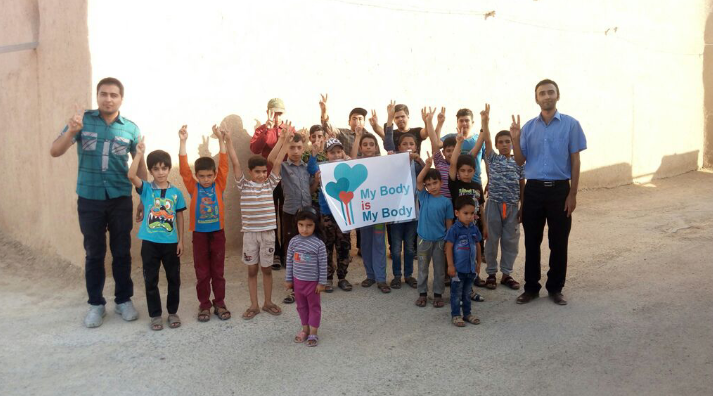
 The brothers are also Iran ambassadors for My Body is My Body, an international educational programme against child abuse, available in 21 languages. They have translated it into Farsi and organized information classes for children and their parents in Iran.

With the support of the World Academy of Medical Sciences, they have also created a national project to raise awareness about the negative physical and mental health consequences of child marriage.

Their work has been well received by children, parents and teachers across the country and abroad. "Many Iranians were very happy with our educational programmes. Every day we received support from children and their parents. We were also invited by many people to organize our classes in cities and in the countryside.”  Their human rights and peace work in Iran and internationally led them to be named World Peace Ambassadors of the International Forum for the Literature and Culture of Peace (IFLAC) in March of this year.

Yet, in Iran, their educational work attracted the wrath of fundamentalist groups who believe that they are promoting Western values, which will corrupt the younger generations. “They say that our activities, especially our campaign against girl brides, promote the UN's 2030 Sustainable Development Goals (SDGs), and because of that children and future generations will lose their Islamic spirit,” Gavanji says. “They believes that child marriage is a correct action and they think that we're promoting anti-Islamic culture in Iran."

After the attack, the brothers hid in the countryside, then in September decided to flee the country, leaving behind their families, research projects and campaigning work. 

They are now living in hiding in a small room in an undisclosed country, as they fear that fundamentalists will track them there. 

 They hope to be offered asylum in Canada or in another country and have launched a signature campaign to help them achieve this. 

“We want to make our voice heard by the United Nations. We ask all journalists, human rights organizations and governments to listen to us and help us.” 
Please, sign their petition.


Monday, 11 March 2019

Iran - human rights lawyer Nasrin Sotoudeh sentenced to 33 years in prison.


Prominent Iranian human rights lawyer and women’s rights defender Nasrin Sotoudeh has been sentenced to a shocking 33 years in prison and 148 lashes.

The sentence, reported on her husband Reza Khandan’s Facebook page, brings her total sentence after two grossly unfair trials, to 38 years in prison. In September 2016, she was sentenced in her absence to five years in prison in a separate case. 

The latest sentence is the harshest sentence Amnesty has documented against a human rights defender in Iran in recent years, suggesting that the authorities are stepping up their repression.

Philip Luther, Amnesty International’s Middle East and North Africa Research and Advocacy Director, said: “It is absolutely shocking that Nasrin Sotoudeh is facing nearly four decades in jail and 148 lashes for her peaceful human rights work, including her defence of women protesting against Iran’s degrading forced hijab (veiling) laws.” 

Sotoudeh was recently informed by the office for the implementation of sentences in Tehran’s Evin prison where she is jailed, that she had been convicted on seven charges and sentenced to 33 years in prison and 148 lashes. The charges, which are in response to her peaceful human rights work, include “inciting corruption and prostitution”, “openly committing a sinful act by ... appearing in public without a hijab” and “disrupting public order”. 

Meanwhile, in a confusing development, earlier today the Islamic Republic News Agency reported that Mohammad Moghiseh told journalists that Sotoudeh has been sentenced to seven years in prison: five years for “gathering and colluding to commit crimes against national security” and two years for “insulting the Supreme Leader”. 

This report did not provide further details or clarify whether the judge was referring to a separate case.

 “Nasrin Sotoudeh must be released immediately and unconditionally and this obscene sentence quashed without delay,” Luther said. 

 “Governments with influence over Iran should use their power to push for Nasrin Sotoudeh’s release. The international community, notably the European Union, which has an ongoing dialogue with Iran, must take a strong public stand against this disgraceful conviction and urgently intervene to ensure that she is released immediately and unconditionally.” 

Nasrin Sotoudeh’s sentence made me think of an interview I recently did for Lacuna Magazine with another Nasrin, also a human rights and women’s rights defender. 

Writer, artist and human rights campaigner Nasrin Parvaz was arrested at the age of 23 by the regime’s secret police after having been betrayed by a comrade. She was tortured and sentenced to death, but her death sentence was commuted to 10 years in prison.

She spent eight years in the same Iranian prison where Nazanin Zaghari-Ratcliffe is now being held, and has used the experience as inspiration for a novel and a book of memoirs. Speaking in London, Parvaz told me there are echos of Nazanin’s story in prisons across Iran, where rights defenders have been subjected to rape, routine humiliation, torture and execution. 

“The Islamic regime is a master of concealing and deception. When the UN human rights inspectors came to visit Evin prison in 1990, they built a new wall across our corridor to conceal us. We never met the inspectors. While president [Hassan] Rouhani [elected in 2013] publicly promised reforms, behind closed doors, there are still too many prisoners dying in detention.

“Prisons are still full of men and women fighting for civil rights. Questioning how and why the regime operates is still dangerous.”

How terribly true…

You can read her story of activism and time in Iran’s prisons in Lacuna Magazine here.

Friday, 18 April 2014

Iran parents halt killer's execution - the power of forgiveness

Courtesy of ABF


Instead, what happened next marked a rarity in public executions in Iran, which puts more people to death than any other country apart from China, wrote Dehghan. She decided to forgive her son's killer. The victim's father removed the noose and Balal's life was spared.

“Balal's mother hugged the grieving mother of the man her son had killed. The two women sobbed in each other's arms – one because she had lost her son, the other because hers had been saved," Dehghan wrote.

This is significant because Iran is known for its high rate of executions and human rights abuses. The new president Hassan Rouhani has disappointed human rights activists for doing too little to improve Iran's human rights and not curbing its staggering use of capital punishment.

As of last week, 199 executions are believed to have been carried out in Iran this year, according to Amnesty International - a rate of almost two a day. Last year, Iran and Iraq were responsible for two-thirds of the world's executions, excluding China.

At least 369 executions were officially acknowledged by the Iranian authorities in 2013, but Amnesty International said hundreds more people were put to death in secret, taking the actual number close to 700.  I wrote a blog post in July 2013 about the 97 executions carried out just in that month, according to a report by from The Abdorrahman Boroumand Foundation (ABF), a non-governmental independent organisation dedicated to the promotion of human rights and democracy in Iran.

Iran is particularly criticised for its public executions, which have attracted children among the crowds in the past. Iranian photographers are often allowed to document them.  Studies have shown that the death penalty doesn’t provide any special deterrent. The public displays of killing, however, perpetuate a culture of acceptance of violence.

I wonder what would happen if more victims’ relatives could do like the Hosseinzadehs and pardon the convicts, if the crowds would stop gathering to watch the executions, if people would publicly object to them…

Monday, 30 September 2013

Stoning - Where is it legal?


I write about human rights, but had no idea that stoning is still a legal punishment in some parts of the Muslim world. It is also practiced extrajudicially in other parts.  Stoning is a form of execution where a group throws stones at a person until they are dead -  mostly as a punishment for adultery. Iran, where stoning is a legal punishment,  has the world’s highest rate of execution by stoning.   

Here is a good infographic by the Thomson Reuters Foundation showing where stoning happens and where it is legal.

The graph also shows that in Iran, the only country where stoning is legal and practiced, men sentenced to dying that way are buried up to their waists, while women are buried up to their chests. If a person manages to escape, they’re free. I assume that no woman can manage that feat…

I find the death penalty abhorrent in any cases, but this slow, painful, cruel, communal way of killing someone is beyond words.


Monday, 29 July 2013

Iran's Deadly Summer: 97 executions so far

Courtesy of ABF

This is disturbing (but not surprising) news I received from The Abdorrahman Boroumand Foundation (ABF), a non-governmental independent organisation dedicated to the promotion of human rights and democracy in Iran.
Executioners rarely rest in the Islamic Republic of Iran, even during the hot summer months. July has been particularly deadly this year. At least 97 executions have been reported between June 20 and July 20, 2013. The majority of these executions have been announced by the authorities themselves or reported by the semi-official media inside Iran.  Surprisingly, the high number of executions has not triggered particular reaction outside of Iran. Nor has it affected the cautious optimism prevalent since the June 15 election, won by Mr. Hassan Rouhani, a member of the Iranian ruling elite and former nuclear negotiator. 
The spike in executions, following the election of a president whose campaign theme was moderation, could be a test, and the absence of reaction could be fatal for hundreds of prisoners on death row. It is in this context that the mothers of four Arab Iranian cultural activists, recently sentenced to death for "Enmity against God” and “Spreading corruption on earth", are desperately calling on the international community to speak up on behalf of their threatened children.

Human rights groups can document cases and echo the voices of victims, as they haverecently for these four young men But they are not invited to any negotiations with Iran, whose authorities rarely engage directly with them. So far, Iran-related discussions are focused on the impact of the 2013 presidential election on nuclear matters; how to engage with the new president; and whether or not to ease economic sanctions. The current human rights crisis, including scores of executions carried out in less than a month and, importantly, the President-elect’s views about it, do not seem to be on the agenda for international stakeholders.
Who are the 20 individuals who were hanged in Karaj’s Qezelhesar Prison, for example, or the 5 women and 2 men hanged in Zahedan’s Central Prison on July 6, and what were they charged with? Were they provided the means to defend themselves or, like the four young Arab activists, were they kept incommunicado, beaten, and coerced into false confessions that were then used against them in court, in violation of the most basic human rights standards? These are life-saving questions that should be part of any dialogue with the Islamic Republic’s leaders regarding its international obligations.
The arrival in August of a new Iranian presidential team provides an opportunity to bring up the issue of the arbitrary and repeated use of capital punishment in Iran and the systematic violation of due process of law and Iran’s obligations under the International Covenant on Civil and Political Rights. No doubt, there are many important and urgent topics on the agenda of talks with the Islamic Republic, but leaving the crucial topic of human rights practices to the side sends a reassuring message to the Iranian leadership, which uses the threat of its tireless killing machine to spread fear and eliminate dissent.

Wednesday, 31 October 2012

Judgement day – Iran Tribunal exposes mass massacres of the 1980s

 
Family members of political prisoners executed during mass massacres of the 1980s and the summer of 1988, gather at Tehran’s Khavaran cemetery to commemorate their loved ones/ Iran Tribunal 
 
Following a harrowing three-day hearing at the Peace Palace in The Hague, the Iran Tribunal, a tribunal of conscience, delivered its interim judgement on October 27th.  According to the tribunal, the Islamic Republic of Iran committed crimes against humanity and gross violations of human rights against its citizens committed during “the bloody decade” of 1980s.

This is a monumental achievement for the survivors and families of the victims of the mass massacres of political prisoners in the 1980s. The Tribunal has allowed their voices to be officially recorded and heard in court for the first time in 25 years. Unlike atrocities in Rwanda, Srebrenica and General Pinochet's Chile, they never had any opportunity for justice and legal redress.

"The consequences of this judgment are profound,” says Prof John Cooper QC, the lead prosecutor at the tribunal. “It finally provides an independent and authoritative finding that the Islamic Republic of Iran [was] responsible for murdering and torturing [its] citizens on a staggering scale. This judgment, along with the carefully documented evidence from over 100 victims can now be presented to the international community as part of the victim's fight for justice.”

When the judgment was announced, the courtroom fell quiet.  The silence was thick with emotions held back for 25 years. Then the people in the assembly slowly stood up and held pictures of their loved ones killed by the Iranian regime in the purges of the 1980s.  All were weeping.

For me, it was an emotional moment as well as I have come to know many survivors and bereaved over the many years I’ve been trying to report the story. I’ve followed the making of the Iran Tribunal - a grassroots movement created by survivors and families of victims because no official bodies would investigate their complaints.  It is a testament to their determination and resilience that they’ve managed to put the truth out there after all these years. The process also exposes shortcomings of the UN and other international bodies, which were supposed to investigate these atrocities. For information about the Truth Commission, the first stage of the Iran Tribunal, click here.

Read my blog in the Economist about the Iran Tribunal’s judgement here.http://www.economist.com/blogs/newsbook/2012/10/iran-1988

Saturday, 16 June 2012

Iran Tribunal to Uncover Iran's Srebrenica

-->
This picture is part of Prison Memoir in Painting by Iranian artist Soudabeh Ardavan. She spent eight years in Iranian prisons and survived the 1988 massacre. She painted this and many other prison's paintings by using her hair as a brush and toothpaste or tea as paint. She now lives in exile in Sweden.
-->
A People’s Tribunal will sit at Amnesty International’s headquarters in London on June 18-22 to unearth secrets the Iranian regime have managed to keep buried for more than two decades.  Survivors of torture and families of murder victims have managed against all odds to set up this international court to investigate the Iranian regime’s biggest state crime.
“When they took me to the death committee in Gohardasht prison, the lobby was piled high with sandals, glasses and blindfolds. That’s all that was left of our friends. They are all gone and I am alive. I am alive to tell their story. That’s my only goal,” says Mehdi Aslani, 53, who survived a mass massacre of political prisoners in Iran the summer of 1988.
Aslani and thousands of other victims have waited 24 years for this, but now they will finally have their day in court.
“The Tribunal’s main purpose is allowing evidence to be heard and allowing the world to find out what really happened in the 1980s in Iran,” says John Cooper, QC, chair of the Iran Tribunal’s steering committee. “It is incredible that torture survivors and families of murder victims have managed to achieve this on their own - and it is shocking they had to do this all on their own – that the UN did nothing.”
In the summer of 1988, the Islamic Republic of Iran executed in secret an estimated 5000 political prisoners across the country. The killing, ordered by an extraordinary fatwa issued by Ayatollah Khomeini himself, was relentless and efficient. Prisoners, including women and teenagers, were loaded on forklift trucks and hanged from cranes and beams in groups of five or six at a time in half-hourly intervals all day-long. The victims were intellectuals, students, leftists, members of opposition parties and ethnic and religious minorities. Many were jailed for no more than distributing leaflets, having a banned book or being accused by “a trusted friend of the regime,” according to Amnesty International.
The massacre was the climax of a massive elimination campaign conducted by the regime from 1981 to 1989: during that bloody decade around 20,000 political prisoners were executed across Iran.
“It is what I would term (based on my past work with the UN in Bosnia) ‘Iran’s Srebrenica’: a monumental atrocity that cannot remain unanswered,” says Payam Akhavan, professor of International Law at McGill University, first UN war crime prosecutor at The Hague and member of the Iran Tribunal.
The deliberate and systematic manner in which these executions took place constitutes a crime against humanity under international law, according to many human rights lawyers. (Widespread and systematic executions of a civilian population across the country, planned and ordered by the highest ranks of the Iranian government.)
Yet, to date, more than two decades after the massacre, there are still no investigation into this crime, no international pressure on the Iranian government to do so, and no recognition from Iran or the international community. In fact, many of the perpetrators are still in power and the international media seem to deliberately avoid covering this issue.
Over the past decades, survivors and families of the victims – many are mothers because the majority of the victims were very young - have campaigned for justice.  They have sent petitions to the UN, organized rallies and seminars and disseminated information on the Internet – but no one is listening.
After the massacre/ Soudabeth Ardavan
 “We are in the information age: with a click of a mouse, you can know what is happening in the far corners of the world. Yet more than 5,000 people were killed in two months in Iran and no one knows about it. It’s like nothing happened,” says Aslani, who lives in exile in Germany.
So the survivors and families of the victims have taken the matter into their own hands.   In 2007, they have come together to form the Iran Tribunal, modeled on the Russell Tribunal set up by British philosopher Bertrand Russelland French writer Jean-Paul Sartre in 1966 to examine American intervention in Vietnam, and the subsequent Russell Tribunals on Chile, Iraq and Argentine. Like these tribunals, the Iran Tribunal won’t have any legal status, but will act as a tribunal of conscience to deal with violations of international law that have not been recognized nor dealt with by existing international jurisdictions.
After five years of fundraising, outreach and assembling a team of prominent lawyers, the People’s Tribunal is now ready to proceed. It is organized in two parts: a Truth Commission and a Tribunal.  The Truth Commission, during which the court will hear and examine oral and written evidence from dozens of witnesses, is held at AI’s headquarters in London on June 18-22.  The Tribunal will then meet on October 25-27 in The Hague to issue a verdict.
Attendance is free, but you need to register. For more information, click here. To follow the proceedings live, click here.

Monday, 28 February 2011

Iran Tribunal to investigate Ayatollah's hidden legacy


As the Arab uprising is breathing a new life into the Iranian opposition, a remarkable new venture is slowly gathering pace outside the country: a sort of Russell Tribunal to investigate possible crimes against humanity perpetrated by the Iranian regime in the 1980s – especially in the summer of 1988.

In the summer of 1988, the Islamic Republic of Iran executed in secret a large number of political prisoners across the country – men, women and children. The killing was ordered by a fatwa issued by Ayatollah Khomeini. The victims were intellectuals, students, leftists, members of opposition parties and ethnic and religious minorities. Many were jailed for no more than distributing leaflets, having a banned book or being accused by “a trusted friend of the regime.”

The estimated number of victims ranks between 4,000 and 7,000.  The massacre was the climax of a massive elimination process executed by the regime from 1981 to 1988, under which around 20,000 dissidents disappeared, either dying under torture or being executed by firing squads. (Read my article on the massacre in the Toronto Star.)

The regime has never acknowledged the massacre, revealed how many were executed nor why. The execution of such a large number of people within such a short time and without any due process, violates many international human rights treaties to which Iran is signatory; yet the world has remained largely silent (Amnesty International and Human Rights Watch tried to raise the alarm, but the world was not interested). Most of the perpetrators are still in power today.

Many believe that the absence of accountability for those crimes has led to the culture of impunity so rampant in today’s Iran, where intellectuals are murdered, women stoned, students tortured.

“Nobody has been brought to justice,” Drewery Dyke, Amnesty International’s Iran researcher, told me when I interviewed him for a piece about the massacre in the New Internationalist (read it here). “Impunity for such appalling crimes only leads to further human rights abuse.”

This picture is part of Prison Memoir in Painting by Iranian artist Soudabeh Ardavan. She spent eight years in Iranian prisons and survived the 1988 massacre. She painted this and many other prison's paintings by using her hair as a brush and toothpaste or tea as paint. She now lives in exile in Sweden.

Over the past 22 years, survivors of the massacre and families of the victims have pleaded for justice before the international community – to no avail. Every September since 1988, they have commemorated the massacre in Iran and all over the world, holding vigils, organizing rallies and seminars, and disseminating information on the internet — willing the world to listen, acknowledge and condemn the terrible events the Islamic Republic wants the world to forget. But no one is listening.

So now, the survivors and families of the victims have decided to act on their own.   They have set up the Iran Tribunal – a sort of Russell Tribunal to investigate these crimes and judge them according to international law.

Like the second and more recently established Russell Tribunal - the Russell Tribunal on Palestine -  the Iran Tribunal won’t have any legal status, but will act as a Tribunal of conscience to deal with violations of international law that have not been recognized nor dealt with by existing international jurisdictions.

After two and a half years of groundwork and preparation, the Iran Tribunal recently formed a Steering Committee, in charge of organizing the tribunal, selecting judges, prosecutors and defense teams and the jury.   The committee is comprised of prominent jurists and human rights activists from Iran and around the world, and chaired by John Cooper QC, a British criminal law and human rights barrister.
The Tribunal is expected to be operational by early 2012. For more information, click here.


Tuesday, 14 December 2010

Khomeini's visit


This morning, I listened to a fascinating interview of Mohsen Sazegara by Fergal Keane on BBC4.  Sazegara was at the heart of Ayatollah Khomeini's regime from the moment the spiritual leader returned to Iran from exile.
Throughout the 1970s, he had been a student activist agitating for the overthrow of the Shah. In 1979 he became Khomeini's press attaché. He also helped found the now feared Revolutionary Guard, originally established as a defence force against possible attack from Israel or the United States.
As the Islamic state was established, dissenters were executed in their hundreds. But then factions within the regime began to turn against Sazegara who was pressing for greater co-operation with opposition groups.
It was a path that would lead to his imprisonment - and eventually to exile in the West. But not before he witnessed for himself what really happened inside Tehran's Evin prison, as he explains to Fergal Keane in Taking a Stand.

The programme made me think of a powerful epic poem I've read recently. The poem, called "Khomeini's visit", vividly describes some of the events Sazegara talked about in his interview and more generally, the history of Iran over the past four decades. It is written by the Iranian poet Majid Naficy. He too was active against the Shah’s regime in the 1970s. After the 1979 Revolution, as the new regime began to suppress the opposition, his first wife Ezzat Tabaian and his brother Sa’id were amongst the many to be executed. He fled Iran in 1983, eventually settling in Los Angeles with his son Azad.

The poem is very long, but try to read all of it (click on "read more") . It is well worth it!

Khomeini's Visit

                     by Majid Naficy

My father never told us

That Khomeini had visited him

For medical treatment many years ago

When Khomeini was only a "Khomeini"

And not yet the Deputy of God. (1)


The patient, perhaps, complained of heart palpations

The father looked at his tongue and eyes

Took his pulse and listened to his heart.

The patient removed his black turban and amber sandals

And took out his light cloak and long tunic. 

He laid down on the bed unmasked

And surrendered himself to a competent physician.


Did the father ask about Journeys written by Sadra of Shiraz (2)

And the patient about Commentary by Nafis, son of Evaz? (3)

Did the patient recite some of his own mystical ghazals,

And the father from free verses of his own son?

Did the patient speak of raising the banner of religion

And the father of kindling the lamp of reason?

No! No! The doctor's office is not a place for chitchat

With so many patients waiting behind the door.

The patient put on his clothing

The father handed him a prescription

And walked him to the door.


Ten years later, in the seventies

When my younger brother Said

Was in the Shah's prison for two years,

Because he had read a pamphlet,

And Khomeini was in exile, in Iraq

I listened to "Voice of the Revolution" in the basement.

One evening, the father came down the stairs

To listen to his old patient

Who spoke of the Shah's torture chambers

And foretold the day of justice.


At that time, no one knew that he

In less than five years,

After the uprising of home-builders in "off-limit" zones

And gathering of intellectuals at Goethe's nights of poetry

After marches of the clergy in Qum, and bazaaris in Tabriz

Strikes of petroleum workers and newspapers

And rallying cries from rooftops at night,

With rising fists and slogans

And falling fears and statues

And the hand-over of prisons and garrisons

Would sit on the throne of the "divine" state;

And after driving out the nationalists from the stage 

He would wrestle with the "Great Satan"

Amidst the hoorays of a Soviet-led left

And the boos of an independent left

Behind the walls of the American embassy,

And with the "export of revolution" to Iraqi Shiites

Saddam's invasion of Iranian land

And the beginning of the Iran-Iraq war

He would energize with "war blessings"

And gather the "flock" behind the "shepherd";