Showing posts with label arts. Show all posts

Tuesday, 15 October 2019

Symbols of Humanity: Syrian artist bridges times, religions


In our divided and polarised world, who, but artists, can conjure up the possibility of coexistence between cultures, ethnic groups and religions?

Born in 1966 in Aleppo, George Baylouni fled to France during the war.  And now his work builds bridges between the East and the West, and the past and the present.

Fascinated by the ancient civilisations of Mesopotamia, he studied their mysterious artefacts and texts, written in ancient cuneiform. He paints religious symbols and makes collages, adding gold leaf, his trademark, telling a tale of ancient worlds and of contemporary times. Uniquely, his paintings combine religions, with several pieces focusing on both Christianity and Islam in the same painting.

His work has been showcased prominently in the Middle East and Europe and he was named one of the 100 most important personalities in the Arab world in 2014 by Arabian Business Magazine.

”Symbols of Humanity”, Baylouni’s first exhibition in London, opens at the Stories Art Gallery in Mayfair on October 17 and runs until November 17. 

Baylouni's exhibition marks the first anniversary of Stories Art Gallery, which features renowned and upcoming artists from around the world, many from war-torn countries, and focuses on the stories behind their artwork.

If you have a chance, do see the exhibition and meet gallery director, the wonderful Manas Ghanem, who was born in Damascus, then educated in the West. Before opening her gallery, she worked as a lawyer in the Middle East and North Africa with UNHCR and Unicef.  


Friday, 15 June 2018

Another Day in Baghdad – Iraqi women tell their stories


Maysoon Pachachi and crew members


A couple of weeks ago, I went to a wonderful event at the Royal Court Theatre in London: a fundraiser for “Another Day in Baghdad”, a film, which tells the story of post-invasion Iraq from a women’s perspective and that of ordinary citizens. It is the first ever-Iraqi feature film authored by Iraqi women - and it unites cast and crew from the Middle East and Europe.


The fundraiser started with a short documentary about the recent test shoot (which you can view here), followed by a reading of part of the film’ script by 14 actors, including, to my delight, the mesmerizing Ben Whishaw and Lizzie Wells (Matilda The Musical).   

I was deeply moved by the script, but also the aim of the film and the way it is being developed – and since they still need to raise £19,600 in order to be able to film in Iraq and support Iraqi talent, I wanted to help spread the word.
 
“Another Day in Baghdad” is based on journal notes and the real life experiences of the two female authors - Irada Al Jabbouri, a Baghdad-based novelist, and Maysoon Pachachi, a London-based filmmaker of Iraqi origin.  The film tells the intersecting stories of ordinary citizens, unfolding in the last week of 2006 in Baghdad. All the characters are Iraqi and many are strong female ones.  

“The time of extreme sectarian violence in which our story takes place foreshadows what is happening in Iraq and the Middle East at the moment,” says Pachachi. “We feel that in the context of the extreme militarized male violence we are seeing in the Middle East, it is crucial to have stories told from a female perspective.

 “These stories are absent in the media and absent from the conscience of the world. Iraq has been presented for decades as a source of evil and cruelty and a threat to its neighbours and the world,” Pachachi adds.  “We feel that it’s especially important now for stories of individual resistance and hope to be told about the area, where so many still maintain solidarity with one another as human beings, in spite of the intensely divisive pressures of religion and politics, with which they are living.”

Co-written by Pachachi and Al Jabbouri, the script won the IWC Schaffhausen Script Award – presented by Cate Blanchett in 2012.

Pachachi and Al Jabbouri have secured the funding needed for filming in Jordan, as well as for the post-production of the film in Europe, but are now raising funds to shoot in Baghdad - where the light and the river are irreplaceable - and hire Iraqi cast and crew.  Part of the film will also be shot in Jordan with Iraqi refugee actors.  

“For Iraqis inside and outside Iraq, opportunities to shape their own narratives – far from Hollywood-style fiction and newscasts – are limited. Through this film, we aim to generate an authentic and meaningful opportunity for Iraqi actors and filmmakers." Pachachi says.

In 2004, she co-founded a free film-training centre in Baghdad and has taught film directing and editing in Britain and Palestine. 

If you want to support this project, you can contribute here.


Sunday, 10 July 2016

Freedom is not easy - exhibition of refugees who found safety in London


Hodan Omar from Somalia/Credit: Caroline Irby @carolineirby


If you are in London July 12-18, come and see “Freedom is not easy” - an exhibition of portraits and interviews of refugees living in London. My friend photographer Caroline Irby represented 12 refugees in the various places where they first felt free or safe after arriving in this city. The portraits are accompanied by interviews I’ve made, capturing their stories of flight, readjustment to a new life, as well as the moment each refugee first felt safe or at home here.
There are an estimated 120,000 refugees in the UK, and last year some 32,414 applied for asylum. For most, life is not easy. Unemployment in refugee communities is above 50% (5.1% is the national average), and in 2015, the British Red Cross supported more than 9,000 who were destitute. Yet some keep striving and pulling through, and successfully make new lives here.
 

Caroline and I have worked together on a number of humanitarian stories overseas and in the UK. We have travelled widely with our work, particularly in Africa and Asia where we have seen some of the causes that trigger people to flee their homes, and visited the camps where refugees and displaced people find shelter - usually in their own countries or in neighbouring states. But some refugees move further: some cross the Sahara, the Mediterranean and the Channel, and now live here in London.

We wanted to meet some of the refugees who have settled here, to learn what propels them to move so far, and to hear about their experiences of seeking - and sometimes finding - freedom, safety and a home in this city.
At a time when politicians and the media too often dehumanise refugees by referring to them as an anonymous mass, we wanted in our small way to restore some of their identities by giving these 12 refugees a face and a voice. We also wanted to show how strong and resilient refugees have to be in order to make it here. The men and women featured in the exhibition also demonstrate that if they require some help to settle in the country, they also bring fresh energy, knowledge, talent and tremendous potential.
 

We also wanted to support Breaking Barriers, the charity which is putting together this exhibition. They are helping refugees to find meaningful employment, matching their skills. So many refugees told us that finding a "real" job was one of the main factors that helped them integrate and feel at home.
 

Here is what Hodan Omar, a young woman from Somalia, told us about the internship she found through Breaking Barriers:

"As a refugee, all you hear is negative: everything seems to conspire to put you down, so you think that maybe they are telling the truth, that you are never going to make it. But at Source8, I felt positive. They made me feel at ease. They trusted me with important things. I felt capable. It freed me of that negative cloud. Yesterday was my last day there, but I’ve gained skills, experience and confidence. Now, I am hopeful I can find a good job."


Some of the portraits/stories in this exhibition are featured in the summer issue of Positive News magazine and on their website. You can read them here.
 

“Freedom is not easy” at the Archivist's Gallery, 2-10 Hertford Road, London N1 5ET, 11-18th July 2016 from 10 am to 6pm.


Saturday, 31 October 2015

Gallery Olympe de Gouges in Paris honours women's rights pioneer


Olympe de Gouges Gallery/credit: Veronique Mistiaen


“DECLARATION OF THE RIGHTS OF WOMAN AND THE FEMALE CITIZEN” 

These red letters  (in French) on a large poster in the window of the new art gallery rue de l’Odéon in Paris 6th stopped me in my tracks.

I read the poster: it was about an avant-garde woman who cherished freedom and opposed discrimination, violence and oppression in all its forms.  And she wrote the remarkable “Declaration of the rights of woman and the female citizen” in 1791. Her name was Olympe de Gouges.   I am ashamed to say that I didn’t know her.

Intrigued, I stepped inside. The lovely gallery’s manager, Victoria Otero, told me that Olympe de Gouges was a political activist and one of France’s first feminists. Although she was born in a modest family, she found her political voice by writing an astonishing number of pamphlets and posters that she freely disseminated around Paris.  Her pamphlets promoted bold, new ideas, such a total equality between sexes, female emancipation and abolition of the death penalty and slavery.  Ahead of her time, she was guillotined for her ideas in 1793.

The Olympe de Gouges gallery was conceived by a French entrepreneur whose offices were in the old building where Olympe de Gouges lived - on Servandoni street near St Sulpice Church, in the heart of the historic 6th arrondissement. To pay tribute to her,  he not only placed a commemorative plaque on the façade of his building, but decided to open an art gallery a few steps away. 

Olympe de Gouges's house/credit: Veronique Mistiaen

New in the golden triangle of Parisian galleries, the gallery Olympe de Gouges wants to “reinstate Olympe de Gouges,  talk about this woman too avant-garde for her time and pay tribute to her strength and convictions,” says Otero.

The gallery features artists who, like Olympe de Gouges, have a critical view on our contemporary world, fight against all forms of inequality and are not afraid to take risks.  As the art market tends to favour men, they also want to provide a space for women artists.  Exhibitions change monthly, which allows the gallery to showcase a wide variety of artists from all over the world.

Until November 11, the gallery featured the Sino-Irish artist Mia Funk. One of her most famous – and controversial – piece, "An Audience with the Queen" (Price Thames and Hudson 2010),  shows the British monarch and Lucian Freud seated naked on a couch sipping tea and eating Pot Noodles.  The work was meant to be exhibited in Dublin for the Queen’s first state visit, but  had to be quickly taken down following protests.

Their November exhibition will focus on immigration with Marc Bellini, a French photographer artist of Corsican origin, who through herbarium photograms traces the routes of migrants to Europe.


Friday, 3 April 2015

Survivors of war and torture united by music - Stone Flowers


Stone Flowers members/courtesy of Stone Flowers

 
-->
Stone Flowers – a musical group comprised of war and torture survivors – is releasing its new album Ngunda, proving that something beautiful can come out of unimaginable violence.

I liked working on this story because Stone Flowers is more than the sum of its parts: it is a music group, producing beautiful, uplifting music, but it is also a therapeutic and political project. Members have experienced torture and terrible losses - of home, family, culture and even of the person they were before. They write about these difficult topics, along with hope and resilience, in the languages and rhythms of their home countries, which include Iran, Kuwait, Sri Lanka, Sudan and DRC.  

Music helps reduce the trauma and gives survivors a way of speaking out against human rights abuses.  It also allows a connection with home and a more positive association with the loss of that home.


 As Stone Flowers members all bring their own musical heritages to the process, the result is rich and unusual - a cornucopia of styles and influences, where Arabic poetry mixed with West African rhythms and English folk segued into Caribbean and Tamil songs.

The name of the group, Stone Flowers, comes from a Persian folk song the group performed for their first album.  They liked the name because it evokes both strength and fragility, and also because it had Manchester overtones (i.e. Stone Roses), where the group is based. 


Created four years ago, Stone Flowers is supported by the charities Musicians without Borders UK and Freedom from Torture North West.  The group is performing life at many events and is now recording a new album, ‘Ngunda’, which will be launched at Amnesty International HQ in London on June 5.  The album takes its name from one of the ten tracks: Ngunda Azali Mutu, meaning 'A refugee is a human being' in the Bantu language Lingala.


Monday, 25 August 2014

"Shout Art Loud" - Using art to fight sexual violence against women in Egypt

-->


The vast majority of women in Egypt have experienced some form of sexual harassment: it is a common occurrence on the streets, on public transport and in private homes. But groups are starting to fight back – and artistic expression is a driving force in the campaigns for change.


Documentary filmmaker and women’s rights activist, Melody Patry is part of that movement. She has just produced "Shout Art Loud", an innovative “living report” on art and sexual violence in Egypt. The interactive documentary explores how Egyptians are using theatre, dance, music and graffiti to tackle the “epidemic” of sexual harassment and violence against women in their country. 

Published by Index on Censorship, an international organisation that promotes and defends freedom of expression, "Shout Art Loud" features interviews with artists, original artwork, videos and performances.


When Patry moved to Cairo in 2012 to learn Arabic and join a small women’s rights group, she was shocked to find out how much sexual violence against women had risen since the revolution. During the period February 2011 to January 2014, Egyptian women’s rights groups documented thousands of cases of sexual harassment, as well as crimes of sexual violence against at least 500 women, including gang rapes and mob-sexual assaults with sharp objects and fingers, .


“As the number of sexual crimes increased, I watched the amount of graffiti promoting women’s rights and denouncing violence against women grow and blossom on Cairo’s walls," she she writes in an introduction to her documentary.  One of them was “the circle of hell”, a mural painted by two Egyptian artists – Mira Shihadeh and el Zeft – near Tahrir Square. The image denounced the disturbing trend of attacks against female protesters in which women are encircled in mobs of 200 to 300 men who fight, pull, shove, beat and strip them.  “This painting, a few meters away for Tahrir Square, was a statement for all to see. Egypt would not stay silent before such crimes. Other murals and pro-women graffiti regularly appear on – and sometimes disappear from – Cairo’s walls,”  Patry writes. 


“When I was given the chance to take part in a theatre workshop exploring issues of sexual violence in Egypt, I jumped at the chance. Seeing the graffiti, and then taking part in a play, showed me first hand how powerful a role art can play in tackling the problem.


“This is why I decided to make “Shout Art Loud”. In the documentary, I try to highlight artists and civil society’s new approaches to denounce sexual harassment, encourage women to speak out and challenge social taboos. These include art exhibitions, graffiti and murals, street performances, dance, theatre, rap, comic strips, and digital tools to report and map harassment."


 “This innovative documentary is a reminder of the vital role artistic expression plays in tackling taboo subjects like sexual violence — in Egypt and beyond,” says Index CEO Jodie Ginsberg. “We want to bring this issue to a wider audience to show just how important artists and writers can be in bringing about change.”

Thursday, 26 June 2014

Unearthed exhibition - Syrian Artist Responds to Conflict in his Homeland

2014-06-25-IMG_9877.jpg
Unearthed (in Memoriam), 2014, repurposed book covers/credit: Emma K Freeman

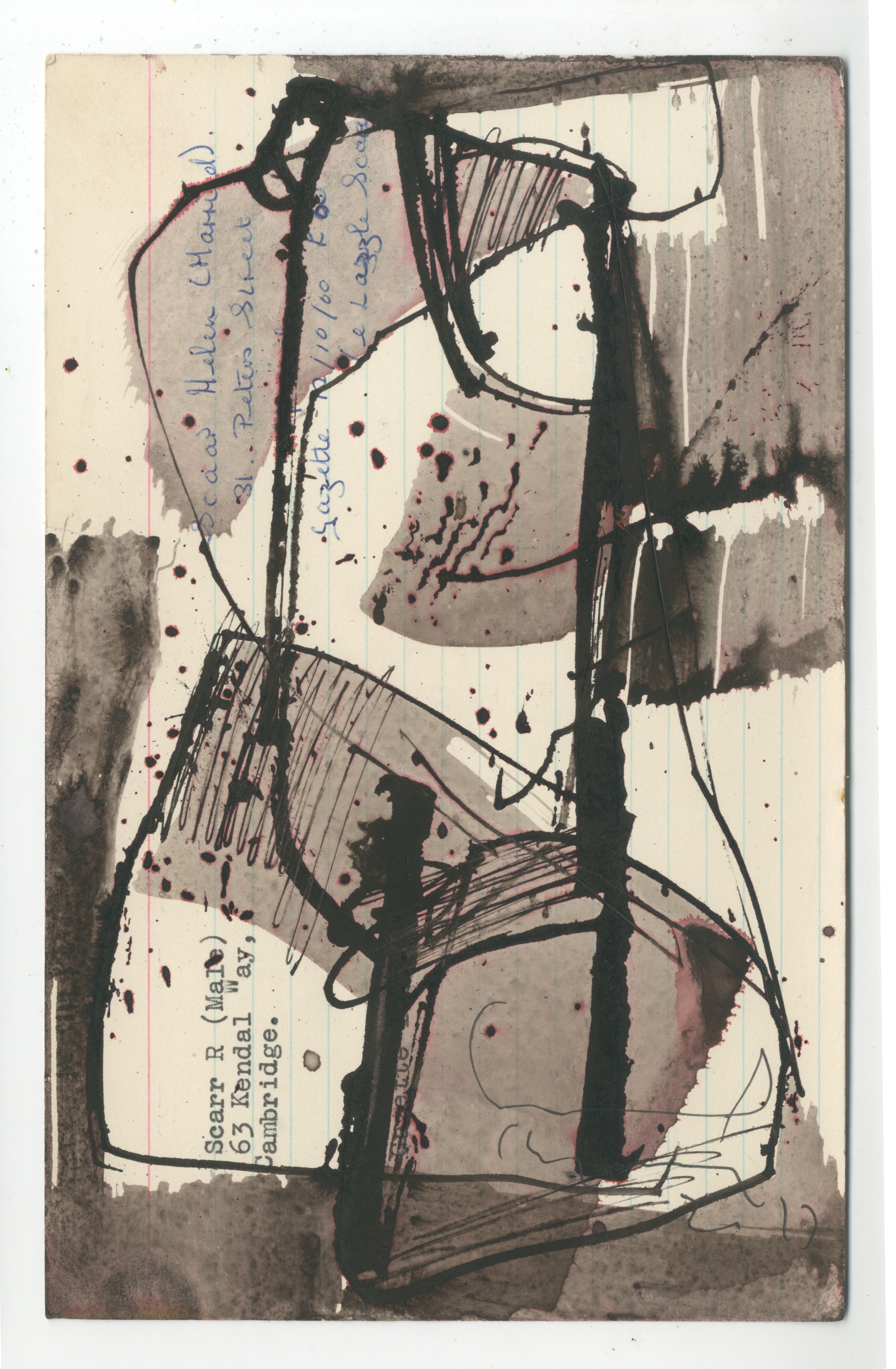
I love artist studios with their works in progress scattered all over, tools and material everywhere, the smell of paint and that special light, so I was delighted when Issam Kourbaj invited me to visit his studio in Cambrige.  Koubaj is a Syrian artist living in the UK, currently working on Unearthed, a exhibition inspited by the conflict in Syria.  I spent an afternoon in his attic studio and another at the P21 Gallery in London where Unearthed opens on July 4 and runs until August 16. I watched as he put the final touch to his pieces and listened to the processes and stories behind them. Each piece is his reflection on the conflict in Syria, but also carries fragments from his childhood in Swaida, a small village built from black volcanic stone in the mountains south of Damascus. 
Kourbaj is a wonderful storyteller, so I wish I could tell his stories here. Instead, I wrote this article about the exhibition. You can also read it on the Huffington Post's website.
Unearthed - Syrian artist responds to the was in his homeland

Over the last three years, Issam Kourbaj, a Syrian artist living in the UK, has been watching from a painful distance the war eviscerating his homeland: its people, its cities and villages, its past and present, and its memory. 

He brings the images of death, destruction and displacement reported by the media to his studio in Cambridge. There, in his attic rooms crammed with all matter of reclaimed objects, he tries to digest, respond and translate the war images into subtle forms "with meaning rather than anger. 

"My work is a quiet gesture, an archive to remember those who have been forgotten, and an invitation to ponder what the future might bring to what's left of my people and of my country," he says.

The result is Unearthed - a mesmerizing and haunting body of work in multimedia: his response to the Syrian conflict, as well as fragments from his childhood in a small village in the Druze mountains south of Damascus. The exhibition opens at the P21 Gallery in London on 4th July and runs until 16th August. 

Kourbaj was born in Syria and studied art, theatre design and architecture in Damascus, St. Petersburg and London. Since 1990, he has lived in Cambridge where he is artist-in-residence at Christ's College and teaches at the university. His work has been widely exhibited and is held in numerous private and public collections, including that of the British Museum.

For this exhibition, he has worked with a wide variety of media, from drawings on paper and photographic and optical work, to large-scale installations made for and assembled in the gallery itself. The exhibition is arranged as a journey, where pieces echo one another and create a multi-layered experience.
2014-06-25-IMG_9521.jpg
Damascus I, 2013, ink, collage and cut-out paper/credit: Emma K Freeman


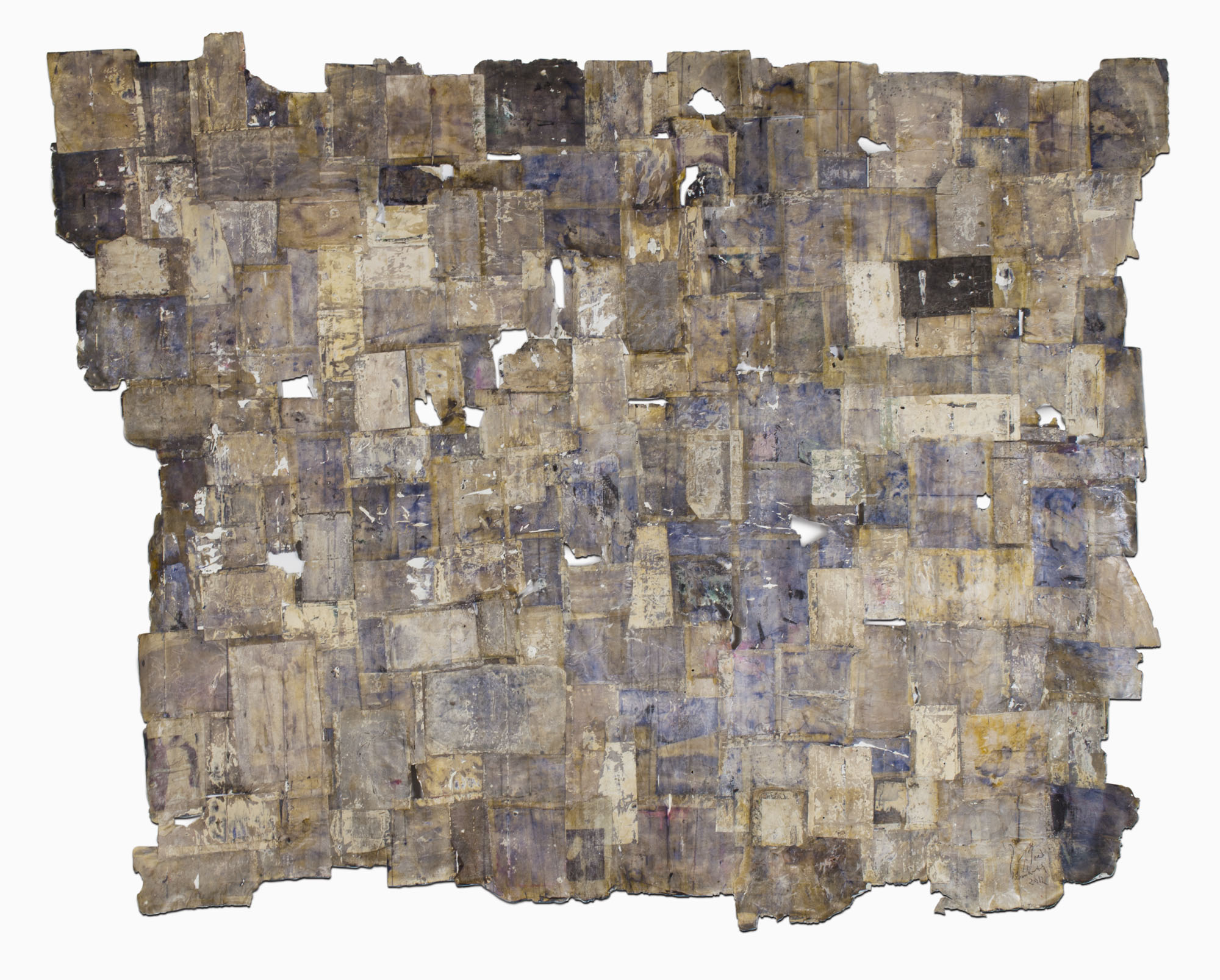
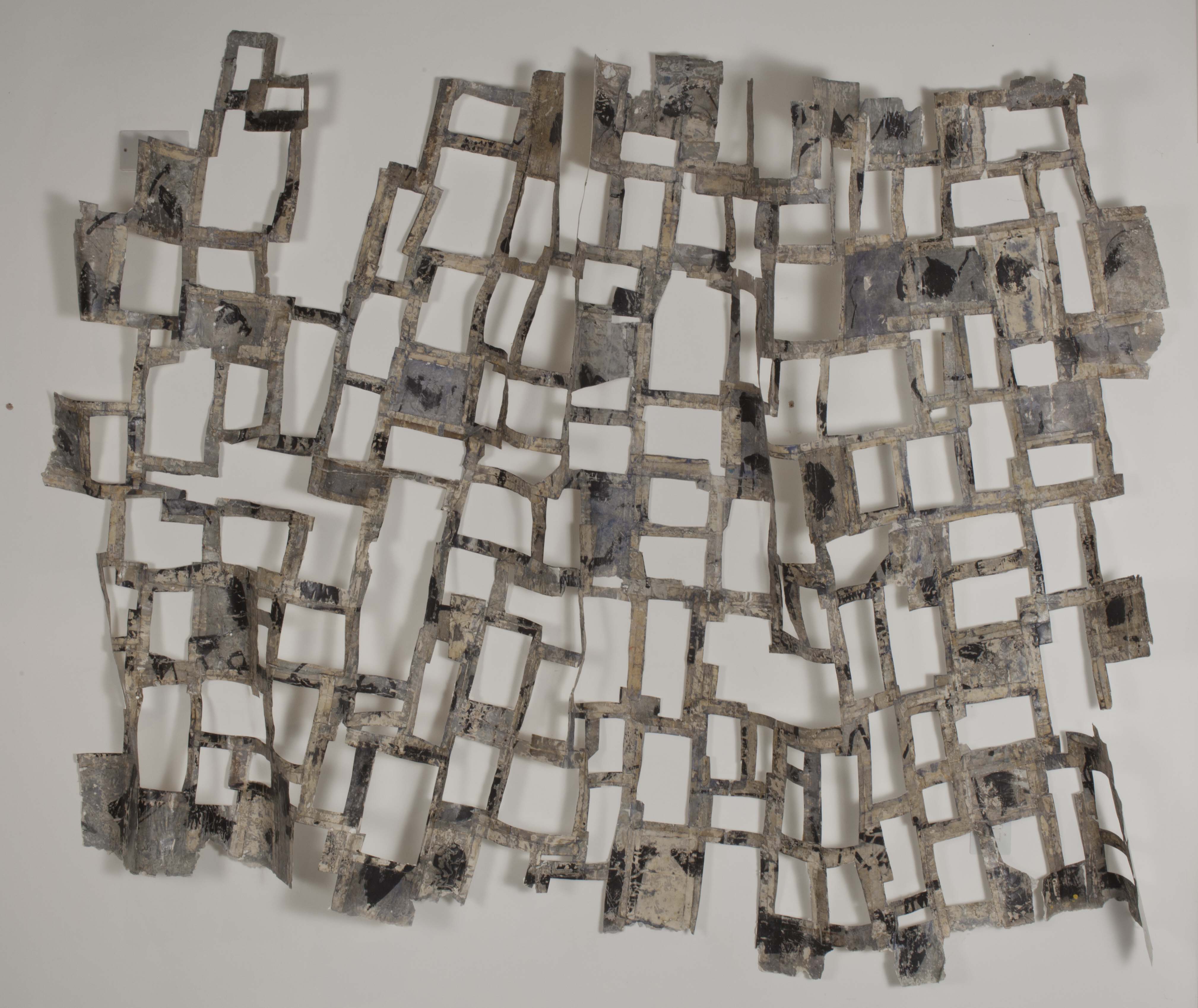
For example, the exhibition opens with Damascus I, a piece based on an aerial map of the old city. Assembled from loose pages from reclaimed books, inked and sanded, it looks like an ancient wall or perhaps mummified skin. "It is the entire city - its many layers, its history." At end of the exhibition, we see Damascus II. It has a sculptural feel to it. It is the buckled, distorted version of Damascus I - a fragile, skeletal city - a city being destroyed by war.

2014-06-25-IMG_9531.JPG
Damascus II, 2013, ink, collage and cut-out paper/credit: Emma K Freeman


Most of Kourbaj's work is created from "excavated" objects - discarded poster fragments, X-rays plates obtained from a local hospital, sales records from a furniture shop, broken chairs and book covers found in a bookbinder' skip behind his studio. 

The 7-meter long Border, the other side of sky is the reverse side of a huge torn piece of billboard collected from a nearby skip. It looks like the rusty wing of an airplane. Scattered underneath, as if falling from the other side, are tiny pieces of colourful paper like little flecks of hope. "They represent all the people who are trying to cross the border, going to the other side of the sky. They don't know where they are going or whether they are going to make it."

2014-06-25-IMG_0627.jpg
Counting, Alphabetising, 2014, paper, fabric and leather fragments; insect pins/credit: Emma K Freeman

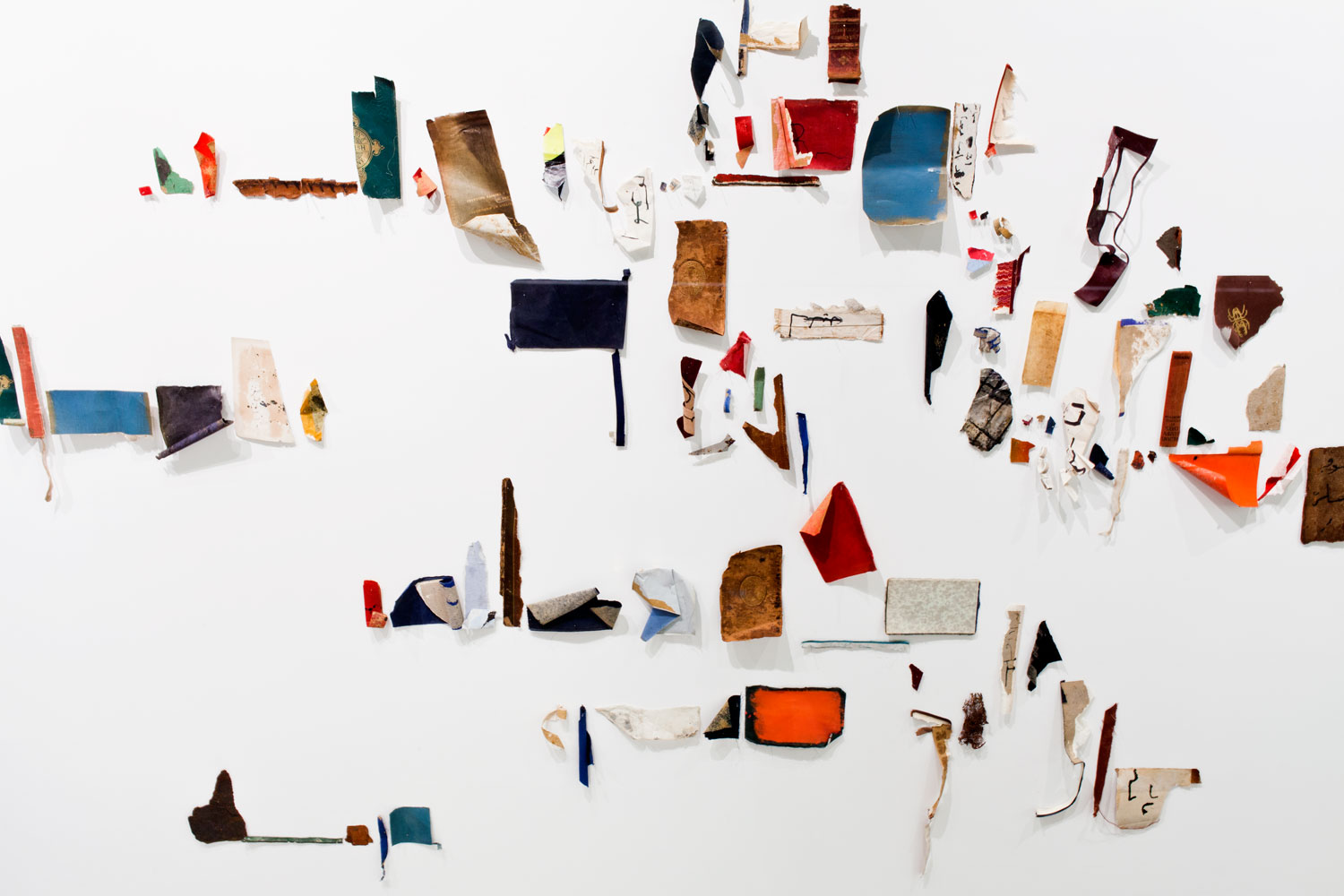
Counting and Alphabetising is a moving, 17-meter-long piece about loss. Small, colourful pieces torn from cardboard, fabric and leather book covers ("but they could be pieces of flesh or clothes") are pinned on the wall like butterflies in an immense entomological display. There are tiny ones arranged in neat rows and larger ones more randomly displayed. "They are a sort of archiving of what remains, of the fragility of life." 
 
Part of the same display, After Image was inspired by his mother. "I taught her to read and write. She was almost making drawings instead of writing. I wanted to connect with her and the struggle to make oneself heard or seen." In order to do this, Kourbaj formed his large letters upside down and with his left hand. 


2014-06-26-P21Unearthed.jpg
Unhearted (in Memoriam), 2014, repurposed book covers/courtesy of P21


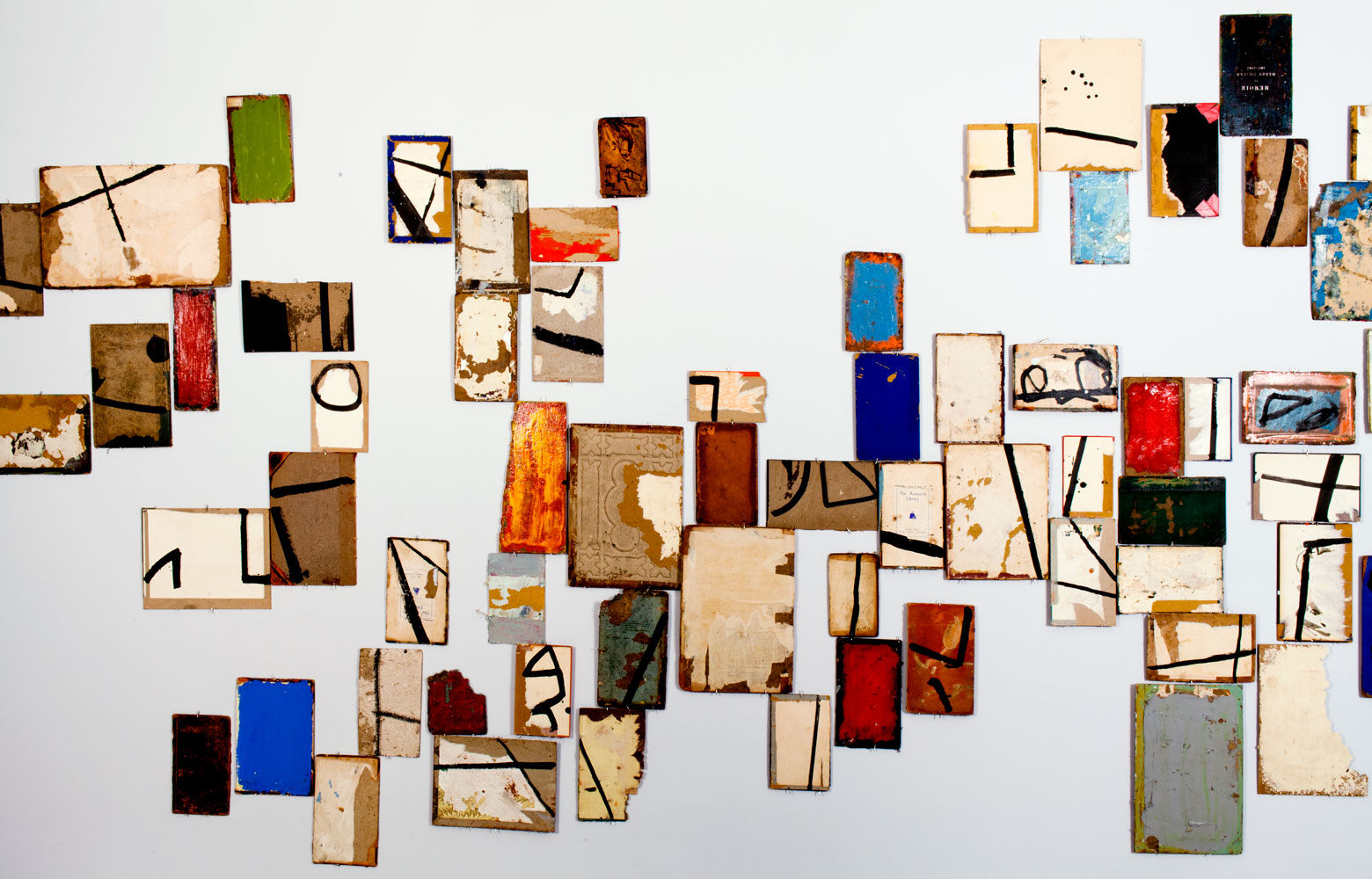
For Unearthed (in Memoriam), the artist covered 18 meters of wall with mounted discarded hardback book covers. Some are painted with bright colours and some are plain, but most have a black line painted across them, reminiscent of the traditional black ribbons used to indicate mourning in many countries. The sheer number of them - "all these lost, redundant books of which only the cover remains" - is a poignant reminder of the growing number of lost lives in Syria. 
 
2014-06-25-Scan21.jpeg
171 weeks and ongoing..., 2011 onwards, ink on paper//credit: Emma K Freeman


One of the exhibition's last works, 171 weeks and ongoing..., is a diary of the war. Kourbaj started making abstract ink marks on cards (old record sales from a furniture store) during the first week of the conflict and keeps adding a new one every week. "They are inspired by the news, but I re-digest them. The images of the war from the media are too much to take. I needed to filter them."

The P21 Gallery is a London-based non-profit organisation promoting contemporary Middle Eastern and Arab art and culture. Proceeds from the exhibition will be donated to Médecins sans Frontières who are working in Syria.

Exhibition dates: 4th July - 16th August, 2014
Readings by Ruth Padel and Hisham Matar: 16th JulyArtist's talk with Venetia Porter: 23rd JulyCurators' talk with Bibiana Macedo and Louisa Macmillan: 30th July

Tuesday, 20 May 2014

War Correspondents

Rebecca Thorn and Oliver Senton/credit: Simon Richardson
--> The dangers of life as a war reporter are horribly familiar. Only last week, the front page of the Times showed the bloodied face of Anthony Loyd, a British reporter shot twice by Syrian rebels who were holding him hostage. According to Reporters Without Borders,  18 journalists have been killed and 173 imprisoned since the beginning of this year alone.


With journalists currently reporting on conflicts in countries such as Syria, Ukraine, Afghanistan, South Sudan and Central African Republic, this is certainly an interesting time for the launch of a new theatrical work that examines the conditions of their employment. I always find it very interesting to see how artists convey and translate serious and difficult issues. And how they manage to make us understand them on a different level, touching us beyond words. 


“War Correspondents” is a 75-minute show that tells the stories of five foreign correspondents, three men and two women - representing the many who take great risks to report on conflicts across the world.  Using a capella songs and choreographed movement, interspersed with poems and extracts of interviews, it tries to bring to life the fear, moral dilemmas, pain, thrill, courage and frustrations that characterise this particular form of journalism. 


The show is the second “song theatre performance” created by Helen Chadwick, a composer, and Steven Hoggett, an Olivier-Award-winning choreographer. The idea emerged from an encounter between Chadwick and Jon Spaul, a photographer who worked on the first Chechen war in the 1990s. “He showed me his devastating photos and told me about what was happening to him and other photographers working there,” she says. “He was just a normal bloke doing extraordinary work. That inspired me.”


Chadwick and Miriam Nabarro, the show's designer, who has worked extensively in conflict zones, spent six years interviewing war correspondents with experience of reporting in Iraq, Chechnya, Afghanistan, Bosnia and elsewhere. Their subjects included Martin Bell, a renowned former correspondent with the BBC, and Giuliana Sgrena, who was taken hostage in Fallujah, Iraq, and subsequently shot at by the American army on her way to the airport.


They started with general questions, and from the answers saw themes emerge that could be used to shape the show: danger, the reason for the correspondents’ choice of work, its impact on their lives, censorship, changes to the job since 9/11 and others.


Chadwick wrote 30 songs based mostly on the testimonies, but also some poems by Brecht, Saadi Yousef and Mansur Muhammad Ahmad Rajih. Hoggett then choreographed accompanying dances. 


Both songs and dances are performed by just five actors, and the result is exquisite, with the music preventing the whole performance from veering too much into the earnest and the sombre. 


Of the many issues examined, the most moving concerns what journalists are supposed to do about the suffering they witness and the guilt they feel when leaving it behind at the end of their assignments. One is surprised that years of covering conflicts have made him “battle-softened” rather than “battle-hardened”. Another comments, “Wars, disasters… they all live inside me. I cannot get rid of them.”


"War Correspondents" is touring around Britain until October 25th.

You can read my review for the Economist’ Prospero blog here.

Monday, 14 January 2013

Landfill Harmonic – Turning trash into music


My New Year resolution as a journalist is to try to focus more on solutions rather than on showing problems, and write stories that leave people with hope and the will to do something rather than feeling helpless.

Here is a perfect example: a beautiful story about people turning trash into music.  The people of Cateura, Paraguay, make their living scavenging through a huge landfill on top of which their slum was built. One day, one of them found a discarded violin shell. It gave them the idea of building recycled musical instruments out of rusting oil cans, pieces of wood and metal, old tools and other trash.  They soon managed to put together a whole orchestra made out of recycled instruments (it sounds amazingly good!) and it has transformed their lives.  

  “The world sends us garbage. We send back music,” says Favio Chavez, the orchestra’s director.

Beautiful, isn’t it?

Thursday, 22 November 2012

Anish Kapoor does a Gangnam Style in support of Ai Weiwei


Turner Prize-winning artist Anish Kapoor has made a rousing (and funny!) video in support of prominent Chinese artist Ai Weiwei. 

Amnesty International activists and various artists gathered at Anish Kapoor’s London studio this week to shoot a parody of South Korean rapper Psy’s mega hit Gangnam Style film in support of Ai.  Ai’s had done his own version last month, featuring the original video interspersed with clips of him and friends doing the popular dance, wearing handcuffs to represent the lack of freedom of speech in China. The film was immediately removed from the web by the Chinese authorities.
Kapoor’s parody version, called "Gangnam for Freedom", was choreographed by Akram Khan, who helped craft the Olympic opening ceremony for London 2012.  Leading figures from the arts, including artists Mark Wallinger, Bob and Roberta Smith and Tom Phillips, dancers Tamara Rojo and Deborah Bull, Southbank Centre Director Jude Kelly, made cameo appearances.  


The video also includes contributions sent from MoMA, Guggenheim, New Museum, Brooklyn Museum and the Whitney Museum of American Art in New York; the Hirshhorn Museum and Sculpture Garden in Washington; Philadelphia Museum of Art; Museum of Contemporary Art San Diego; Helen Bamber; Hanif Kurieshi, and many others.  
Kapoor, who sported a brigh pink T-shirt in the video, said: “Our film aims to make a serious point about freedom of speech and freedom of expression. It is our hope that this gesture of support for Ai Weiwei and all prisoners of conscience will be wide-ranging and will help to emphasize how important these freedoms are to us all.” 
The film has won support from various human rights organizations, among them, Amnesty, Liberty, Index on Censorship and The Helen Bamber Foundation.  
Museums and organizations around the world will be screening the film, including the ICA who will be showing the film prior to each feature shown in their cinema from Friday, for two weeks.

Monday, 6 August 2012

England riots one year on – Hackney’s youths reflect on freedom and safety

-->
Freedom/Lydia Noura, 16

To mark the anniversary of the devastating riots, which spread across the country last summer, Art Against Knives is hosting an exhibit exploring notions of freedom and safety in London’s Hackney’s diverse community.

Through film, audio, photography, painting and writing, the exhibition showcases the community’s response to the riots, police’s stop-and-search and freedom. The work is the result of collaborations between established photographers and young people from the borough.

The exhibition, which opens on Thursday 9 August at the Art Against Knives Gallery in Shoreditch and runs until the end of the month, kick-starts ‘STOP AND TALK’, a nationwide campaign that calls for better and fairer relationships between the police and young people.

The exhibit’s opening night also features a talk on journalism and the riots with award-winning Guardian journalist Paul Lewis, as well as a preview of Pagan, a short film about Kes, a 18-year-old from Hackney caught between the police and rival gangs. The film opens to the public on 31st August at Dalston Eastern Curve/V22.

For many young people, the borough is a haven of arts, culture and fashion, but for Kes and thousands who grew up here, most of the area is off-limits.  Large parts of Hackney have been claimed by one gang or another, and though most people have no idea where the borders lie, for Kes these invisible lines dictate where he goes and what he does in the place he calls home.

Instead of being able to turn to the police, young black people like Kes are 30 times more likely to be stopped-and-searched than white people, so the presence of officers on the streets only makes them feel less safe.

Stop and Search/Ondre Roach, 18


Hackney has been simmering with discontent as young people find themselves on the wrong side of the police and increasing social inequality. Last year's riots saw the borough reach boiling point.

The 'STOP AND TALK’ campaign is asking the police to try to better understand young people, connect with them and protect them rather than automatically see them as suspects.

Art Against Knives is a youth-led charity, which works to reduce the causes of knife crime through art initiatives and providing an alternative to violent gang culture.

The charity was born from the tragic and unprovoked stabbing of Oliver Hemsley, a 21-year-old student from Central Saint Martin’s College of Art & Design. The attack, which has left Oliver in a wheelchair, took place in Shoreditch, East London in August 2008. Art Against Knives decided to create something positive from this terrible experience.

WHAT DOES FREEDOM MEAN TO YOU? EXHIBITION- 9th- 30th August 2012
Art Against Knives Gallery, Unit 55, Bethnal Green Road, Shoreditch, London E1 6GJ