 |
| Sarajevo's Library/Miriam Nabarro |
I came across the work of the wonderful Miriam Nabarro while doing a piece on War Correspondents for the Economist's Prospero blog, a song theatre show
on foreign correspondents. Nabarro, who
has worked in conflict zones for many years, designed the show and helped interview the correspondents.
Looking at her website, I was amazed at the scope of
her work (theatre
design, photography, printmaking and textiles) at a still relatively young age.
Her work has
taken her to Iran, Australia, Sudan, Kosova, Eritrea and the DRC, where she has
created performances, exhibitions and installations in theatres, football
pitches, churches and factories, with national theatres, artists, street
children and people of all ages.
I was excited when she mentioned her new project: The Damnation of Memory - Do Not Forget,
Remember and Warn!, an exhibition celebrating the reopening of Sarajevo’s
iconic war-bombed library. For the show, Nabarro
experimented printing square, black-and-white images she shot with her old
Hasselblad camera onto glass with liquid emulsion to create a fragile, ghostlike
feeling. She produced nine dreamy plates,
which seem to whisper stories of 'before', of the library's savage destruction, but also of resilience and hope.
I love them, so was
disappointed when a piece I wrote for the Times about her exhibition failed to
feature her work because the editor believed the black-and-white images would not
reproduce well.
As there are only a few
days left to view this beautiful, evocative exhibition, I wanted to show some
her images here, along with the unedited piece I wrote for the Times. The Damnation of Memory - Do Not Forget,
Remember and Warn!, is showing at the School of Oriental and African Studies (SOAS) in London until September
5. Go see it, if you have a chance.
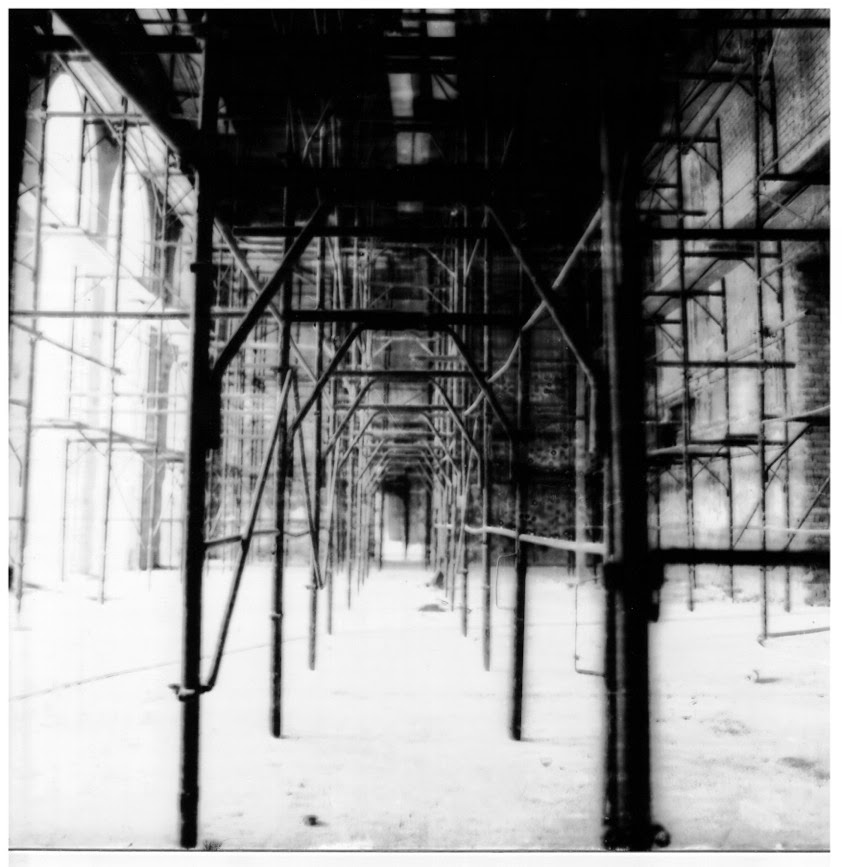 |
| Sarajevo's Library/Miriam Nabarro |
The Damnation of Memory -
Do Not Forget, Remember and Warn! – An exhibition celebrating the reopening of Sarajevo’s
iconic war-bombed library.
A
plaque at the entrance of Vijećnica, Sarajevo’s recently reopened iconic
war-bombed national library, reads:
'On this place....
Serbian criminals in the Night of 25-26th August 1992 set on fire the National
and University's Library of Bosnia and Herzegovina. Over 2 Millions of Books,
Periodicals and Documents Vanished in the Flames
Do Not Forget, Remember and Warn!'
Do Not Forget, Remember and Warn!'
The destruction of Vijećnica
was one of the most devastating acts of the 1992 Bosnian Serb siege of Sarajevo
and became its symbol. Nearly 90 per cent of the library’s collections
vanished in black smoke, which hung over the city for three days. “Set free
from the stacks, characters wandered the streets, mingling with passers-by and
the souls of dead soldiers,” wrote
the Bosnian poet Goran Simic in his 1993 Lament for Vijecnica.
The Damnation of Memory - Do Not Forget,
Remember and Warn!,
an exhibition of photographs celebrating the
reopening of Sarajevo’s library after 22 years, is showing at the School of
Oriental and African Studies (SOAS) in London until September 5. Vijecnica was restored
to mark the centenary of WW1, which was triggered by the assassination of
Austrian Archduke Franz Ferdinand. He was shot as he left the building, which
was at the time City Hall.
“Anyone you mention the
library to has a story,” says Miriam Nabarro, the first Artist in Residence in
the Department of Development Studies at SOAS, who photographed the library
under reconstruction in 2006 and again in 2012. She was told stories about the time “before”, about
the library’s multicultural atmosphere and its magical
books; stories about their destruction and how Sarajevans formed a human chain
to try to save as many books as possible; and stories about Vedran Smailovic,
who played his cello for 22 days in the burned down
library in defiance of the snipers and shelling.
Nabarro, a theatre
designer and photographer, first shot a series of images on a Leica camera in
2006, but they seemed too “journalistic” to reflect the depth of emotions and stories
the building evoked.
 |
| Sarajevo's Library/Miriam Nabarro |
“Walking through the
partially restored shell of the building, you could still see the charcoaled
marks of burnt books on the stucco walls, bits of carved graffiti post
catastrophe asking for Mir (Peace) and favorite quotes and
authors.”
Nabarro wanted her work to
respond to the building and its history rather than merely recording its
reconstruction, so she returned to Sarajevo in 2012, this time with her Hasselblad, an old-fashioned medium format
film camera. (She had used the same
camera to shoot Hidden Corners, her behind-the-scene
photographs of the National Theatre in 2010).
She then experimented printing
the Hasselblad square, black-and-white images onto glass with liquid emulsion to
create a fragile, ghostlike feeling.
“I work this process
very quickly, coating the glass with a gelatin solution, then melting the
emulsion in the darkroom, applying it wet to the glass plate, exposing it
immediately and then straight into the developer/ stop/fix. It has taken a
while to perfect the technique, or rather, to learn about its eccentricities
enough to manage the outcomes... but somehow this felt like the perfect medium
to evoke the feeling of loss and memory, and also of hope that the architecture
of the library gives.”
To enhance the dreaminess
of the plates and let the viewer’s mind wander between the library’s past and
future, she suspended her work from the wall by mild steel rods. This allows the
light in behind the images and causes them to appear as if they are floating.
The result is a
sensitive, evocative and very moving exhibition. There are only nine plates, as
well as a beautiful handmade book, but they leave a deep impression. And they
seem to echo destruction and hope in other places and times.
The Damnation of Memory is at the Wolfson Gallery in School of Oriental and African Studies
(SOAS) University Library until September 5.
 |
| Sarajevo's Library/Miriam Nabarro |


