Thursday, 23 June 2011

Get London Reading


Two weeks ago, the London’s paper, the Evening Standard, launched an inspiring and  successful campaign to encourage and help Londoners to read.

The Get London Reading campaign was prompted by the realization that in this city full of bookshops, libraries, publishers and writers, one in three children grows up without a single book of their own and one million people cannot read. “This is a betrayal of our children because reading is an essential tool for life,” says Editor Geordie Greig.

The paper has joined forces with Volunteer Reading Help, a charity that trains ordinary adults to go into London's most deprived primary schools to provide one-on-one reading support for struggling pupils. The charity does a tremendous job, but needs more volunteers and more donations. The Evening Standard is urging its readers to be part of the solution: “Volunteer today, donate today - and change lives.”

Over the past two weeks, the Evening Standard has published shocking new figures exposing illiteracy in London:

• 1 in 4 children in London leaves primary school at 11 unable to read or write properly
• 1 in 5 leaves secondary school without being able to read or write with confidence
• One million (or one in six) working adults in the capital cannot read with confidence. Nationally, five per cent of adults in England have literacy skills either at or below the level of a seven-year-old
• 40 per cent of 11-year-olds from inner-city primary schools have a reading age of between six and nine when they start secondary school
• 1 in 5 pupils at inner London schools has special educational needs, such as dyslexia

The paper’s chief features writer, David Cohen, talked at a recent Freelance Media Group lunch at the Groucho Club about the Get London Reading campaign.

He shared some of the moving stories he uncovered while reporting on the campaign, like that of the little girl who brought to class the Argos catalogue (home and general merchandise retail) when a teacher asked his pupils to bring in a book from home.  'It's the only one we've got,” said the nine-year-old.

The paper also featured many people – some highly successful – who explained how being unable to read affected their self-esteem and life. One of them, poet Benjamin Zephaniah, who is dyslexic, talked of how dyslexic people tend to go "one of two ways", conquering their fears and flourishing, or ending up in jail. And a multi-millionaire property mogul spoke for the first time about his “darkest secret” – that he cannot read – to expose the depth of the illiteracy problem in London.

The campaign has generated huge support from politicians, writers, celebrities, businesses and the general public.

So far, they have raised £145,000 – enough to fund 290 volunteers who will read one-to-one to 870 children.

To volunteer or donate, click here 

Tuesday, 21 June 2011

The Sound of the Egyptian Revolution


In the early days of the Egyptian revolution this year, three young musicians from Cairo recorded a solidarity protest song and posted it on YouTube.  "Sout al Horeya" (the Sound of Freedom) attracted over one million views within days and became the unoffocial anthem of the revolution.

The song is uplifting and beautiful even for those like me who don't understand the lyrics.  But even better with the lyrics! Here is what they mean: "The sound of freedom is calling, in every street corner in our country, the sound of freedom is calling. We will re-write history, if you are one of us, join us and don't stop us from fulfilling our dream."

Amir Eid, the guitarist and writer of the song, told Amnesty International that he decided to write the song and shoot it like a campaign for Tahrir Square to show the world what was really happening there as the Egyptian media coverage was unfair.

Amnesty UK played the song's video at the Trafalgar Square demonstration in February. "I was so happy. This was Egypt that I wanted the world to see," he told AI.

The mood in post-revolution Egypt is full of hope, he said. "We can see our future ahead of us."

Wednesday, 15 June 2011

Afghanistan is world’s most dangerous place for women – followed by DRC, Pakistan, India and Somalia


Afghanistan, Congo and Pakistan are the world's most dangerous countries for women in 2011 due to a barrage of threats ranging from violence and rape to dismal healthcare and "honour killings", an international expert poll showed today. India and Somalia are the next worst places to be a woman.


The global report is shocking and also depressing for showing dismal lack of progress. When will things change? Most of these terrible situations, statistics and suffering are well documented – what more do we need?
The survey has been compiled by the Thomson Reuters Foundation to mark the launch of TrustLaw Women, a website aimed at providing free legal advice for women's groups around the world.
Not surprisingly Afghanistan is named as the world’s most dangerous country for women because of its high levels of violence, poor healthcare and poverty. And the war was supposed to improve the plight of Afghan women…
“Afghanistan has one of the highest maternal mortality rates in the world. That aside, it is also a context that gives a woman minimal opportunity for education, health access, reproductive choice, etc. The lack of hope of the situation of women improving in the near future, as opposed to countries such as Sierra Leone and Southern Sudan, makes the situation comparatively even worse," says Dhammika Perera of International Rescue Committee.

Continuing conflict, Nato airstrikes and cultural practices also combine to make Afghanistan a very dangerous place for women. "In addition, women who do attempt to speak out or take on public roles that challenge ingrained gender stereotypes of what is acceptable for women to do or not, such as working as policewomen or news broadcasters, are often intimidated or killed," says Antonella Notari, head of Women Change Makers a group that supports women social entrepreneurs around the world. 

 
The second worse place goes to the Democratic Republic of Congo for the staggering level of sexual violence in the lawless eastern part of the country. One recent US study claimed that more than 400,000 women are raped there each year. The UN has called Congo the rape capital of the world.
Pakistan comes next on the basis of cultural, tribal and religious practices harmful to women. "These include acid attacks, child and forced marriage and punishment or retribution by stoning or other physical abuse," the poll finds.
The fourth worse place goes to India, which is more surprising for a country emerging into an economic super-power and a country not at war. India’s inclusion to the danger list is due to its high level of female infanticide and sex trafficking.
And Somalia completes the list. The country, in a state in political disintegration, suffers high levels of maternal mortality, rape, female genital mutilation and limited access to education and healthcare.

The poll asked 213 experts from five continents to rank countries on issues like overall perception of danger, access to healthcare, violence, cultural discrimination and human trafficking.

"This survey shows that 'hidden dangers' like a lack of education or terrible access to healthcare are as deadly, if not more so, than physical dangers like rape and murder which usually grab the headlines," Monique Villa, chief executive of Thomson-Reuters Foundation, says.

For more information, go to the TrustLaw website, which provides in-depth information, statistics, interviews and videos on the study. Also read the Guardian’s article by Owen Bowcott. The piece also provides links to case studies in all five countries.
 

Friday, 10 June 2011

V&A musing


I had lots of time to kill between meetings in London yesterday, so went to one of my favourite places, the Victoria and Albert museum. On my own, with no agenda, I spent delicious hours ambling through its vast labyrinth of eclectic galleries, looking at the amazing ceramics, sculptures, paintings, textiles, jewellery and more - sketching, reading, examining, marvelling, dreaming. 

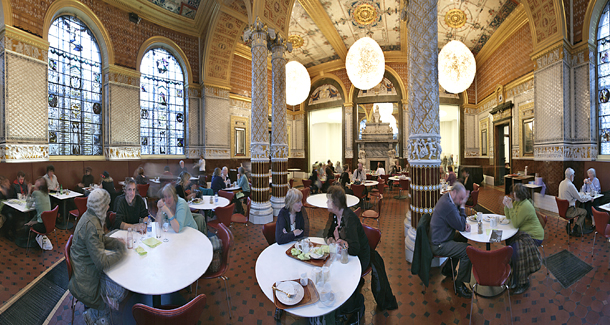
And I had coffee in the stunning cafe- the V&A's original restaurant, the Morris, Gamble and Poynter Rooms. They formed the very first museum restaurant in the world and were intended as a showpiece of modern design, craftsmanship and manufacturing.
 
 I had started my day stressed out, but left the museum feeling stimulated, excited and happy.  Beauty, self-expression, colours and creativity are good for the soul, as we all know. And taking time off to wander is sometimes as productive as a hard day at the office.

Monday, 30 May 2011

Women's Views on News


 At a recent Women in Journalism seminar, I’ve met the founder of WomensViewsOnNews.org, a women’s daily online news and current affairs service.

Alison Clarke founded WVoN in 2009 because she “was fed up with the male domination of the news.” She wanted a platform where all women’s voices and experiences could be heard by all.

According to the most recent survey by the Global Media Monitoring Project (March 2010), women feature in only about a fifth of the world’s news headlines and just ten percent of all news stories.

“Literally thousands of stories about, by and for women are never told.  This sends a message that women’s experiences and opinions are just not as important or as valid as those of men. We challenge that approach and aim to redress the imbalance in women’s favour,” Clarke says.

The site provides up-to-date news on all the major national and international stories of the day, in much the same way as any newspaper or online news service, but the stories they feature are always about women.  They also run feature articles and opinion pieces from time to time, but the focus is on news. Topics covered include arts and entertainments; business/employment;  feminism;  health; politics; science/technology;  sport; violence and world.

WVoN gives women a voice in two ways – by publishing stories that the mainstream press ignores; and by acting as a central point for stories that they do publish about women.

They source their stories from a range of online global, daily newspapers, press agencies, charities, magazines (weekly and monthly), social justice organizations and assorted blogs.  And they publish exclusive features by WVoN co-editors, as well as external guest editors who have a particular expertise.

Today’s featured articles, for example, include stories on growing protest against New York cops rape acquittal (sourced from Change.org),  women noticing other women’s weight first (sourced from the Daily Express),  the pitfalls of teaching abstinence (sourced from The Guardian) and Kandahar girls risking everything for an education (sourced from The Canadian Press). There are also original pieces on women urban planners and on living dolls written by WVoN co-editors.

WVoN is a volunteer collective made up of women journalists from different parts of the world including the US, Canada, the UK, Ireland and India.

They work on a rota basis with at least one journalist allocated to post stories up onto the site six days a week (Monday to Saturday). They post on average between 15 and 20 news stories every day.

The “duty” volunteer searches the sites from an extensive list of sources, looking for stories about women (they steer clear of ones about celebrities). The volunteer then writes a short description of each news story that she (or he) has decided to post onto the site and then links it to the original source.

If you are interested in becoming a volunteer, click here, and if you want to find out more, get in touch.

Sunday, 22 May 2011

Ursula Sladek – mother of five leads green revolution


Ursula Sladek/Courtesy of the Goldman Environment Prize

 I wrote a piece for the Guardian this Saturday about Ursula Sladek, who created one of Europe’s first green energy companies, owned by the people for the people, while raising five kids. What interested me in this story is that she was just an ordinary person without any scientific or business training – and already more than busy with her large family – yet, she decided she had to do something after the Chernobyl meltdown 25 years ago. 

Sladek, 64, never planned to create a power company, but felt compelled to act when radioactive residues from Chernobyl some 2000 km away were found on the playgrounds, gardens and farmlands of Schönau, the small Black Forest town where she lives with her family.

“I had to think about whether my children could eat our spinach and lettuce or drink our milk, and whether they could play in the sandpit. I also knew I needed to look at the broader picture and question the use of nuclear energy.  You cannot have five children and not care about the world they have to live in,” she says.

So Sladek, her husband, a GP, and a group of like-minded parents began researching the energy industry in Germany to see if they could limit their community’s dependence on nuclear power.

They started small, researching how energy was produced and how they could save it. Then they tried to motivate the whole town into saving energy by running campaigns and competitions. Later, when the regional power company refused to increase renewable energy and reward efficiency, they decided to take over the grid themselves.  “It was a crazy idea because none of us knew how to run an electricity company.”

Sladek and her group created Schönau Power Supply (EWS), a citizen-owned cooperative, and launched campaigns to be allowed to manage the grid and raise the necessary funds. “We had to learn how to act politically, how to campaign, how to run a company and an awful lot about electricity. When I started, the only thing I knew was that electricity was coming out of the socket. But learning all this was not too difficult. If you really want something, you can learn what you need,” she simply says.

From providing one million kilowatt hours to 1,700 customers in 1998, EWS now provides over 400 million kilowatt hours to over 100,000 customers throughout Germany.  And Sladek is hoping for one million customers by 2015.

And with a flurry of new customers wanting to switch to EWS after Fukushima, Sladek is busier than ever. “I would have liked to have more time for my children and now my grandchildren. But actually, I am doing what I do for them, and they know it. It is their future I am trying to protect and so I really think it is worth it.”

Last month, Sladek was named European winner of the 2011 Goldman Environmental Prize, a sort of Nobel Prize for environmental heroes.

You can read my Guardian article here.

Sunday, 15 May 2011

AI global report urges support for historic changes


As Amnesty International launches its annual report on human rights on the eve of its 50th anniversary, the world stands on the threshold of historic change.


Courageous people are standing up and speaking out in the face of bullets, beatings, tear gas and tanks. This bravery is sending a signal to repressive governments that their days are numbered. But they are fighting back.


The international community, including the UK Government, must decide if they stand on the side of reform or repression.


AI report on “The state of the world’s human rights”, released on Friday, says that growing demands for freedom and justice across the Middle East and North Africa and the rise of social media offer an unprecedented opportunity for human rights change – but this change stands on a knife-edge.

Says Salil Shetty, Amnesty International Secretary General:  “Not since the end of the Cold War have so many repressive governments faced such a challenge to their stranglehold on power. The demand for political and economic rights spreading across the Middle East and North Africa is dramatic proof that all rights are equally important and a universal demand.

…The call for justice, freedom and dignity has evolved into a global demand that grows stronger every day. The genie is out of the bottle and the forces of repression cannot put it back.”

Unprecedented access to information, means of communication and networking technology, as social media networks, are fuelling this new global activism.

But government are fighting back. Governments in Libya, Syria, Bahrain and Yemen have shown a willingness to beat, maim or kill peaceful protestors to stay in power. Even where dictators have fallen, the institutions that supported them still need to be dismantled and the work of activists is far from over. Repressive governments such as Azerbaijan, China and Iran are trying to pre-empt any similar revolutions in their countries.

The Amnesty report, a global overview that exposes abuses in 157 countries, indeed reveals restrictions on free speech in at least 89 countries; torture and other ill-treatment in at least 98 countries; cases of prisoners of conscience in at least 48 countries; and documents unfair trials in at least 54 countries.

AI is urging the international community to seize the opportunity for change and ensure that 2011 is not a false dawn for human rights.