Showing posts with label photography. Show all posts

Tuesday, 16 February 2021

A Domestic Worker' Story - photo essay on love, loss, and displacement


Caroline’s daughter, Elodie with Juning’s second son, Roel, on the family farm in Bantayan Island/Credit: Caroline Irby
 

Award-winning photographer Caroline Irby grew up in London with Juning, a Filipina woman, who stayed with her family for 22 years, first in Hong Kong, then in London.  “I can’t say where Juning’s influence on my early years began and ended: she was in almost every part of my life.”  Caroline says that today no smell is more comforting than the smell of rice, which Juning loved to cook. And it is now her children’s staple.

But Juning had four children of her own living on her native Bantayan, a small island in the Philippines 7,000 miles away.  

It was only when Caroline became a mother herself that she grasped the price Juning and her children had to pay. “I can’t shake off a feeling of strangeness that their lives and mine carried on in parallel for all those years, mine with their mother, theirs without. We are all part of the same curious equation, and after decades of living in tandem but remotely, I wanted to try to understand how this all happened and what the effect on the people involved had been.”


Juning’s four children left behind
The result is Someone Else’s Mother”, a beautiful and sensitive photo essay, interweaving Caroline's own recollections of a childhood spent with Juning with conversations and photos with Juning and her four children – gleaned in London and over three visits to Bantayan.

I found the book particularly interesting and moving because, although it tells the very personal story of Caroline and Juning and their families, it also echoes parts of the stories of millions of nannies and their host families across the world.

Every day, just from the Philippines, 5,000 people leave their country in search of work abroad. For decades, this movement has been female dominated: more than 70% of Filipino emigrants are currently women.


When she became a mother, Caroline decided to look after her children herself as much as possible, aware that is a freedom of choice Juning couldn’t have.

Juning explained: “I was desperate to earn more money. My children were still young and I left them with my mother. It hurt me when I left them, but I had no choice: I had to work abroad for their education.”

And Roly, Juning’s oldest child, told Caroline when she visited Bantayan in 2018 with her own children:  “I was lonely. Everywhere I was looking for her care. You were lucky, Caroline: you had her care for so many years. I had no one to talk to when I had a problem.”

Juning achieved her goal of feeding and educating her family: three of them have university degrees. Between them, there is a farm, several other homes, nine children, two foster children, and the extended family is well supported. “Quietly, Juning has been a vessel for a huge amount of change.”

Yet, “Someone Else’s Mother” is a bittersweet story with no happy ending. The thoughtful texts and light-infused photography weave together a story of  attachment, loneliness and displacement, love and loss, memory, sadness and hope, guilt and inequality. It is also a story to try to understand.  

And nannies and domestic workers all over the world will recognize parts of that story.

The book, published by Schilt in 2020, can be ordered online and from bookstores (and here).

Juning’s grown up children with Caroline’s children on Batayan Island/Credit: Caroline Irby


Wednesday, 11 October 2017

Refugee Exhibition: "Claiming a New Place on Earth"


If you are in London this week, please come and see our exhibition “Claiming a New Place on Earth” at Protein Studios in Shoreditch, London.  Through photographs and interviews, photographer Caroline Irby and I have recorded the journey of 10 refugees or asylum seekers aged 18-24, who arrived in the UK as minors and are now coming of age in this country. 

How is it to grow up in an Afghan village with no water and no electricity, then to find yourself alone in London at 18, not speaking a word of English?

How does it feel when life is passing you by, when you cannot get your driving license, go to university or get a job because you are waiting for your papers?


Thousands of teenagers arrive in the UK every year seeking asylum. Many have missed out on education and have been scarred by war and by having to leave their home countries.  In the UK, they have to navigate complex systems to get the support they need. Yet, they are also young people with talent, pride, aspirations and dreams.


The young refugees are from Syria, Ivory Coast, Iran, Afghanistan, Nigeria, Pakistan, Ukraine and Uganda. They talk about the life they have left behind and their new experiences in this country - the hurdles and challenges they are facing, especially around the asylum and education systems - as well as their dreams and aspirations for the future.  They were photographed in the context of their dream job. 


The portraits and interviews are part of the exhibition “Claiming a New Place on Earth” at Protein Studios in London, Oct. 10-15 (the title is from Lesbos 2015  by poet Ruth Padel). The exhibition was commissioned and curated by Breaking Barriers (BB), a wonderful charity helping refugees to find meaningful employment.

Caroline and I have worked together on a number of humanitarian stories overseas – particularly in Africa and Asia - and in the UK.   We have a keen interest in refugee issues because we have seen some of the causes that trigger people to flee their homes. We wanted to meet some of the young refugees who have settled here to learn what propelled them to move so far, and to hear about their experiences of trying to make a new life here.  And, at a time when Brexit negotiations are pressing on and immigration is such a loaded topic, we wanted to let some young refugees tell their own stories in their own words.

This is our second collaboration with Breaking Barriers. Last year, Breaking Barriers’ exhibition portrayed refugees at the place where they first felt free or safe in the UK.

You can see some of the portraits and interviews in this Guardian article


Wednesday, 3 September 2014

Exhibition Celebrates the Reopening of Sarajevo’s Library - The Damnation of Memory - Do Not Forget, Remember and Warn!


Sarajevo's Library/Miriam Nabarro
I came across the work of the wonderful Miriam Nabarro while doing a piece on War Correspondents for the Economist's Prospero blog, a song theatre show on foreign correspondents. Nabarro, who has worked in conflict zones for many years, designed the show and helped interview the correspondents.

Looking at her website, I was amazed at the scope of her work (theatre design, photography, printmaking and textiles) at a still relatively young age. Her work has taken her to Iran, Australia, Sudan, Kosova, Eritrea and the DRC, where she has created performances, exhibitions and installations in theatres, football pitches, churches and factories, with national theatres, artists, street children and people of all ages.

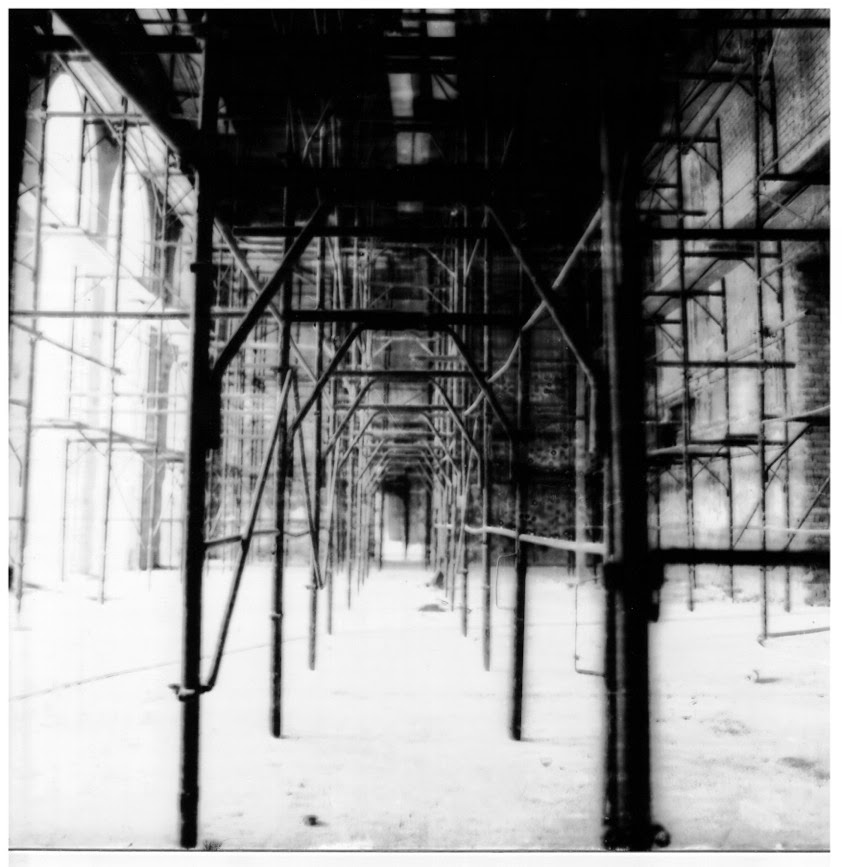
I was excited when she mentioned her new project: The Damnation of Memory - Do Not Forget, Remember and Warn!, an exhibition celebrating the reopening of Sarajevo’s iconic war-bombed library. For the show, Nabarro experimented printing square, black-and-white images she shot with her old Hasselblad camera onto glass with liquid emulsion to create a fragile, ghostlike feeling.  She produced nine dreamy plates, which seem to whisper stories of 'before', of the library's savage destruction, but also of resilience and hope.

I love them, so was disappointed when a piece I wrote for the Times about her exhibition failed to feature her work because the editor believed the black-and-white images would not reproduce well.

As there are only a few days left to view this beautiful, evocative exhibition, I wanted to show some her images here, along with the unedited piece I wrote for the Times. The Damnation of Memory - Do Not Forget, Remember and Warn!, is showing at the School of Oriental and African Studies  (SOAS) in London until September 5.  Go see it, if you have a chance.
Sarajevo's Library/Miriam Nabarro
 
-->
The Damnation of Memory - Do Not Forget, Remember and Warn! – An exhibition celebrating the reopening of Sarajevo’s iconic war-bombed library.
A plaque at the entrance of Vijećnica, Sarajevo’s recently reopened iconic war-bombed national library, reads:

'On this place.... Serbian criminals in the Night of 25-26th August 1992 set on fire the National and University's Library of Bosnia and Herzegovina. Over 2 Millions of Books, Periodicals and Documents Vanished in the Flames
                  Do Not Forget, Remember and Warn!'

The destruction of Vijećnica was one of the most devastating acts of the 1992 Bosnian Serb siege of Sarajevo and became its symbol.  Nearly 90 per cent of the library’s collections vanished in black smoke, which hung over the city for three days. “Set free from the stacks, characters wandered the streets, mingling with passers-by and the souls of dead soldiers,” wrote the Bosnian poet Goran Simic in his 1993 Lament for Vijecnica.

The Damnation of Memory - Do Not Forget, Remember and Warn!, an exhibition of photographs celebrating the reopening of Sarajevo’s library after 22 years, is showing at the School of Oriental and African Studies  (SOAS) in London until September 5.  Vijecnica was restored to mark the centenary of WW1, which was triggered by the assassination of Austrian Archduke Franz Ferdinand. He was shot as he left the building, which was at the time City Hall.

“Anyone you mention the library to has a story,” says Miriam Nabarro, the first Artist in Residence in the Department of Development Studies at SOAS, who photographed the library under reconstruction in 2006 and again in 2012.  She was told stories about the time “before”, about the library’s multicultural atmosphere and its magical books; stories about their destruction and how Sarajevans formed a human chain to try to save as many books as possible; and stories about Vedran Smailovic, who played  his cello for 22 days in the burned down library in defiance of the snipers and shelling. 

Nabarro, a theatre designer and photographer, first shot a series of images on a Leica camera in 2006, but they seemed too “journalistic” to reflect the depth of emotions and stories the building evoked. 
Sarajevo's Library/Miriam Nabarro
“Walking through the partially restored shell of the building, you could still see the charcoaled marks of burnt books on the stucco walls, bits of carved graffiti post catastrophe asking for Mir (Peace) and favorite quotes and authors.”

Nabarro wanted her work to respond to the building and its history rather than merely recording its reconstruction, so she returned to Sarajevo in 2012, this time with her Hasselblad, an old-fashioned medium format film camera.  (She had used the same camera to shoot Hidden Corners, her behind-the-scene photographs of the National Theatre in 2010).   She then experimented printing the Hasselblad square, black-and-white images onto glass with liquid emulsion to create a fragile, ghostlike feeling.  

“I work this process very quickly, coating the glass with a gelatin solution, then melting the emulsion in the darkroom, applying it wet to the glass plate, exposing it immediately and then straight into the developer/ stop/fix. It has taken a while to perfect the technique, or rather, to learn about its eccentricities enough to manage the outcomes... but somehow this felt like the perfect medium to evoke the feeling of loss and memory, and also of hope that the architecture of the library gives.”   

To enhance the dreaminess of the plates and let the viewer’s mind wander between the library’s past and future, she suspended her work from the wall by mild steel rods. This allows the light in behind the images and causes them to appear as if they are floating.

The result is a sensitive, evocative and very moving exhibition. There are only nine plates, as well as a beautiful handmade book, but they leave a deep impression. And they seem to echo destruction and hope in other places and times.

The Damnation of Memory is at the Wolfson Gallery in School of Oriental and African Studies  (SOAS) University Library until September 5. 

Sarajevo's Library/Miriam Nabarro